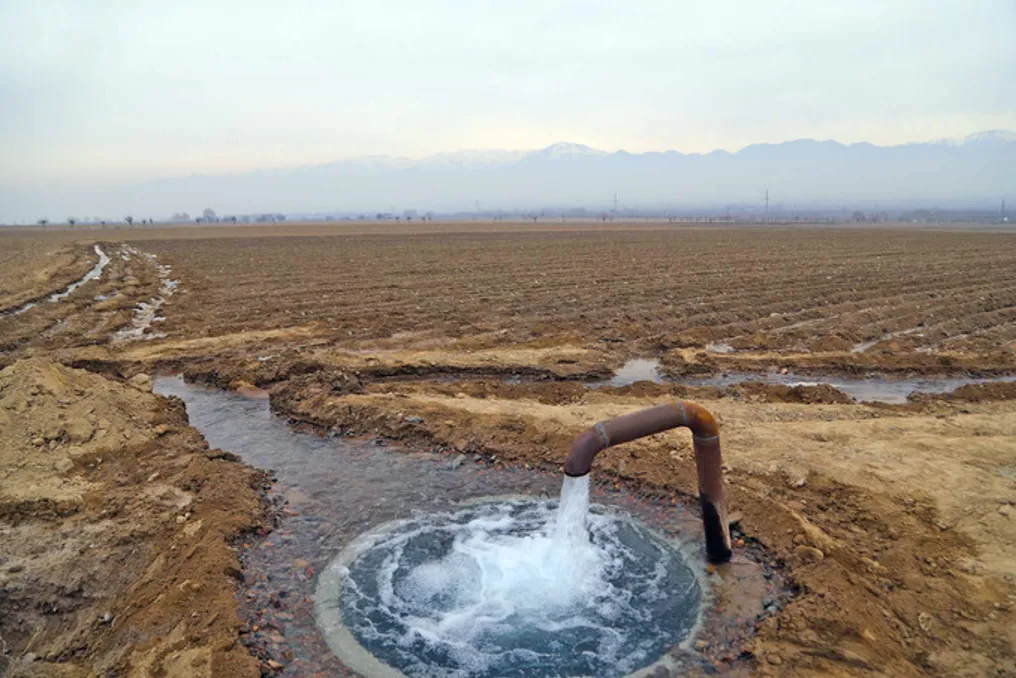
Uzbekistan has demonstrated significant progress in reducing water stress, joining the ranks of countries showing notable improvements. According to data from the UN-Water mechanism tracking UN Sustainable Development Goals indicators, the ratio of freshwater abstraction to all renewable resources in the country decreased from 169% in 2017 to 122% in 2022.
Thus, over a five-year period, the level of water stress decreased by 47 percentage points, with a further drop projected to 117% by 2026. For comparison, Pakistan reduced this indicator by 24.6 pp, Turkmenistan by 13.6 pp, Armenia by 6.1 pp, and Azerbaijan by only 1.8 pp.
Presentation of Reform Results
The results of reforms in the water sector, along with current challenges and future plans, were presented at the first meeting of the Expert Council organized in Tashkent by the Center for Sustainable Development in Water. Representatives from relevant scientific institutions and international organizations attended the event to jointly develop the direction of future state policy.
The meeting was opened by Timur Butunbaev, Deputy Head of the Presidential Administration for the reform of the water supply system. He emphasized that fundamental changes have occurred in the industry over the last eight to nine years, including the adoption of the Water Code and the approval of the water management development concept until 2030. Butunbaev noted that according to this concept, many target indicators for 2030 have already been met.
Personnel Provision and Diplomacy
Abdulkhakim Salohiddinov, Vice Rector of the National Research University 'Tashkent Institute of Irrigation and Agricultural Mechanization' (TIIMSKh), reported on the launch of a new specialization in training specialists. In implementation of the presidential decree of April 2 of this year, a master's program in international water diplomacy has been opened for the first time in Uzbekistan, accepting not only Uzbek citizens but also residents of neighboring countries, including Afghanistan. Furthermore, the university offers advanced training courses under the program 'Water Diplomacy and Agro-Water Management' for practicing specialists and decision-makers in this field.
Water Resource Modernization and Management
Sherzod Muminov, Deputy Director of the Scientific and Information Center of the Interstate Coordination Water Resources Commission (ICWRC), stated that after the approval of the water management development concept, it has been possible to implement water-saving technologies on 60% of irrigated lands and concrete 40% of irrigation canals. The modernization of pumping stations has led to a nearly 30% reduction in their energy consumption. A unified digital database covering over 600 thousand water users and more than 4 million hectares of irrigated land has also been created. These measures ensure an annual saving of over 10 billion cubic meters of water, with a plan to increase this figure to 15 billion by 2030.
Regional Challenges and Projects
Muminov also highlighted regional problems. Among them is the construction of the Koshtepa canal in Afghanistan, which could cause water shortages in the lower reaches of the Amu Darya during dry years. Another challenge relates to Tajikistan's plans to expand irrigated areas by another 50 thousand hectares by 2040, which will require additional water abstraction from the Syr Darya and Amu Darya basins. The ICWRC continues to function as a platform for coordinating water distribution among countries in the region even in conditions of low water flow.
Reforms in the Kashkadarya Example
Bahriddin Hasanov, Professor and Dean of the Faculty of Hydraulic Engineering of the National Research University 'TIIMSKh', presented a report on a month-long expedition of a group of scientists to the Kashkadarya region to study the progress of reforms. As of 2026, the total water savings in the region amounted to 538 million cubic meters, with 215 million cubic meters saved through the implementation of water-saving technologies, and 323 million through the repair and renewal of irrigation networks.
Of the total length of the region's canals, 470 km are earthen channels without concrete lining, and according to the 2026 plan, 108 km of main and inter-regional canals, 180 km of intra-regional networks, and 484 km of canals in farmer and cluster farms are scheduled for concreting. It is planned to convert 11.1 thousand hectares of irrigated land to drip irrigation, 5.3 thousand hectares to sprinkler irrigation, 3.8 thousand hectares to discrete irrigation, and another 21.8 thousand hectares to other water-saving methods. 18 out of 76 pumping stations in the region are subject to modernization, which should save 30 million kWh of electricity. Already 26 stations operate under a public-private partnership model, and five more stations are planned to be transferred to the private sector in 2026.
Scientific Base and Land Use Problems
Independent expert Dilshod Shodiev pointed to the inadequacy of the scientific base underlying the reforms. He noted that about 20 thousand scientific works were defended in Uzbekistan over the past five years, less than 1% of which related to the water sector—specifically 48 works. Shodiev attributes this to chronic underfunding of science, as state spending on scientific research in the sector has decreased by 30% in the structure of general budget expenditures over the last three years. Moreover, the share of R&D expenditure in Uzbekistan's GDP is about 0.1% or less, significantly lower than the figures for Israel (5.7%), South Korea (3.5–4%), and Kazakhstan (0.7%).
The expert also criticized the funding application procedure through the Agency for Innovation Development under the Ministry of Higher Education, Science, and Innovation, which takes at least nine months and involves 12 stages, some of which he considers superfluous. Shodiev concluded that such a regime hinders the acceleration of scientific developments and requires a simplified, faster financing mechanism.
Barriers for Farmers
Shodiev raised the issue of farmers' reluctance to invest in water conservation. Since farmer and dehqan farms account for the majority of irrigated land (about 90%), the Center for Water Sector Development is studying the reasons for the slow adoption of technologies in the farming sector. According to the current Land Code, the state can seize land from farmer farms on 11 grounds, including 'inefficient land use,' the interpretation of which is determined by the local hokim. Over the last three years, land has been seized from 33% of farmer farms.
The expert provided an example illustrating the problem: if a farmer's income decreases even slightly, the hokim may consider the use inefficient. Shodiev noted that the Statistics Committee for 2024 shows that the average income per hectare of a farmer farm is 33 million soms, whereas a dehqan farm generates 385 million soms, almost 12 times more. This difference is explained by the stability of rights: dehqan land is inherited and perceived as property, while the farmer, lacking guarantees of lease retention, is not interested in expensive water-saving technologies.
Work of the Center for Sustainable Development
Diyorahon Toshmatova, Deputy Director of the Center for Sustainable Development in Water, reported on the activities of the organization established by a presidential decree of October 13, 2025. The Center's mandate includes analytical support for reforms, strategic planning, improvement of the legal framework, development of international cooperation, and implementation of innovations. Currently, in collaboration with Swiss and Dutch specialists, a national concept for rational water resource use and environmental protection for the period 2027–2050 is being developed, and legislative acts are being revised to align with the new Water Code. The Center is also preparing a World Forum on Water Conservation, which will take place in Samarkand this September.
Requirements for Reform Transparency
Iskandar Abdullaev, an expert from the International Institute of Water Resources Management, believes that the focus of reforms should be directed not only towards infrastructure and technology but also towards increasing water users' trust in the reforms themselves. It is important how users assess the quality of services and the transparency of interaction with the state, as well as how technical maintenance of systems is carried out. Abdullaev emphasized that Uzbekistan's ambitious goals—increasing efficiency, implementing water-saving technologies, reducing energy consumption, and developing PPP—will only become manageable when they are translated into a clear operational scheme defining responsibility, accountability, and visible end-user results. Without a single digital foundation, in his opinion, every element of the reform risks remaining isolated.