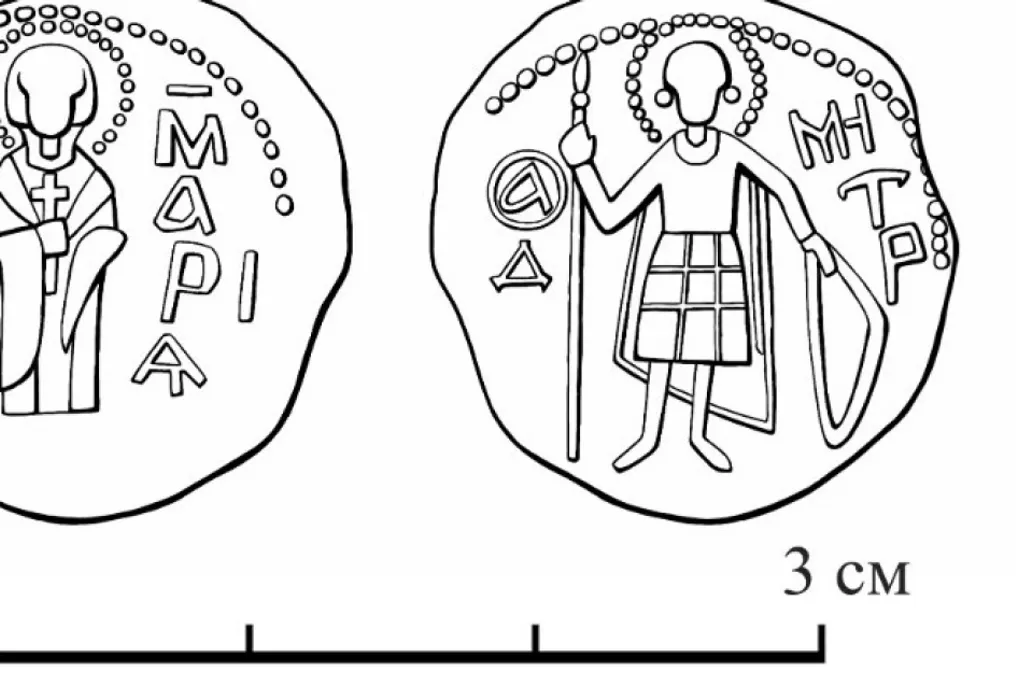
During rescue excavations conducted by Russian archaeologists in Vladimir, two ancient lead seals, made using identical matrices, were discovered. These bullae were identified as belonging to Maria Vsevolozhskaya, the wife of Prince Vsevolod Bolshoe Gnezdo, who was the founder of a major branch of the Rurikids, including the Moscow princes.
Popular
Significance of the Lead Seals
Lead seals, also known as bullae, are a valuable source of information about record-keeping and the document circulation system in Rus'. These lead seals were used to confirm the authenticity of documents. Although bullae were widely used in the Old Russian state only in the mid-11th century, during the time of Yaroslav the Wise's sons, earlier finds exist.
Content and Owners of the Seals
The owners of these seals included various segments of society: princes, military commanders, officials, church figures, and other representatives of the upper class. Typically, each bull contained two elements: a benevolent inscription and an image of a patron saint. Additionally, many seals depicted the princes themselves along with their family emblems, called tamgas.
Discovery in the Medieval Part of the City
Women rarely appeared among the known seal owners. It was Nikolai Makarov and his colleagues from the Institute of Archaeology of the Russian Academy of Sciences who reported on artifacts of this kind. This year, researchers continue work in the medieval part of Vladimir, where the construction of a hotel is planned for the future. During excavations in cultural layers dating from the second half of the 12th to the beginning of the 13th century, remains of buildings, palisades, various pits, and other artifacts were found.
Details of the Found Bullae
Of particular interest are the two lead seals created on identical matrices. On one side of the bullae is depicted Saint Mary holding a cross, and around her is stamped the inscription AGIA - MARIA. On the opposite side, Saint Dmitry with a spear and shield is shown, and the inscription O[agios]D - MITR is also present. According to scientists, these new findings allow it to be established that the bullae belonged to Princess Maria Vsevolozhskaya, who died in 1206, the wife of Prince Vsevolod Bolshoe (Velikoe) Gnezdo, who bore him twelve children and became the progenitor of the large branch of the Rurikids who governed in North-Eastern Rus'.
Interpretation of Female Seals
Researchers noted a curious feature of the new bullae: one side depicts a saint, and the other depicts a saint. Scientists interpret such seals as belonging to Old Russian princesses. It is assumed that the female image symbolizes the heavenly patron of the princess herself, while the male image symbolizes the patron of her husband or father. In the case of Maria Vsevolozhskaya, the second side of the bullae likely depicts the heavenly patron of her husband—Dmitry Solunsky, since the prince's baptismal name was Dmitry.
Other Finds of Bullae
Bullae of Old Russian princes have been found in various Old Russian cities and even outside of Rus'. For example, in 2023–2024, seals of Yuri Dolgoruky, the father of Vsevolod Bolshoe Gnezdo, were discovered in Suzdal and its surroundings. And in 2022, near Kaliningrad, where Prussians (Samby) previously lived, a bulla of Vladimir Monomakh, who was the father of Yuri Dolgoruky, was found.