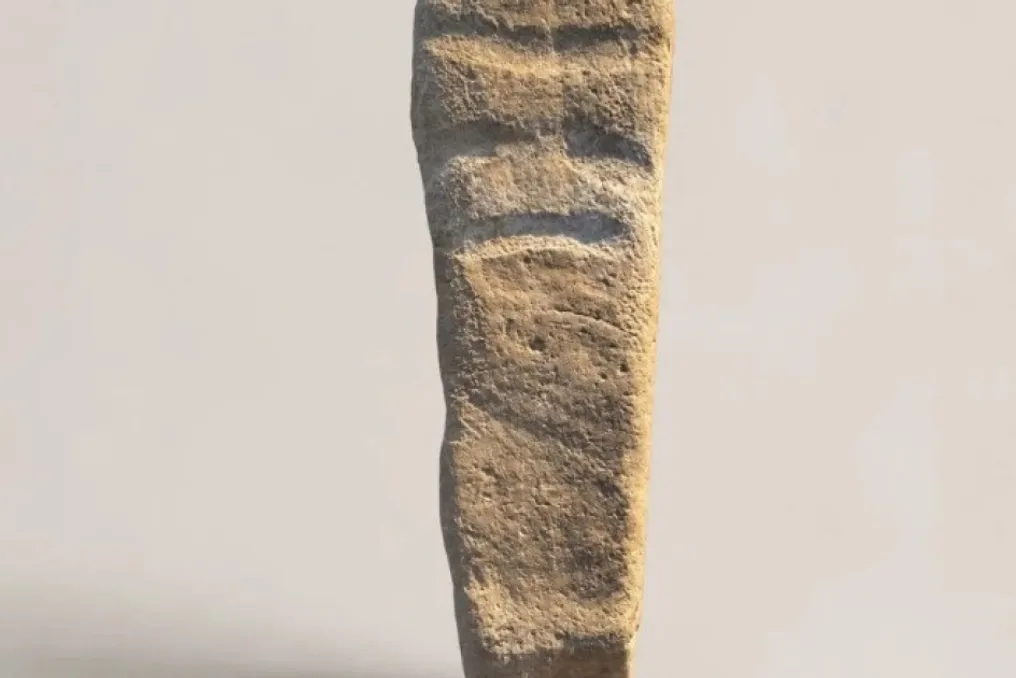
During the tenth season of archaeological work at the early Scythian 'royal' kurgan Tunnug-1, an ancient stone stele was found. The discovery occurred on the edge of one of the excavations conducted in previous years.
Description of the find
Researchers discovered a stone statue about half a meter high, which was presumably used by nomads during a burial ritual. On the front part of this stele, carved arches and lines resembling human facial features are visible. Although similar stelae have been found in this kurgan before, analogous artifacts have not been encountered at other monuments.
Characteristics of Kurgan Tunnug-1
Kurgan Tunnug-1 is a large site located in the Piy-Khem district of the Republic of Tuva, in an area known as the 'Valley of Kings,' where numerous elite burials are concentrated. Most of this monument belongs to the early Scythian period and is a massive mound with a diameter of about one hundred meters. Systematic study of the structure, which began in 2017, has shown that it dates back to the formation period of Scythian culture, approximately 830–800 BCE. This monument is considered the oldest known 'royal' kurgan in the Scytho-Siberian world because both very early animal style artifacts and evidence of horse sacrifices were found here, which may correspond to Herodotus' descriptions.
Other archaeological discoveries
Another part of the material mentions genetic studies conducted on the remains of approximately four hundred people found in an ancient basilica in the Hungarian city of Sekesfehérvár. These studies allowed for the isolation and study of DNA, among which three probable representatives of the Árpád dynasty were identified. According to data published in the journal iScience, one of these individuals was the Hungarian King Béla II the Blind, who lived in the 12th century CE.