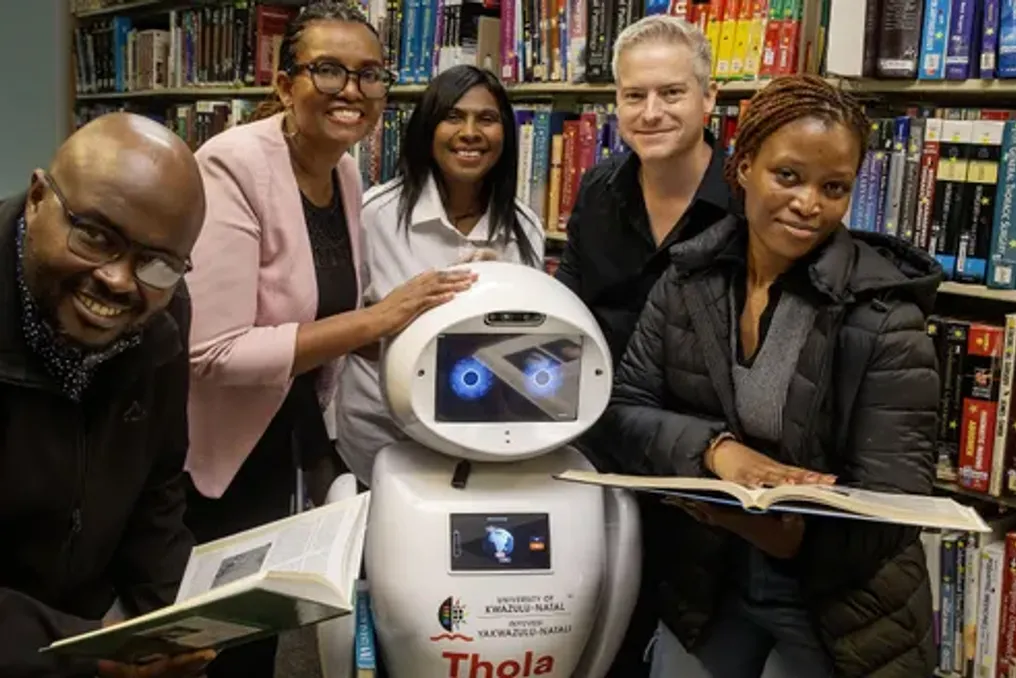
The future of library science is no longer the stuff of science fiction; it is now manifesting in the corridors of the UKZN University Medical School. Thola, a cutting-edge library assistant robot designed to help students find information, has been introduced here. This demonstrates that libraries are not merely repositories of knowledge but also centers of innovation.
Popular
Capabilities of the Thola Robot
This multilingual assistant can communicate in four languages: English, Afrikaans, Sesotho, and IsiZulu. Students can ask it to locate any book, and it can respond in any of these languages.
Strategy for Developing Library Services
Dr. Nonhlanhla Ngcobo, director of the institution's library services, reported that Thola was ordered last year. According to her, although the robot does not require vacations, coffee breaks, or a monthly salary, its purpose is not to replace human involvement, which has always defined libraries. Instead, it is intended to assist students, guide them to the right resources, and support librarians in the rapidly changing digital age.
Ngcobo emphasized that Thola is part of a strategy to transform UKZN's library services into a true 21st-century, technology-oriented library. She added that this also aligns with the strategy of meeting the needs of students, such as Generation Z, as familiar technologies must be used to reach this audience.
Localization and Expansion Plans
Although there are two other library robots in the country, Thola is the only one developed locally. Ngcobo explained that this was a deliberate decision to ensure local technical support rather than relying on foreign developers. She noted that other institutions have to wait for developers to fly to South Africa, whereas the developer of Thola was only an hour's drive from the campus in case of issues.
Thola is the first of his kind in all UKZN library services, and there are plans to introduce additional robots into other libraries. The Edgewood library is next in line to receive a robotic librarian.
Technical Implementation and Design
Engineer Trevor Lorimer from Power Line Robotics designed Thola. He told the Independent on Saturday that he initially had reservations when receiving the first order to create the robot, but it became a project that sparked his passion. Lorimer noted that from an engineering perspective, it is a highly complex task, and the slightest adjustment could cause a failure elsewhere. He is currently working on configuring mapping using special technology that allows the camera to scan the surrounding space.
According to Lorimer, once Thola becomes fully autonomous, it will be able to map the environment and navigate the library independently. Currently, it is controlled remotely, but the ultimate goal is for it to move freely, interact with students, and act as a 24-hour assistant. The robot functions like a computer, accepting commands either through voice instructions or text input on its screen.
Student Acceptance of the Robot
Library staff reported that when Thola arrived, curious students would stop to greet the robot, take selfies, and ask where to find anatomy textbooks. Thola was designed to be friendly, interactive, and easy for students to engage with, inspired by the friendly nature of WALL-E and the futuristic design of EVE from the Pixar cartoon. Its name was chosen during a university competition where a student had the honor of naming the robot that would join the university community. The name 'Thola' means 'to find.'