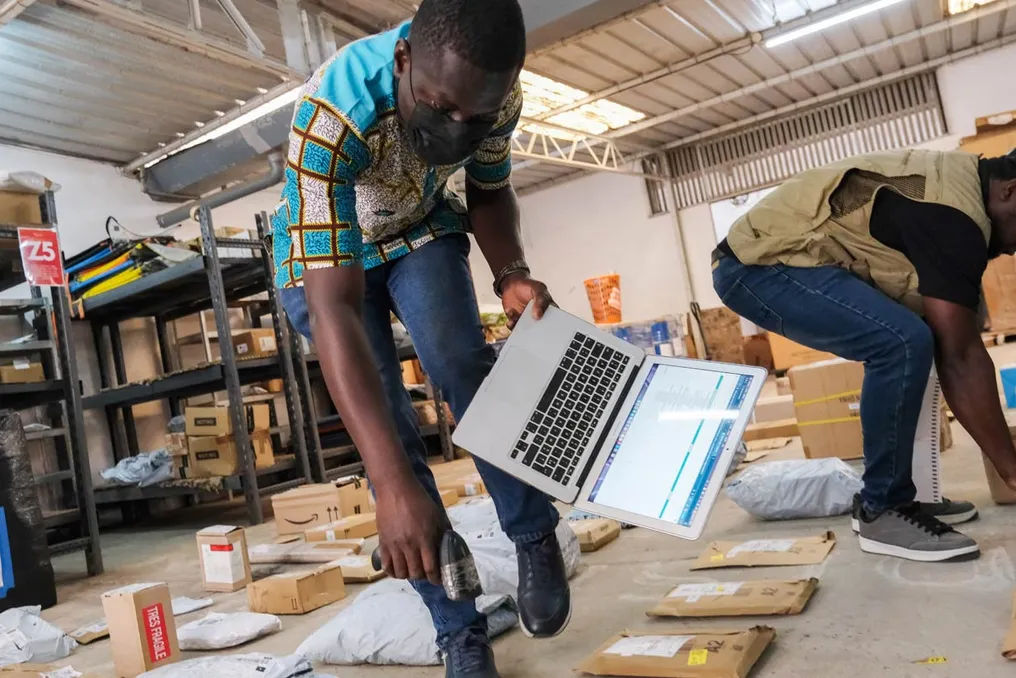
The growing boom in online shopping in Africa is supported by intermediaries who help buyers purchase goods from major global brands such as Amazon and Walmart, despite these companies not having a presence in most of the continent.
The growing boom in online shopping in Africa is supported by intermediaries who help buyers purchase goods from major global brands such as Amazon and Walmart, despite these companies not having a presence in most of the continent.
Local and foreign parcel forwarding companies play a key role in this process, utilizing technological solutions and increasing internet penetration to bypass difficulties. These challenges include the lack of formal postal addresses and the inaccessibility of traditional banking services for many consumers.
An example of such a service is the Senegalese startup Afrety. It allows African buyers to order goods from the USA, Europe, and China, and then receive them directly at an address. The Afrety service provides buyers with warehouse addresses in China, the USA, and France. Several orders can then be consolidated and packaged for shipment to West Africa. Customs duties are paid upon receipt, generating revenue for local governments.
Customers without bank cards can make payments via mobile money, which can be topped up with cash at kiosks. Mobile money is widely used in Senegal and other parts of Africa instead of traditional banking systems. Once parcels arrive in Senegal, they are delivered across major cities like Dakar using motorcycles and vans, guided by GPS navigation.
Souane Diop, the 34-year-old CEO of Afrety, emphasized the need for high flexibility in the company's operations. Afrety was founded in 2018 with the goal of connecting informal traveler networks between France and Senegal. The company has grown significantly: it processes four to five metric tons of cargo weekly by air and two to three containers by sea. To maintain low costs, Afrety leases a warehouse in France and collaborates with partners in the USA and China to handle trade in those countries.
A major competitor to Afrety is the global logistics company Aramex, which operates two platforms with overlapping services. While Afrety developed through deep ties between Senegal and the former colonial power France, which has a large Senegalese diaspora population, Aramex relies on MyUS in Sub-Saharan Africa. Aramex acquired MyUS in 2022 and also launched its own Shop and Ship platform, serving many countries on the continent.
Amadou Diallo, CEO of Aramex Group, stated that the company aims to meet the needs of African customers who wish to have access to brands and choices that would otherwise be unavailable to them. Angola is one of Aramex's main areas of operation, but the company also functions in complex regions, such as Somalia, which has suffered from war for decades. Aramex considers Sub-Saharan Africa one of the fastest-growing regions, and the most sought-after goods are electronics, clothing, toys, and agricultural machinery with auto parts. The company plans to double its revenue from shipping these and other goods by 2030.
Nevertheless, there are limitations to growth. For both Aramex and Afrety, customers are mainly located in large cities where relative wealth is concentrated. According to the consulting firm Tech Cabal Insights, e-commerce in Africa heavily depends on economic centers. Internet penetration has reached approximately 43% of Africa's 1.5 billion inhabitants, but only a small portion of the population has sufficient income for online purchases. Even in Nigeria, a powerhouse of West Africa, only one in three internet users makes online purchases. In poorer regions, such as Central Africa, about one in twenty people uses online shopping.
South Africa, possessing the wealthiest economy in Sub-Saharan Africa, dominates internet usage on the continent and stands out among African countries for its level of online purchasing. According to Mastercard data, the volume of online retail in South Africa has increased by almost 35% annually over the past five years, reaching approximately 140 billion Rand in 2025. This growth has attracted major brands that have begun operating in Sub-Saharan Africa. For instance, Amazon launched its first marketplace in South Africa in 2024, competing with the local e-commerce giant Takealot. Last year, the first Walmart stores opened in Johannesburg, Africa.
When contacted, neither Amazon nor Walmart commented on whether they plan to expand into other parts of Sub-Saharan Africa, nor did they respond to requests for data on intermediary sales.
Despite the giants of online commerce remaining absent from most of Africa, intermediaries face different competition. Nigerian retailer Jumia, often dubbed the 'Amazon of Africa,' operates in eight Sub-Saharan African countries, offering consumer goods ranging from fashion to electronics and home appliances. Although the company has not yet achieved profitability, it expects to reach break-even this year.
Francis Dufé, CEO of Jumia, stated that the company is countering competition from Chinese retail giants such as Temu and Shein by adapting its services for each country, including opening local help centers and pickup points in rural areas. Leaders from Jumia and Aramex noted that Nigeria is one of the African e-commerce markets with the greatest potential. The Nigerian government does not publish regular e-commerce data but cited UN figures estimating the total volume at $75 billion by 2025. Aramex opened a warehouse in Nigeria in April of this year. Dufé added that business in Nigeria grew by approximately 50% in the last quarter of 2025, noting that the market is 'still largely untapped, and we are just beginning our transformation in Nigeria.'