For a long time, South Africa's relationship with the World Cup was defined by unrealized potential. Despite moments of hope and having talented squads, exiting in the group stage remained a constant problem.
For a long time, South Africa's relationship with the World Cup was defined by unrealized potential. Despite moments of hope and having talented squads, exiting in the group stage remained a constant problem.
However, the 2026 Bafana Bafana generation achieved something unprecedented—they led South Africa beyond the group stage of the World Cup for the first time. This success lifted the burden of years of disappointment.
Previously, the 1998 team participated in the tournament after recovering in international football but was eliminated in the group. Four years later, in 2002, the team was very close to success, defeating Slovenia 3-2, but the goal difference led to elimination despite having an equal number of points as Paraguay.
Then came 2010, when the home championship generated huge expectations, but even the advantage of playing on home soil did not allow the team to advance further, making Bafana the first host nation to exit in the group stage. These memories remained part of the national team's history, and each new generation carried the responsibility of changing this script.
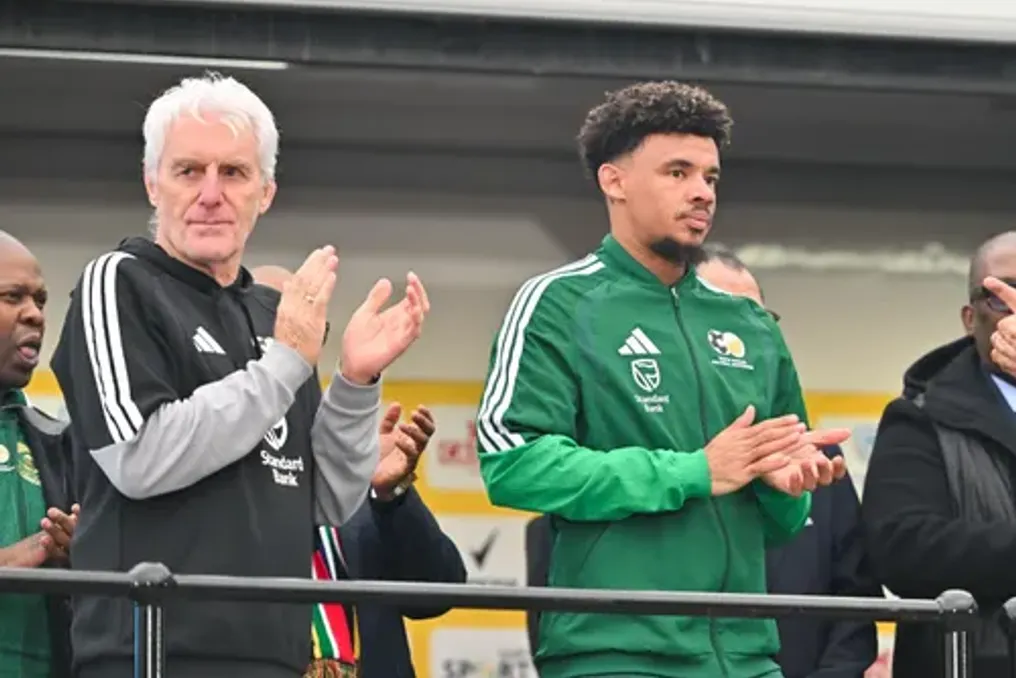
The 2026 team managed to change this history. Under the guidance of coach Hugo Broos, Bafana formed its identity based on discipline, organization, and belief. They stopped merely competing with the world's best and started challenging them.
The breakthrough occurred in Monterrey when Tapelo Maseko's decisive goal against South Korea secured a historic spot in the playoffs. However, the achievement was driven not only by this moment but also by the development of a squad combining experience with fearless young talent.
Relebogile Mofokeng stepped onto the main stage without fear of the event. Mbekezeli Mbokazi demonstrated maturity beyond his years in defense, while players like Tapelo Maseko and Osim Apollos showed South Africa's attacking potential. Alongside them were experienced figures, including captain Ronwen Williams, Tebogo Mokoe, and Aubrey Modibu, who laid the foundation for the flourishing of the young generation.
The main difference between this team and previous ones is that they arrived at the World Cup not just hoping to survive, but believing in their place among the elite. Although the subsequent defeat to Canada in the playoffs brought disappointment, it did not erase what had already been achieved.
History has been made. Now the task is to ensure this moment becomes a starting point, not a one-off achievement. The next step is consistent performance beyond the group stage, challenging top African teams, and closing the gap with footballing elites. Nevertheless, the 2026 generation deserves recognition for carrying the memory of past generations, overcoming the weight of expectations, and finally breaking through the barrier that stood for so long.
The historic participation of the Bafana Bafana team in the Football World Cup earned universal recognition and a warm reception from South African fans, despite criticism that continues to dispute one of the greatest achievements in the history of South African football.
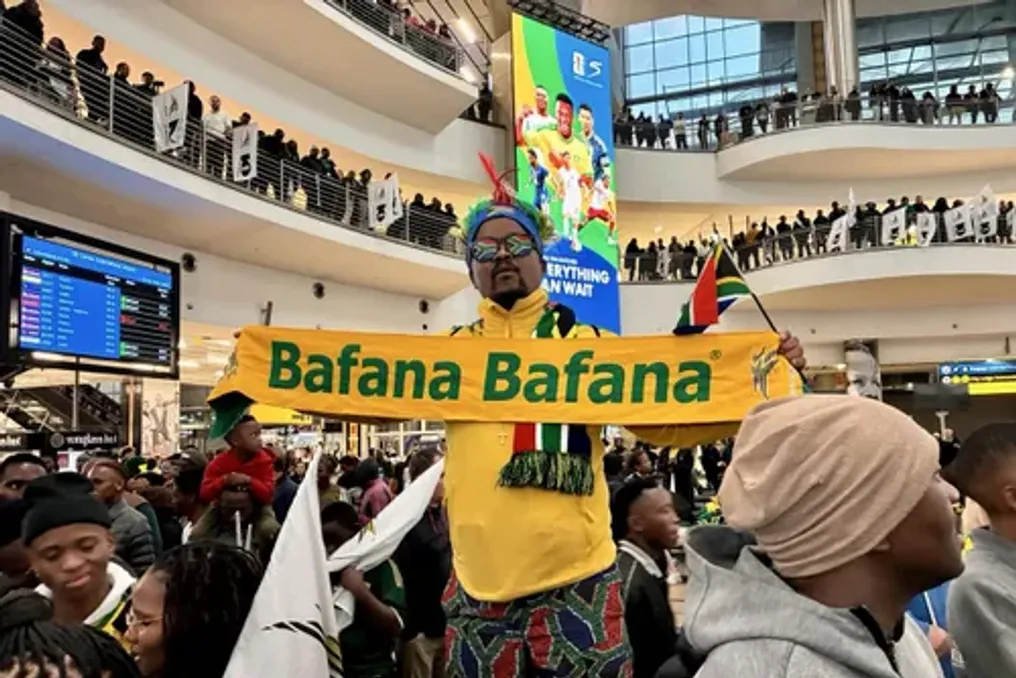
The author, who attended the welcome party at O.R. Tambo International Airport early on Thursday morning, was once again struck by the pride and excitement shared by South African football fans as they greeted Bafana Bafana after their significant performance at the World Cup.
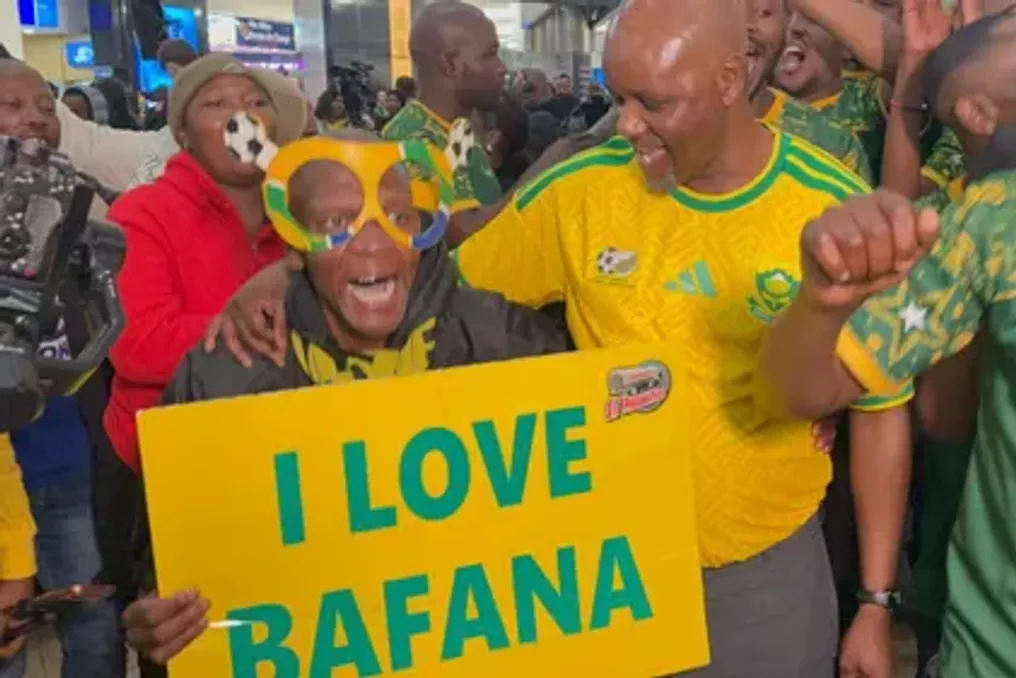
Fans gathered in the international arrivals hall to celebrate the team's historic campaign at the World Cup. Supporters began gathering long before the team's scheduled arrival at 5:30 AM, eager to see the history-making squad.
When the team finally appeared around 7:30 AM, the fans gave them a truly heroic reception.
Bafana became the first South African team to reach the World Cup playoffs before being eliminated by the hosts of Canada in added time of the Round of 32 match on June 28th.
A similar scene was observed in 2023 when Bafana returned with a bronze medal at the Africa Cup of Nations (Afcon), finishing third. This marked the first time in 23 years that the team had reached the podium at Afcon.
There is no doubt that South African football has shown growth since Hugo Broos took charge in 2021. Although, given his age, the 74-year-old specialist will likely retire soon, the foundation he laid is invaluable.
However, reading comments under one of the stories about this heroic reception, the author encountered usual, cliché, and predictable responses. In response to an IOL News post on Facebook about Bafana's arrival, Maryann Walters wrote: 'Why a heroic reception, they won one game, not the World Cup.' Roelof van der Merwe stated: 'At least give them a participation certificate.' Meanwhile, Brent Webber noted: 'Top-32 is a historic event that will not be repeated because they are not a Rainbow Nation team with a quota system. wait, I forgot they had a historic event—3 red cards in the very first opening game of the World Cup.'
The rhetoric of some circles on social media remains the same. The author wishes that critics would come to the airport to voice their objections in person. However, their voices would undoubtedly be drowned out by singing, shouting, and vuvuzela sounds, and no one would notice them.
Nevertheless, it is people like these who stand out, furiously typing on keyboards to share their opinion about Bafana.
Previously, the author wrote a column titled 'Springboks and Proteas Fans Unite—Why Bafana Needs Your Support the Most.' There, he argued: 'Even if Bafana makes a huge shock at the World Cup and passes the group stage, it is unlikely they will receive the same level of support at home as the Springboks or Proteas.'
This material was mainly addressed to typical rugby or cricket fans who too quickly dismiss Bafana's achievements. And even if they made this shock, for the minority who will never truly feel proud of this team, it was not enough.
Football is the most popular sport in South Africa, as well as the most widely played and watched globally. By number of participants, it may be the most competitive sport on the planet. Considering all these factors, what Bafana achieved at the World Cup was both historic and worthy of celebration. The progress they made under Broos is undeniable, but some people simply refuse to acknowledge it.
Bafana Bafana coach, Hugo Broos, shared his thoughts on what moment proved to be a turning point in the team's history at the World Cup. He admitted that the debut match against Mexico was lost not only due to tactical errors but also because of everything associated with the atmosphere of the largest football arena.
Broos explained that the team was ready for the game; however, the impressions from the bus ride to the stadium, the sight of a huge crowd of 80 thousand Mexicans, and the opening ceremony created something more than just an ordinary match. For a team still learning to cope with the pressure of the World Cup, the environment itself became a kind of opponent even before the game started.
The noise, the scale of the event, and the general pressure formed a psychological wave that Bafana struggled to withstand. On the field, this manifested as a clear division in the game: structurally, the team was not completely dismantled without the ball, but when in possession, it lacked the ability to handle the intensity and the demands of decision-making.
This contrast defined Bafana's early identity—organization without fluidity and discipline without confidence. Although they could endure periods of pressure, they were not yet able to dominate matches. Such a imbalance at the World Cup level often leads to defeat.
However, Broos emphasized that the difference between survival and collapse lies not in the failure itself, but in the reaction to it. Two days after the loss, the coach held a meeting that subtly changed the trajectory of the entire campaign. Instead of panic or radical tactical revision, he conducted a direct and honest analysis of the mistakes and what could be salvaged.
He noted that during this meeting, the team was clarified on what went wrong and what went well, while the players were encouraged to forget the negative aspects but learn from the positive ones. This 'reset' proved critical, as it simplified the message, eliminated fear in decision-making, and gave the players permission to play without the burden of the first match's failure.
An improvement was already noticeable in the match against the Czech Republic: Bafana played more cohesively, became more structured in possession, and more frequently aimed forward rather than just moving sideways. The defensive foundation remained solid, but now there was purpose in the game.
The culmination was the game against South Korea, where Bafana managed to combine both components of their game: defensive discipline and attacking courage. They knew how to handle pressure, but more importantly, they made transitions with purpose and belief, which led to the result that secured a historic playoff spot.
Broos insists that this evolution was not accidental but resulted from accelerated learning in extreme conditions—the team was forced to adapt quickly or fall behind. He concluded that at this level, one always has much to learn, and it must be done quickly. The team's transformation went from being subdued before 80 thousand voices in Mexico to playing confidently in Monterrey, becoming an example of adaptation in tournament football.
The Bafana Bafana team returned to South Africa early on Thursday morning and was greeted as heroes. Thousands of fans gathered at OR Tambo International Airport to celebrate their momentous campaign at the FIFA World Cup.
Fans began gathering long before the team's scheduled arrival at 5 am, eager to see the Bafana squad that made history. The atmosphere in the arrival hall was so charged that movement among the huge crowd was difficult. Constant cheers and a palpable sense of euphoria accompanied the reception of Bafana, which matched the status of national heroes.
Despite a 1-0 defeat to Canada in the match on the 32nd round on Sunday, this marked the first time in South African history that the national team reached the FIFA World Cup playoffs. Many did not expect such a deep run.
General assessment suggested that Bafana could qualify for the playoffs as one of the best teams finishing third in the expanded 48-team tournament. However, they exceeded these expectations by finishing second in their group and qualifying automatically. It is worth noting that this second-place finish would have been enough to advance even in a 32-team World Cup format, underscoring the significance of their achievement.
It should also be remembered that Bafana's greatest achievement might have been participating in the World Cup itself. They last earned their spot based on merit at the 2002 tournament. Although they participated in the 2010 tournament, it was due to automatic qualification as hosts. Even the deduction of three points for a player who was ineligible during the qualifiers could not prevent Bafana from topping their group against continental heavyweights like Nigeria.
Although their outstanding journey concluded with a heartbreaking loss to Canada, it rekindled faith in South African football and reminded the country of the team's potential, leading them to return home as heroes.