British researchers analyzed human remains extracted during excavations of a Roman villa on the Isle of Wight. They concluded that the scattered bones of several individuals are likely the result of one or more violent incidents that took place between 250 and 400 AD.
Popular
Hypothesis of Persecution
One hypothesis suggests that the villa's inhabitants might have been victims of brutal persecutions organized by Emperor Constantius II against former supporters of the usurper Magnentius. This information was published in the journal Britannia.
History of Brayding Villa
On the Isle of Wight, in the English Channel, the remains of a magnificent Roman villa named Brayding were discovered in 1879. Initial studies of this monument began in 1880–1881 and continued repeatedly. Research showed that the first country residence in this location appeared in the mid-first century AD. Over time, the villa expanded and improved, likely due to the growing wealth of its owners. In the third century, it suffered a major fire, and in the fourth, at least one or several destructions.
Mosaics and Finds
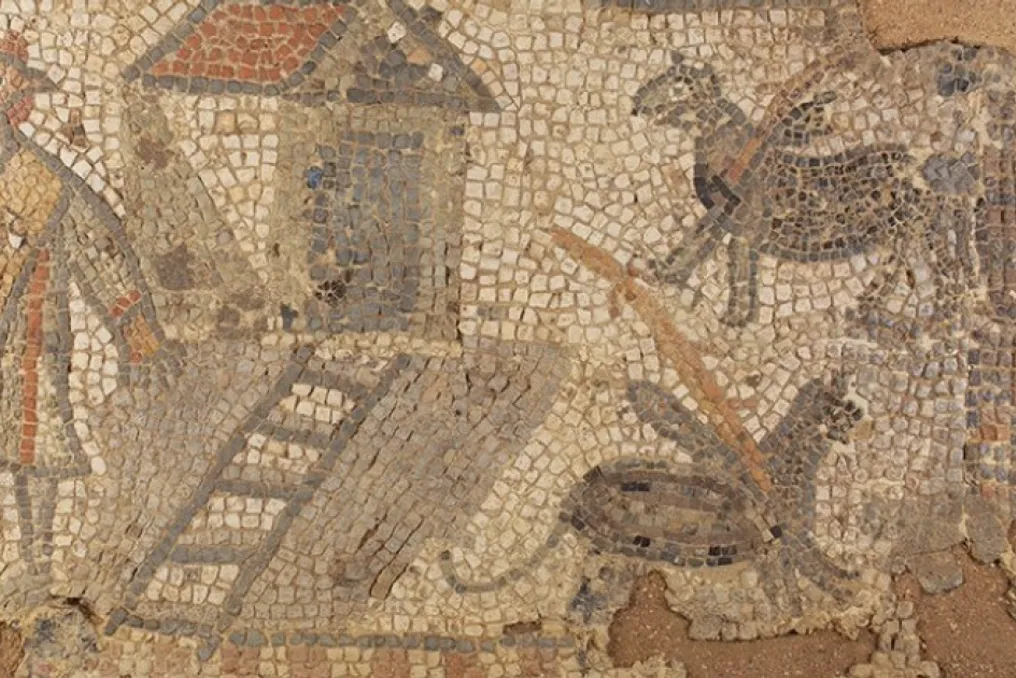
Brayding Villa is particularly known for its beautiful mosaics. One mosaic, found almost 150 years ago, still sparks debate regarding its subject matter. This mosaic depicts a building with a staircase, next to which stand two quadrupeds with long tails and possibly wings. On the opposite side of the building is a large anthropomorphic figure with a rooster's head. Scientists have proposed many interpretations of the composition, but there is no definitive answer yet.
Analysis of Human Remains
Michael Fulford from the University of Reading and Derek Hamilton from the University of Glasgow focused their attention on the human remains found during the work at Brayding Villa. Previously, even during the initial excavations, researchers found human bones at the bottom of an old well along with the remains of three young dogs. Later, other scattered human remains were discovered on the villa grounds.
In addition to the bones of a teenager from the well, the collection of finds includes more than ten fragments of skeletons from different people. Traces of animal teeth were observed on an adult's femur, and cuts left by a tool or weapon were found on the shoulder blade. A similar cut was found on the rib of the teenager from the well. To confirm the ancient age of these finds, four bones were sent for radiocarbon dating, which established that all remains date from the period between 250 and 400 AD, corresponding to the time of Roman rule in Britain. This data indicates that the bones are related to events that occurred over a relatively short period.
Considered Hypotheses
Researchers put forward several suggestions regarding the causes of death. Firstly, in the late third century AD, the problem of piracy intensified in the English Channel, which could have led to an attack by Frankish or Saxon bandits on the villa located near the coast. Secondly, the possibility of people and the residence being involved in the events of 296 AD, when the Roman fleet campaigned against the usurper Gaius Allectus, who ruled Britain and part of Gaul from 293 to 296 AD, was considered. However, these versions were not confirmed by archaeological data, as coins found at the villa indicate that the events most likely took place in the 4th century.
Most Probable Scenario
Comparing the radiocarbon dating of the bones with the coin analysis allowed scientists to suggest that the tragic events could have taken place at the villa between 330 and 348 AD or slightly later. In 343 AD, the Roman army under the command of Emperor Constans went to Britain, where fighting was taking place. There is a suggestion that the villa and its inhabitants might have suffered during this military campaign.
Furthermore, if the finds included coins minted before the 350s, it can be assumed that the villa suffered after the military defeat of the usurper Magnentius in 353 AD and his suicide. Emperor Constantius II began persecuting everyone who supported his enemy, and the residents of Britain were not spared. The ancient Roman historian Ammianus Marcellinus mentioned that around 354–355 AD, many inhabitants of Britain, including innocent ones, were subjected to torture, arrest, execution, and their property was confiscated. The article's authors consider this hypothesis the most plausible, suggesting that the residents of Brayding Villa became victims of these persecutions.
Other Finds in Britain
Roman villas continue to be discovered in Britain. For instance, in 2020, a British family in Leicestershire accidentally found an ancient object. Subsequent excavations revealed the ruins of an ancient villa with thermae and mosaics, one of which depicts scenes from the Trojan War, which specialists believe are based not on Homer's 'Iliad' but on Aeschylus' play 'The Phrygians.'
Additionally, British archaeologist Hilary Cole from Barbican Research Associates analyzed a Roman-period find discovered in York in 1983–1984. Specialists from the York Archaeological Trust found a fragment of a glass vessel, tentatively dated to the end of the 2nd century AD. According to Cole, this vessel may have been used to store kohl, which she wrote about in the journal Britannia.