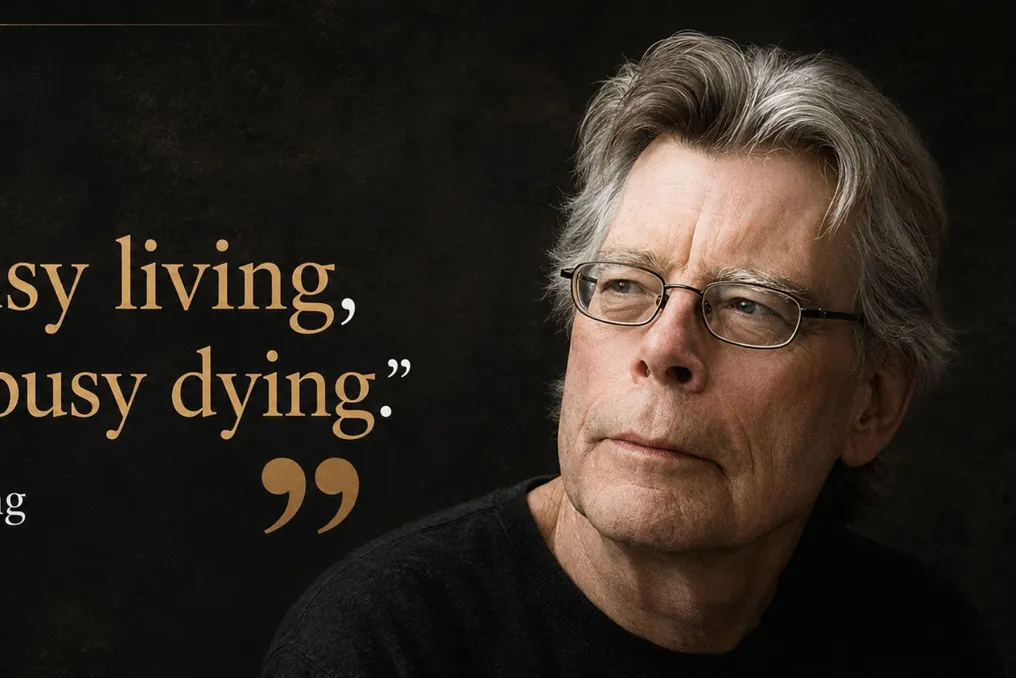
Stephen King's phrase, 'Be busy with life or be busy with death,' has long gone beyond its original context. The author used this phrase in 1982 to tell a story about an unjustly imprisoned banker named Andy Dufresne, and by the time the film adaptation was released in 1994, it had become a kind of personal creed for many people who felt stuck.
Popular
The Essence of the Contrast Between Movement and Rest
The genius of this phrase lies in the fact that it does not offer a third option—it excludes concepts like resting, waiting, or solving problems later. According to this idea, a person is always in one of two states: either moving toward something or slowly and imperceptibly giving up on life. There is no neutral position here.
The Comfort of Stillness
Stagnation rarely announces itself with loud events; people do not wake up with the decision to stop living. It manifests through small concessions: accepting a job that is unsatisfactory, maintaining a habit because changing it seems more difficult than maintaining the current state, or accepting a version of oneself formed around twenty-five years ago that is no longer being reviewed. Inaction seems safe because it demands nothing from a person. In contrast, movement requires risk, discomfort, and the possibility of failure in what has been undertaken.
The Biological Impact of Stagnation
This is not just a metaphor; it has a biological basis. Prolonged inactivity measurably changes the body, and research in this area has become much more detailed in recent years. People who spend more than eight hours a day in a sedentary position with minimal physical activity carry a risk of death comparable to the risk associated with obesity or smoking. Globally, insufficiently active people face a 20–30% higher risk of death than active ones.
The consequences are not limited to the cardiovascular system. Muscle tissue that is not used for a long time begins to lose mass and develop oxidative stress at the cellular level; the body truly begins to degrade faster if it is not forced to work. A sedentary lifestyle also impairs the muscles' ability to process glucose and fats, which explains the close link between inactivity and type 2 diabetes and metabolic diseases, regardless of whether a person exercises separately. Furthermore, studies link sedentary behavior to increased levels of anxiety, depression, and, in the long term, accelerated decline in cognitive function.
Manifestation in Public Life
The division into 'life versus death' can be seen everywhere if one looks closely: in companies that continue to use methods that worked five years ago instead of adapting, in institutions that mistakenly take caution for stability, and in leaders who prefer the comfort of the familiar over necessary risk. Organizations do not collapse instantly; first, they enter stagnation, and the collapse only becomes obvious later.
Manifestations in Private Life
On a personal level, this can manifest in relationships that no longer suit a person but from which they do not leave; in education or career paths chosen at age 19 and never questioned at age 30; or in medical check-ups that are constantly postponed. None of these cases is a dramatic moment. They are simply quiet automatic settings, and the true challenge of the quote is to notice that you are making a choice at all, even if it doesn't feel like it.
Choosing Life
The practical interpretation of King's phrase is not about performing any extreme acts. It is much humbler and more complex: one must stop confusing inertia with rest. One should choose one area—physical, professional, or personal—where a person is 'drifting along,' and take one conscious action during this week, rather than just making some decision. After all, the body keeps track even when you don't notice it. The same applies to everything else.