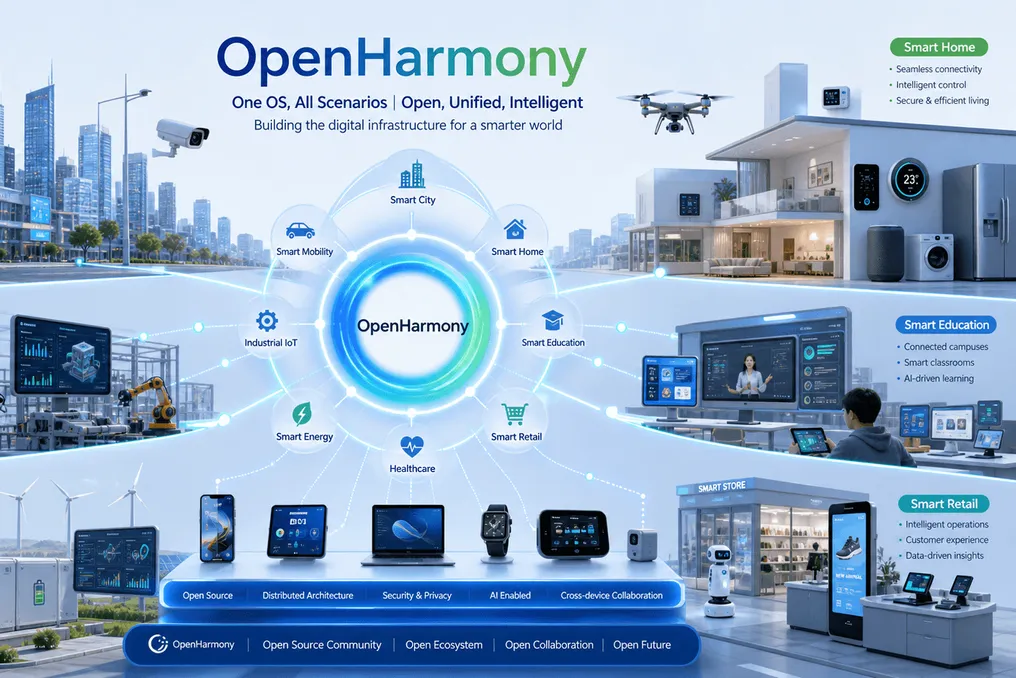
Six years after Huawei introduced the basic capabilities of HarmonyOS into the OpenAtom Foundation in 2020, OpenHarmony has evolved into one of the most significant open-source projects in China. The project has attracted over 13,000 community participants, includes more than 140 million lines of code, and serves over 1.3 billion devices in its ecosystem.
Popular
Scale and Compatibility
Over 500 manufacturers have certified more than 1800 products as compatible with OpenHarmony. The system has extended far beyond smartphones, becoming an industry-vertical operating system that enables operation in fields such as mining, power generation, healthcare, transportation, and public services.
Industry Solutions and Implementation
The primary deployment model has been industry-specific distributions. For instance, MineHarmony is used to manage smart mining operations. ElectricHarmony integrates power grid devices within China Southern Grid. This company began researching IoT OS based on OpenHarmony in 2021, adding over 10 million lines of its own code on top of 20 million lines from the open community. Currently, the system connects over 600 supply chain partners with more than 2000 adapted devices, covering the entire cycle of energy generation, transmission, distribution, and consumption.
Applications in Medicine and Public Services
MedicalHarmony allows for the creation of smart hospital rooms where bedside terminals, nursing tablets, and monitoring equipment function within a unified system with real-time data exchange. The practical impact of the system has been demonstrated in several cases. In Longgan District, Shenzhen, an OpenHarmony-based smart water pump station achieved autonomous operation, reducing energy consumption by 10% and cutting PLC controller costs by 5%. In a hospital serving the population in the new Lianjiang district of Chongqing, smart rooms allow patients to control room settings and view medical data via bedside terminals, while nurses can remotely monitor infusion status.
Technical Advantages of the Architecture
At the core of OpenHarmony's technical superiority lies its distributed architecture. Unlike traditional embedded OSs, OpenHarmony utilizes distributed soft bus technology, which ensures seamless device interaction regardless of the manufacturer, forming a unified digital foundation on heterogeneous hardware. 68 Special Interest Groups cover technical areas from the kernel to applications, and over 100 Chinese universities have established OpenHarmony technical clubs or developer associations to foster talent.
New Directions and State Support
Recently, OpenAtom Foundation launched the YiHong community for measurement and control systems, focusing on industrial automation and metering sectors that have long suffered from standard fragmentation and proprietary protocols. By providing an open base OS, this initiative aims to unify device interaction in industrial automation. China's 15-Year Plan clearly supports the creation of open-source systems, creating a favorable political environment for the further expansion of OpenHarmony.
Significance of the Transformation
The transformation has been highly significant. Starting as a smartphone OS concept in 2020, OpenHarmony has become China's distributed operating system for the physical economy, integrated into critical national infrastructure. Its development aligns with the global trend toward sector-specific open-source platforms but is complemented by a strategy of national technological independence and an internal production cycle covering chips, devices, and cloud services.