Experts insist on the need to implement a competency-based hiring system in South African public institutions, as the country's ports and municipalities are in decline. According to specialists, transitioning to meritocracy in municipalities and state-owned enterprises can solve problems in key government sectors that drive economic growth.
Port Infrastructure Problems
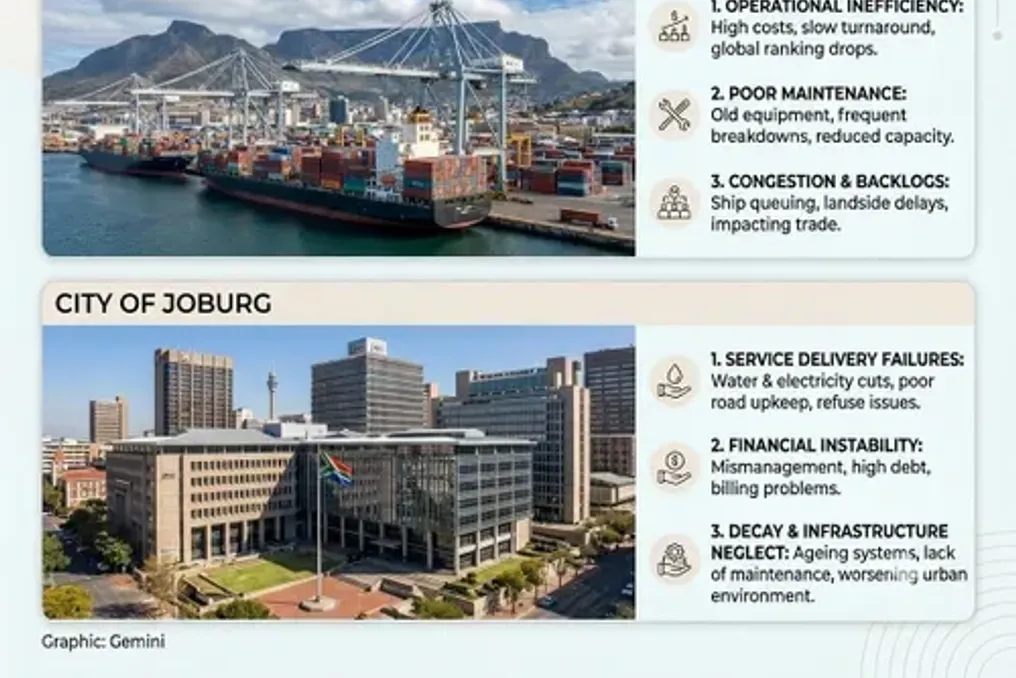
According to the S&P Global Container Port Performance Index, compiled jointly with the World Bank, South African ports ranked lowest among 400 ports surveyed globally. The Port of Durban was rated 398th out of 400, and the Port of Cape Town was ranked 400th. Although the Port of Durban showed the greatest improvement, its ranking remained unchanged. It was reported that the country's fruit exports lost billions of rands due to serious operational failures at the Port of Cape Town, forcing producers to ship fresh produce to other ports.
Financial Status of Municipalities
Concurrently, the Auditor-General of South Africa, Tsakane Maluleke, reported that the country's municipalities are showing regression not only in audit results but also in financial standing and service delivery. None of the eight South African municipalities received a clean audit opinion. These municipalities, including the City of Johannesburg, City of Cape Town, eThekwini Municipality, Tshwane, Ekurhuleni, Mangaung, Buffalo City Metro, and Nelson Mandela Bay, are responsible for nearly 54% of local government expenditure and serve about 40% of the country's population and households.
Financial Difficulties and Recommendations
This week, the National Treasury announced that it has suspended the transfer of 13.5 billion rands in equitable share to 69 municipalities that committed violations. According to the National Treasury, these municipalities, some of which, failed to comply with financial norms and other financial management directives.
Professor William Gumede, an expert from the University of Witwatersrand School of Management, emphasized that only competent individuals should be appointed to public institutions, and applying a deployment system in key areas is unacceptable; everything must be based on merit. Gumede noted that collapse occurs in key state structures, such as ports, when incompetent staff are hired. He also stated that procurement must be reviewed by thoroughly vetting those involved in supply chain management and engaging reliable companies with proven experience in effective service delivery.
Proposals for Port Modernization
Gumede proposed introducing a public-private partnership system in critically important areas, such as ports, which are vital for economic growth. According to his idea, companies wishing to modernize or improve systems should not receive government funding for tenders. Instead, they should raise their own financing through commercial banks and other sources, and then have the right to manage the facilities for a certain period before handing them over to the state. This, he said, would significantly help eradicate tender fraud.
He added that for better oversight, tender results should be published. 'We must know who the directors are and whether they have any ties to specific political parties or politicians. Their performance or competence can be publicly assessed. There is a lack of civil movements in the economic space. Therefore, let us include ports on the Parliament's watch list, where we will receive quarterly reports on port operations. Everything must be transparent,' stated Gumede.
Impact on Economy and Agriculture
Gumede stressed that if, for example, temperature-sensitive agricultural products are destroyed at the port before reaching their destination due to inefficiency, it will be a catastrophe not only for the involved companies but for the entire ecosystem. He explained that this would lead countries and companies relying on supplies from South Africa to either have to buy goods from other countries or turn to suppliers capable of ensuring timely delivery, resulting in business loss for local companies.
He said this also negatively affects GDP, as agriculture, along with mining, has supported the country's GDP for many years. To achieve economic growth, the country needs to export its goods. Exports stimulate the economy and increase employment opportunities because as exports increase, companies become busier, creating more jobs.
Expert Opinions on Problems
Some local logistics experts argued that the World Bank's CPPI metric only considers vessel time in port, ignoring geography, weather, and land evacuation. However, Gumede called this reaction 'defensive,' as other countries face worse weather conditions than South Africa but still cope. He urged against taking a defensive stance, as it undermines efforts for rapid port recovery, and insisted that the focus should always be on finding solutions.
Gumede also noted that most municipalities fail due to a lack of political accountability. He warned that if these governance issues are not resolved, large companies may leave municipalities and settle in smaller, more efficiently managed municipalities. Regarding the loss of clean audit status by the City of Cape Town, Gumede called it an alarming signal for the city requiring strengthened measures.
Ways to Solve Governance Problems
To address problems in the public sector and ensure economic growth, Gumede believes it is necessary to start with proper leadership for managing institutions. It is also important to examine the work culture to determine if employees are coming to work; if they are absent, trade unions should be involved to prevent the protection of dishonest employees. The country must clean up the procurement sphere by contracting with efficient companies, reducing corruption, and implementing a monitoring system for these institutions. Transparency is required during the recovery, and this must be reported publicly through Parliament, with the Auditor-General participating in all these processes.
David Rudd, Chief Economist at Efficient Group, stated that ports with the lowest ratings have a huge negative impact on the economy, especially on sectors like agriculture and mining. He emphasized that these two sectors can contribute significantly to the economy but cannot export goods due to port inefficiencies. Rudd noted that the country needs to make much greater efforts and allocate more funds not only to ports but also to many other infrastructure projects. The country is currently in a state of 'running in place.'
He added that Transnet has brought in private port operators, especially in Durban, to improve efficiency, and progress is being seen, albeit at a very low level. Another way to improve port operations is to delegate more authority to various provinces. Rudd also reported that due to delays at ports, some South African mines are already redirecting their exports through the Port of Maputo in Mozambique, meaning a loss of business as companies often bypass South Africa due to inefficiency.
He pointed out that municipal user payment models, where clients are billed for actual service consumption, are violated due to ineffective political leadership. Rudd concluded that the deployment system applies not only to municipalities but also to state-owned enterprises that are collapsing due to poor political leadership. The only way to restore these institutions is strong, ethical political leadership and ensuring that everyone appointed to municipal and state institutions is competent, and appointments are based on merit. He also noted a political shift in the country, as no single political party holds an absolute majority, leading to some form of accountability for those in political office.