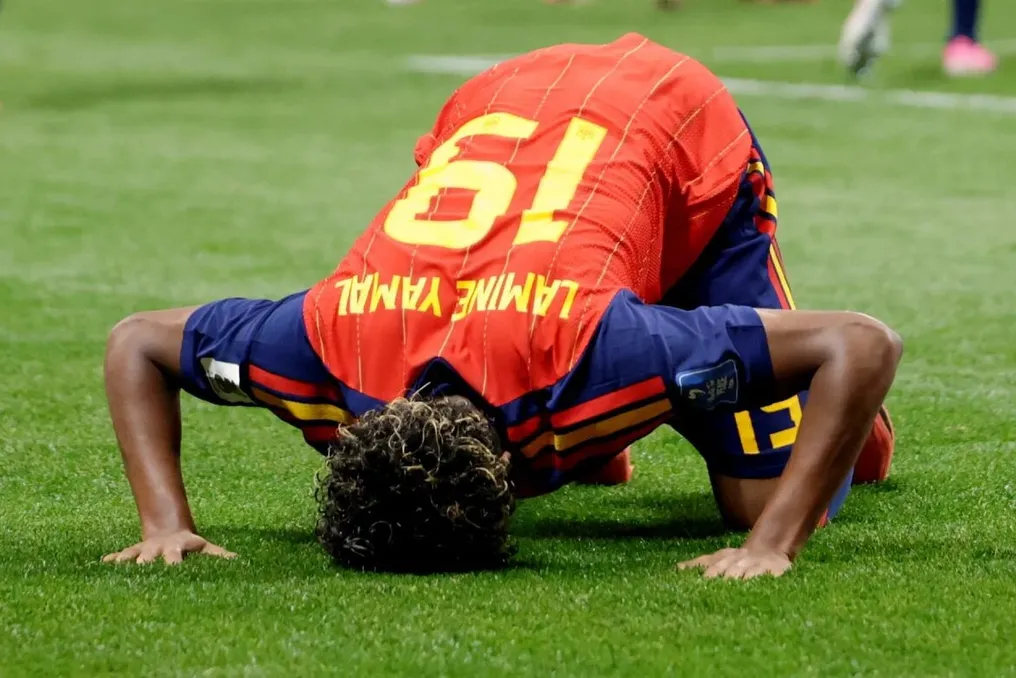
For many decades, Islam has been a source of political tension in Europe. However, on the largest football pitch, a new generation of players demonstrates that this faith is an integral part of European society.
Examples of religious expressions
It is estimated that there are about two billion Muslims worldwide, which accounts for approximately a quarter of the world's population. Given that 13 countries with Muslim majorities will participate in the 2026 World Cup, public displays of Islamic faith are not surprising. Nevertheless, some of the most discussed demonstrations of Islamic faith came from players representing predominantly Christian countries.
Lamine Yamal, a young prodigy playing as an attacker for Spain and FC Barcelona, attracted public attention when he performed sujood (prostration) after scoring his first goal in the World Cup against Saudi Arabia. Yamal's faith had already drawn attention in March during a friendly match between Spain and Egypt in home ground Barcelona, when some fans chanted: 'Musulman el que no bote' ('Whoever doesn't jump is a Muslim'). Yamal responded on social media, stating: 'I am a Muslim alhamdulillah... Football is for entertainment and lifting people's spirits, not for showing disrespect to people because of their beliefs.'
Political polarization in Europe
These chants did not arise in a vacuum. Across Europe, far-right forces, as well as an increasing number of mainstream political parties, are trying to create a false dichotomy: Christian Europe versus supposedly alien forces of Islam. This occurs despite the fact that Christianity itself originated on the same non-European peninsula from which Islam emerged approximately six centuries after the crucifixion of Christ.
Experiences of other players
Yamal is not the only European footballer who has faced alienation from his own fans. In 2024, German central defender Antonio Rudiger noted the beginning of Ramadan in an Instagram post, raising his index finger in the gesture of tawhid (symbol of monotheism). Instead of an innocent expression of faith, editor Julian Reichert of the newspaper Bild Zeitung claimed it was a symbol of support for the so-called Islamic State (IS). Rudiger filed a lawsuit against Reichert, accusing him of slander and incitement to hatred, although the legal proceedings were later dropped by the state prosecutor.
A few days before Yamal's goal against Saudi Arabia, another European player also celebrated with sujood. When Yassine Ayari scored the opener for Sweden against Tunisia, many focused on his Tunisian roots and the fact that the Tunisian Football Federation had previously tried to persuade him to switch sides. Out of respect for his father's homeland, Ayari raised his hands as if asking for forgiveness. However, the player's success and that of the Swedish team reignited a familiar debate, as many, including leader Dimmi Ackesson of the Swedish Democrats, refused to recognize Ayari as Swedish.
Social media was filled with criticism of both his act of faith and his restrained celebration. In reality, Ayari's success showed that Islam is part of Europe, and that the vast majority of immigrants integrate.
Integration and family opinion
His father, Azouz, convinced him to give up Tunisia, telling the publication Aftonbladet: 'My children are part of Sweden. My children were born in Sweden. My children's friends are in Sweden. I am an immigrant. Yassine is Swedish with Tunisian roots. Therefore, he has the right to play for Sweden.' He added: 'I really want him to play for Sweden. He should feel that he can give something back to a country that has truly taken care of him. It opened a school for him, opportunities; he ate his meatballs with mashed potatoes. Why should I interfere? I am so happy for him.'
Changing the Muslim landscape of Europe
While Ayari, Yamal, and Rudiger inherited their faith from immigrant families, a growing number of European footballers have adopted Islam through conversion. Among the most famous are Dutch midfielder Clarence Seedorf, a four-time UEFA Champions League winner, Malian striker Frederic Kanouté, born in France, and French midfielder Paul Pogba, who won the 2018 World Cup.
Another convert, Jad Spence, is an English left-back at this World Cup and became the first Muslim player to represent the country when he debuted in the World Cup qualifier against Serbia last year. After a 5-0 victory, he stated: 'I was surprised because I didn't know I was the first, so it is a blessing.' He continued: 'It is good to make history and, hopefully, inspire young people around the world that they too can succeed. They can do what I do.'
The Caribbean example in Europe
Europe also provided a path to Islam for three members of the Cape Verde national team at the World Cup. This small island nation, which became one of the tournament's unexpected stories due to bold performances against Spain, Uruguay, and Argentina, is primarily Roman Catholic. Nevertheless, the team that achieved historical success relied heavily on its diaspora, with almost half of the squad born outside Cape Verde.
Jamiro Monteiro, 32, first represented Cape Verde in 2016, and then embraced Islam five years later in his hometown of Rotterdam. His teammates, Logan Costa and Steven Moreira, born in France, followed a similar path, embracing Islam during their professional careers.
Logan Costa spoke about his spiritual journey: 'I was interested in religion from a young age and read about Islam, and then I lived with a teammate who was a Muslim, and he encouraged me to start praying with him. That's when I started feeling something inside myself.'
Moreira, 31, who was named MLS best defender in 2024, described a similar experience. 'I was in the academy in Rennes, and I lived with a friend. We did something wrong, and we were separated, and I was housed with an older player.' This older player—former Everton midfielder Abdoulaye Doucouré—was a practicing Muslim. Observing him pray five times a day and fast during Ramadan sparked Moreira's curiosity. Soon he began asking questions and eventually started practicing Islam himself.
He shared: 'I felt something moving inside me, but you are a little afraid because you weren't raised in it... You don't know how your family will react... but when I told them, they said: 'You have become a better person now.' Alhamdulillah.'
Unity in the national team
The trio together performed sujood in honor of Jamiro Monteiro's first goal at the 2023 Africa Cup of Nations. Their bond also reflects a broader sense of unity within the national team. Logan Costa stated in an interview before the team's outstanding performance in the tournament, where they passed the group stage and came close to losing to Argentina: 'Whether we are Muslims or Christians, our strength is that we are together, we are all Cape Verdeans.'
The trio enjoys the respect and support of their national team and teammates; they are provided with halal food during training camps and tournaments. Ironically, their different faiths are viewed within the squad simply as another consequence of being born and raised in Europe.