Crude oil prices began to rise after the United States struck Iran for the second consecutive day. These actions provoked retaliatory measures from Tehran against US allies in the Persian Gulf region, as both sides continue the conflict over the status of the strategic Strait of Hormuz.
Escalation of Conflict and Attacks
Recent military actions and Iran's announcement late last week about a possible closure of Hormuz—a key route for global oil trade—led to a rise in crude oil prices on Monday and undermined the interim peace agreement. In response to the latest US attacks, Iran struck countries in the Persian Gulf. The Islamic Revolutionary Guard Corps announced new strikes on Bahrain, Jordan, and Kuwait, according to state media reports.
Military Actions
U.S. Central Command (CENTCOM) reported that its forces completed another barrage, which began Sunday night, targeting dozens of Iranian sites. American aircraft, warships, and drones conducted a new wave of offensive strikes against Iran, using precision munitions to weaken Iran's ability to continue attacking international vessels passing through the Strait of Hormuz.
Stance of the Parties on the Strait
The recent week of tension is linked to competing claims over the critical energy trade route. The Iranian Guard asserts that the strait is currently 'closed,' while the United States insists that the strait remains open for maritime traffic and is not under Iranian control.
Global Market Reaction and Mediators
Oil quotes, which had been falling after the June agreement, jumped by 4.5 percent when futures trading opened in Asia. This reaction was driven by fears of supply disruptions in global markets, with the American benchmark WTI exceeding $74 per barrel. Mediators are attempting to find a diplomatic solution to end the war after President Donald Trump announced a ceasefire this week.
Accusations and Consequences of Attacks
Iran's Foreign Ministry stated that the US attacks on Sunday 'have brought instability back to the Strait of Hormuz' and 'have rendered all efforts' to establish peace in the region useless.' Iranian state media reported two deaths resulting from American strikes, which, they claimed, were aimed at vast areas of southern and western Iran, including the island of Kish and Bandar Abbas near Hormuz, as well as the Khuzestan province bordering Iraq.
Retaliatory Measures and Regional Response
Iranian state media reported on Monday that the Islamic Revolutionary Guard Corps struck US military facilities and bases in Jordan, Bahrain, and Kuwait. Air raid sirens sounded in Bahrain, and the Kuwaiti army stated that its forces intercepted 'hostile aerial targets' on Monday. The Jordanian army reported intercepting four Iranian missiles.
Origins of the Escalation
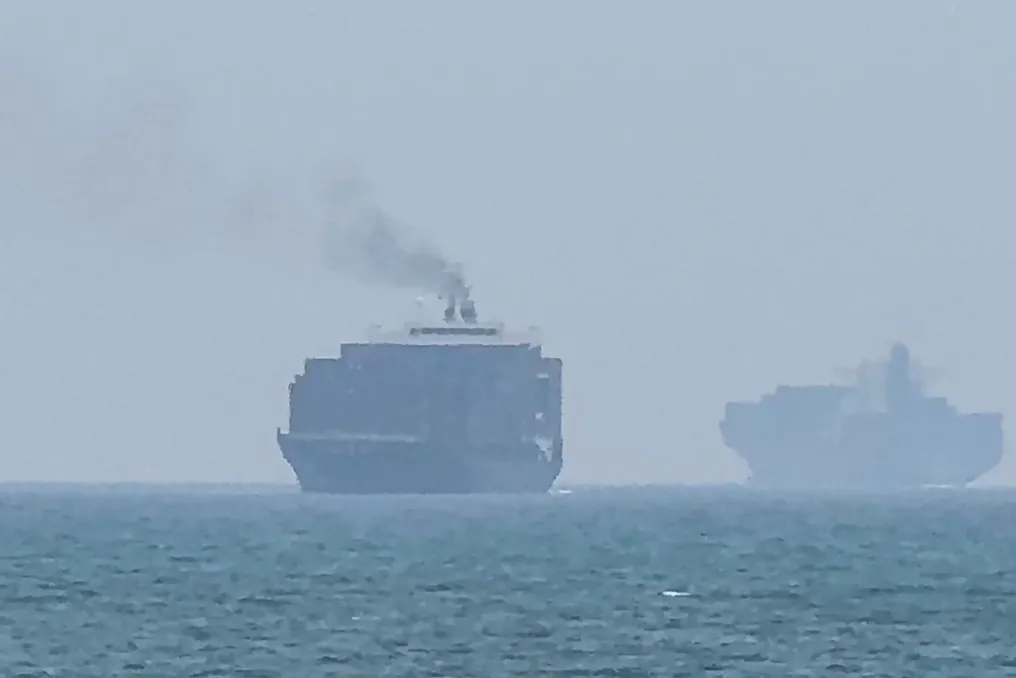
The renewed hostilities followed an Iranian attack early Sunday on a commercial vessel in the Strait of Hormuz. The crew was forced to leave the ship after it caught fire. Following this incident, the Islamic Revolutionary Guard Corps stated that 'the Strait of Hormuz will be closed until further notice and until the end of American intervention in this region,' according to the IRNA agency.
Impact on Neighboring Countries
Control over this strategic waterway has become a key lever of pressure for Iran, as the country's Supreme Leader's advisor stated on Sunday that it is more important than 'dozens of atomic bombs.' CENTCOM countered on social media platform X that the strait is 'open to all vessels seeking lawful passage.' On Sunday evening, Iranian state media reported hits from at least 10 'hostile projectiles' on the island of Kish. Strikes were also recorded on Farur Island, located east of Kish in the Gulf, which, according to them, resulted in the death of one telecommunications employee and injuries to two others. IRNA also reported early Monday that US strikes led to one death and four injuries at a water pumping station in the southwestern city of Mahshahr. The Iranian Guard stated that it also struck Oman, which rarely becomes a target.
Diplomatic Consequences
Muscat summoned the Iranian ambassador and presented him with a formal protest—a rare move for the sultanate, which is trying to balance the conflicting demands of Washington and Tehran. This incident occurred just hours after the country hosted the Iranian Foreign Minister to discuss the Strait of Hormuz. According to New Delhi, the attack on Sunday on a Cypriot-flagged container ship resulted in the disappearance of one Indian sailor. Meanwhile, Muscat reported the rescue of 23 crew members from a commercial vessel. The British maritime agency UKMTO reported that the crew abandoned the ship and transferred to a life raft approximately 17 kilometers east of Oman.
1