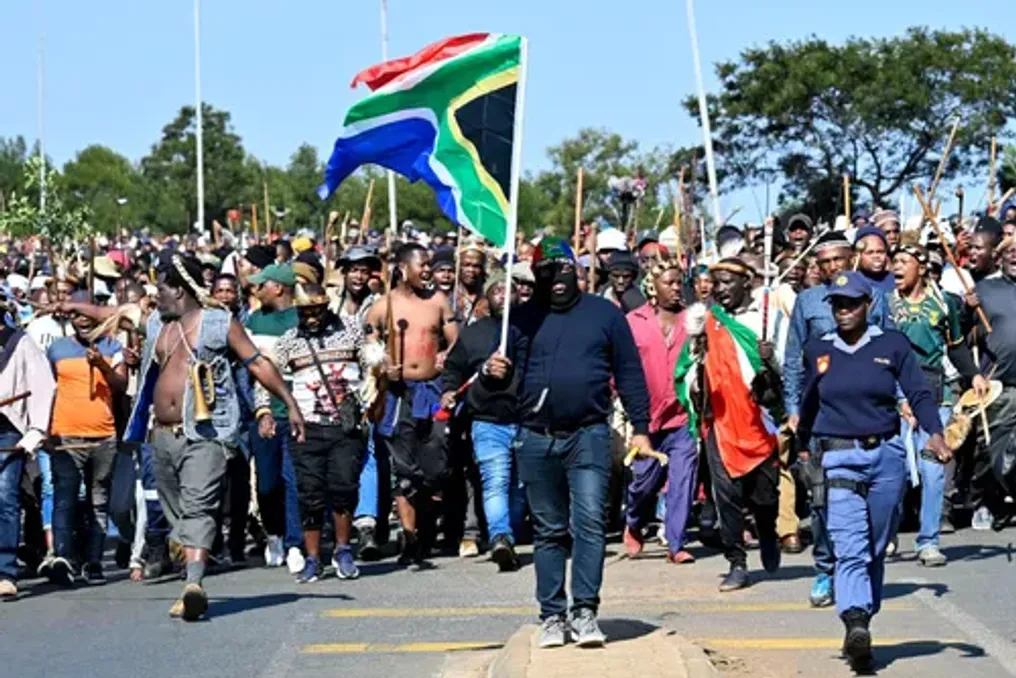
Recent demonstrations in South Africa reflect deep public dissatisfaction related to unemployment and the quality of public services, contradicting the notion of the country being violent. The article analyzes the underlying economic difficulties and emphasizes the urgent need for action.
Causes of Protests and the Economic Situation
Over the past week, South Africa has drawn the attention of the global and local community due to marches held on Tuesday. While some portray the country as aggressive towards foreigners, this is not accurate. It is crucial to consider the deep frustrations and anger of the population. Society is exhausted by an economy that grows barely fast enough to keep pace with population growth, let alone absorb hundreds of thousands of young people entering the labor market annually. The country faces one of the highest unemployment rates in the world—43.7%, leading to entrenched poverty and inequality.
Despite numerous challenges, South Africa remains an economic hub for the Southern African region and a significant part of the continent. It cannot remain a relatively isolated oasis of prosperity amidst an ocean of poverty. The marches took place, and were mostly peaceful, for which credit should be given to the police officers. However, the sincere demands of the demonstrators and society, especially the working class, cannot be ignored; these issues require urgent resolution.
Employment Crisis and Economic Development
The first problem is the unemployment crisis. No society can be proud or feel secure if four out of ten citizens cannot find work, especially decent and permanent employment. Over 62% of youth are at risk of unemployment. Solving the unemployment problem must become a top priority for the government, businesses, trade unions, and society as a whole. Once people get jobs, many acute socio-economic crises will begin to subside.
To create jobs, the economy needs to be pulled out of its sluggish state, which has lasted over ten years, and raised to the required 3% growth. This implies assisting Eskom and municipalities in ensuring electricity accessibility for working-class families, businesses, and industry. Accelerating investment in rail transport, ports, roads, water supply, airports, and other vital economic infrastructure is also necessary.
Furthermore, the process of starting a business must be simplified, and financing must be accessible and acceptable for SMEs, especially in rural areas and settlements. The private sector must actively participate in job creation, including discussing alternatives to staff reductions with workers and unions. Employers are obliged to pay workers a living wage. This is critical for ensuring worker health and productivity, as well as their sense of value and motivation. For economic growth, it is also vital that workers receive a decent salary and become shareholders, allowing them to purchase goods needed by businesses.
Social Services and Migration
Employers should prioritize hiring young South Africans. It has often been observed that employers exploit the desperation of undocumented labor, violating their labor rights and immigration laws. If this is not addressed, it will become a trigger for future conflicts. Part of the demonstrators' anger is linked to the state of public and municipal services. When communities face deteriorating water supply and sanitation infrastructure, such as sewage leaks on roads in settlements, why should they be surprised by protests? When workers spend days queuing at the Department of Interior or hospitals for the most basic services, why should they be suppressed?
While acknowledging everything that causes anger, it is also necessary to note the progress made by society since 1994 under successive African National Congress administrations. These administrations implemented public services for the working class to reduce poverty and inequality, and in recent years, they have managed to overcome power outages that damaged the economy, restore other state-owned enterprises, and begin dismantling networks of state resource theft. It is necessary to honestly acknowledge the unacceptable level of crime and define steps to eliminate it.
As with other aspects of the state, competent leadership of law enforcement agencies must be ensured, vacancies on the front lines must be filled, critical skills must be attracted, and personnel and institutions must be provided with the necessary resources to win this fight. Protests occurred because society is losing faith in the state's ability to ensure the rule of law, which is an extremely dangerous situation for any society.
Policy and Migration Issues
Any form of xenophobia, racism, or discrimination must be categorically rejected, as the country knows the meaning of these phenomena after experiencing apartheid. We are not like that, and we should never be. At the same time, it must be demanded that every resident of South Africa, citizen or not, complies with all laws. Migration must be managed, not a chaotic process. South Africa cannot bear the burden of providing employment for an entire region or continent; primarily, we owe our loyalty to South African citizens.
Migration is part of history, including the country's history, as the mining industry was built by generations of workers from Cofimvaba to Cabo Delgado. There is a historical obligation to help develop the region that the country owes so much to. The region and the continent must prosper. This requires other African governments to take responsibility to their citizens by addressing the reasons why they are forced to leave their homes due to mass human rights violations, climate change, or a complete lack of jobs and economic opportunities.
The government must strengthen border security and provide the Department of Interior, Border Control Agency, as well as SAPS and SANDF with the necessary resources to constantly ensure the rule of law. Despite numerous problems, they must be solved. Migration is an integral part of human nature and must be managed in a humane and sustainable way. These marches have been an alarming signal that cannot be ignored.