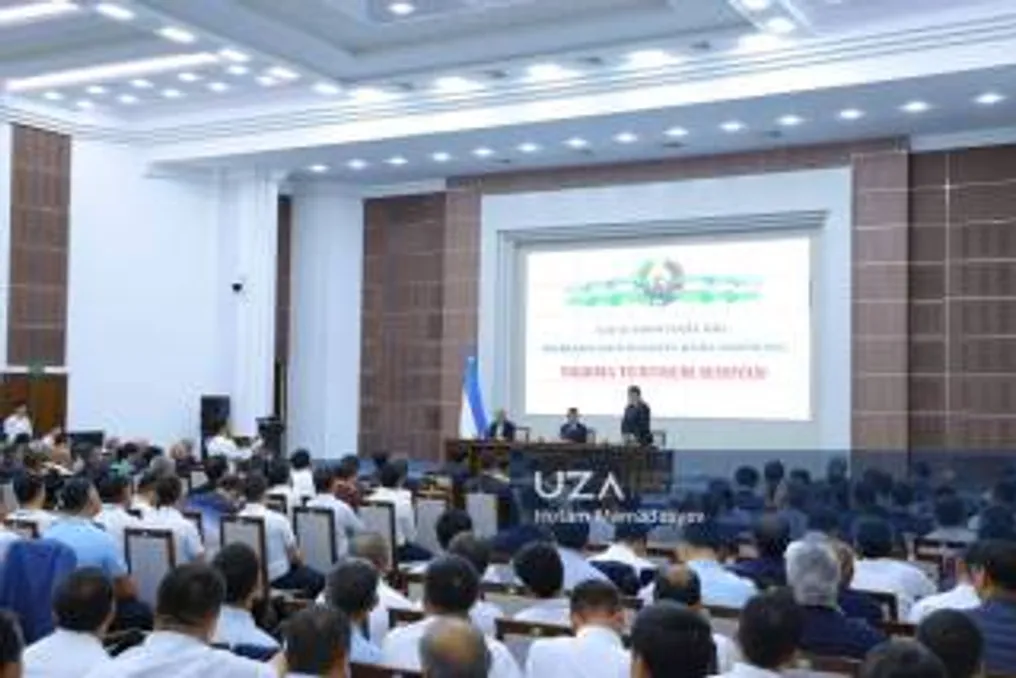
A critical evaluation of the effectiveness of handling citizen appeals in Boyovut District was conducted. At a meeting chaired by the head of the district, Niyoz Khazratkulov, the results for the first half of the current year were discussed.
A critical evaluation of the effectiveness of handling citizen appeals in Boyovut District was conducted. At a meeting chaired by the head of the district, Niyoz Khazratkulov, the results for the first half of the current year were discussed.
It was noted that the number of repeated appeals increased by 32.3% compared to the same period last year. In the first six months of the current year, a total of 2210 appeals were received in the district, of which 291 were repeated.
Repeated appeals indicate that some issues were not fully resolved upon the initial appeal or that a solution satisfying the applicants was not provided. Out of the total number of repeated appeals, 139 were resolved positively, 109 legal clarifications were provided, 2 were rejected, 11 were completed, 9 additional clarifications were provided, 7 were taken under long-term control, and 14 are under study.
The activities of organizations most frequently mentioned in repeated appeals were also critically analyzed at the meeting. These included: the gas supply unit 'Boyovuttungaz', the Boyovut District branch of the joint-stock company 'Sirdaryo Suv Ta'minoti', the department for poverty reduction and employment assistance, the district medical complex, the power supply enterprise, the social services center 'Inson', the department of family and women, and the Enforcement Bureau.
The head of the district assigned clear tasks to leaders to improve the quality of handling appeals. He emphasized the need to consider every appeal not formally, but based on its true essence, solve problems within the framework of the law and established deadlines, ensure open dialogue with citizens, and strengthen executive discipline.
Knowledge centers have been introduced based on the experience of Namangan. At the twenty-fourth session of the Namangan Regional Council of People's Deputies, 'roadmaps' were approved, developed to mobilize additional reserves and opportunities in the cities and districts of the region.
The session took place at the 'Center of Knowledge' in the city of Namangan with the participation of representatives of the Presidential Administration, members of the Senate of the Supreme Council, deputies, heads of local councils, responsible leaders of republican ministries and departments, deputy governors, law enforcement officers, as well as representatives of regional departments, organizations, and the media. The session was conducted by the Chairman of the Namangan Regional Council of People's Deputies, Solijon Muminov.
The Governor of Namangan Region, Senator Shavkat Abdurazzokov, delivered a report on important tasks that must be accomplished following the head of state's visit to Namangan on June 23, 2026. It was noted that fulfilling these tasks must be based on science, innovation, and scientifically sound approaches, as well as implementing a completely new system of working with regions.
As part of the 'Namangan experience,' 14 republican 'knowledge centers' were consolidated across the cities and districts of the region. Based on research conducted by these structures in the regions, a total of 126 issues were identified, including 39 issues on restoring industrial enterprise activities, 35 issues on developing the service sector, 21 issue concerning the social sphere, 18 issues in agriculture, 10 issues in road infrastructure, and three issues in other areas. Based on this data, 'roadmaps' were developed to mobilize additional reserves and opportunities.
Furthermore, the 'Academy of Banking and Finance of the Republic of Uzbekistan' was established in Namangan Region as a permanent partner 'knowledge center.' Presidential Advisor Obid Hakimov highlighted the significance of the new system being implemented within the framework of the 'Namangan experience.'
At the session, heads of Namangan's cities and districts presented reports on the 'roadmaps' developed in cooperation with the unified 'knowledge centers,' concerning the mobilization of additional reserves and opportunities. During discussions, existing problems and ways to solve them for each area and location were comprehensively analyzed, along with an exchange of opinions on improving the projects. Proposals from responsible persons and deputies were heard. A corresponding decision was adopted on the considered issues at the end of the session.
As part of the national program 'Together with the People' by UzLiDeP, important steps are being taken to closely communicate with the population and resolve emerging issues.
Within this program, the city and district Councils of Tashkent and Almazor organized another 'Cosmic Reception' for residents. More than 300 citizens participated in this reception, and their appeals were reviewed. As a result, 152 problems were resolved, and free medical examinations were organized for the population.
Before the field reception, over 1000 households in local neighborhoods were studied to gather information about families in need, elderly individuals living alone, and citizens with disabilities. During the event, these citizens were provided with wheelchairs, hearing aids, and referrals for treatment. Additionally, unemployed citizens were provided with employment, and some families received practical assistance in the form of food, medicine, and household goods.
Such field receptions play an important role in resolving citizen appeals on-site, upholding human dignity, and strengthening open dialogue with the people.
Uzbekistan continues to analyze the work being carried out by ambassadors to enhance economic diplomacy through the activities of its embassies and consular centers in foreign countries within the scope of foreign diplomacy.
Uzbekistan's Extraordinary and Plenipotentiary Ambassador to Poland, Amirsaid Azamkhojaev, held a meeting with representatives of the company "LeasingTeam Group." During this discussion, issues such as strengthening cooperation in the field of labor migration, expanding opportunities for citizens, and developing mutual relations were discussed.
A meeting was held with Mishal Kano, Chairman of "Kanoo Group" in Bahrain. During the meeting, matters concerning the expansion of cooperation between Uzbekistan and "Kanoo Group," the implementation of investment projects, and the development of partnerships in new promising directions were reviewed.
A meeting took place in Tashkent between Akram Aliyev, Deputy Minister of Investment, Industry and Trade of the Republic of Uzbekistan, and Albrecht Frischenslager, Director of Investments of the British company "United Green Group." In this meeting, the project to establish a modern integrated livestock cluster was discussed.
The next meeting of the "Japan – Uzbekistan" association was held in Tokyo. Representatives from Japanese ministries and agencies, public organizations, scientific and business circles, mass media, as well as citizens residing in Japan participated in this event. At the meeting, joint initiatives aimed at promoting Uzbekistan's tourism and investment potential, developing cultural and humanitarian relations, and expanding economic cooperation were discussed.
According to the information, the "Japan – Uzbekistan" association, established in 1998, is currently one of the leading friendship organizations serving to develop public diplomacy in Japan, uniting nearly 300 representatives from politics, business, science, and culture.
At the proposal of the Ambassador of the Republic of Korea to Hungary, Chul Min Park, the Ambassador of Uzbekistan in Budapest, Oibek Shahavdinov, participated in a dinner together with the heads of the diplomatic missions of India, Indonesia, Philippines, Thailand, and Vietnam.