In the remote village of Rongmei in Manipur state, a group of children measures shadows under the shade of a tall tree. Instead of using desks or classroom walls, students use the earth, light, and their own curiosity as the basis for learning.
The Educational Center Concept
These sessions are supervised by two educators: Ananya Mukherji and Kabitu Rongmei. The Khaangchu educational center transforms the village itself into a learning space, allowing children to acquire knowledge without abandoning their language, identity, or life experience.
Kabitu Rongmei emphasizes the importance of this approach, stating: 'When children cannot see their world in what they are learning, education slowly loses its meaning for them.' Khaangchu was created to restore this meaning.
Kabitu Rongmei's Path to Change
For Kabitu Rongmei, who was born into the Rongmei tribal community, education was never a given. He grew up in the very village where Khaangchu is now located, but his early years were marked by instability in formal schooling. Government teachers were often absent, and learning outcomes remained extremely low.
At the request of his parents, Kabitu left his village at the age of six. His childhood was spent in constant movement—he lived with relatives, in hostels, in different districts and states, striving to access an education that his home village could not provide. The situation was complicated by political instability in Manipur; frequent strikes and shutdowns led to prolonged school closures.
After completing higher secondary education, financial difficulties forced him to pause his studies. He started working, seeking opportunities, and eventually enrolled in a university in Guwahati through a subsidized program. It was there, through experience and conversations, that he posed the question: if change is possible, where should it begin? For Kabitu, the answer was clear—in the field of education.
The Meeting of Two Paths
Around the same time, Ananya Mukherji was asking similar questions, but from a completely different starting point. Having grown up in Jamshedpur and received her education in Delhi, she spent two years as an intern with Teach For India, working in urban classrooms. However, even in cities, she observed deep inequalities in education.
Ananya noted: 'If it is so difficult in places like Delhi or Hyderabad, what must it look like in regions with almost no resources?' During her internship, she met Kabitu in 2021, and they decided to stay in touch. When Kabitu contacted her from his village, inviting her to teach, Ananya decided to accept the invitation.
In April 2023, she arrived in the village and encountered children studying in classes where they did not understand the language of instruction. Textbooks contained references to distant and unfamiliar realities. The system demanded memorization but offered nothing relatable to the children's lives. Shortly after, a conflict erupted in Manipur, communication lines were disrupted, and the internet went down. Ananya recalls that 'the classrooms continued to function as before'; children continued to cram essays about festivals while changes occurred around them. This contrast between real life and what was taught showed that education here was not just broken; it was detached from reality.
Rethinking the Learning Process
The first steps toward creating Khaangchu were modest. Kabitu began working with teenagers in the village, many of whom struggled with basic reading and writing, using an abandoned government school building to develop literacy. However, it quickly became clear that the problem was deeper than just skills; it was about significance and belonging.
Together with Ananya, they began envisioning something different—not just a school, but a space where education would be rooted in the lives of the children it served. In 2022, public discussions began, which were informal dialogues to ascertain people's needs and what education meant to them.
By 2023, a small extracurricular pilot project was launched. In January 2024, Khaangchu officially opened its learning space, which was built with funds raised online and physically constructed by the villagers themselves. Kabitu notes: 'The residents gathered for a whole week to build it; that is our level of involvement.'
Features of Learning at Khaangchu
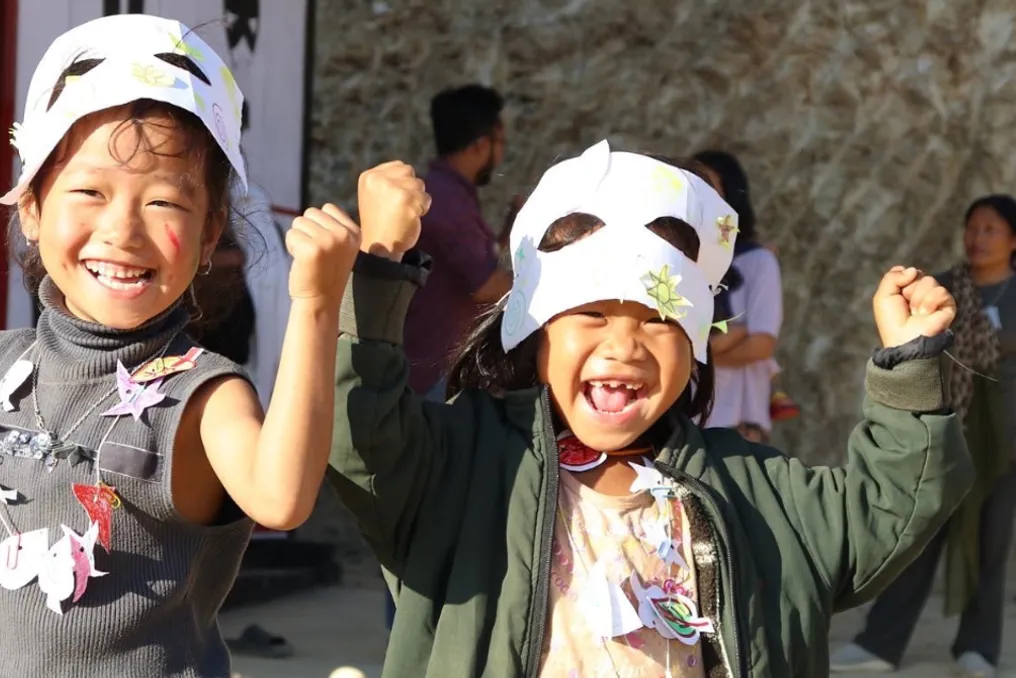
At Khaangchu, the school day does not start with a bell. Children start arriving as early as 8 am, although lessons officially begin at 9 am. They come to play, spend time, simply to be themselves. Ananya adds that this speaks to the children's desire to be there.
The day begins with a morning circle dedicated to storytelling, music, and conversation, most of which takes place in Rongmei—the children's native language. This is done intentionally because traditionally, education required children to leave their language and, consequently, part of their identity outside the classroom. At Khaangchu, there is no such barrier.
This is followed by structured, yet flexible, learning. Lessons are not confined to classroom walls. For example, the mathematical concept of height and distance is studied under trees through shadows, and natural science lessons take place in open fields. Learning becomes an experience, not just memorization.
Three times a week, students participate in 'community immersion,' directly studying the surrounding environment. They learn about Rongmei clans, traditional practices, oral histories, and cultural knowledge, with elders and parents also acting as teachers. Ananya explains: 'Anyone who wants to teach here is a teacher.'
Program Results and Impact
In a short period, Khaangchu has demonstrated a tangible impact. As of 2025, 49 children have been enrolled in the program with attendance above 95%. About 85% of students achieve or exceed proficiency levels in English and Math, and 42 children have already reached age-appropriate reading levels. Importantly, over 90% of traumatized children show greater emotional stability and visible joy in daily learning. Today, the school has accepted 120 children aged 2.5 to 12.
Transformation of Students and Teachers
For local teachers, such as Naitona Taimey, Kachiamtuiiu Gangmei, and Kungtailiu Gangmei, the transformation of the children has become a deeply personal experience. They have been teaching these children since the early days of Khaangchu, working with students aged 5 to 11. They recall that initially, the children were fearful and spoke little, but changes began within a few weeks. 'They started opening up. Now they share thoughts freely, ask questions, express themselves,' they say.
Language plays a key role: 'When they are allowed to speak Rongmei, they feel comfortable. Their confidence grows,' explains Naitona. Connection to the environment is also vital: 'If we teach about trees, we don't just show pictures—we go outside, observe, collect, and discuss so it becomes real for them,' says Kungtailiu. The teachers themselves note that this experience transforms them too: 'We are not just teaching—we are learning together with them every day.'
Return to Community Values
For the Rongmei community, Khaangchu is more than just a school; it is a kind of restoration. Gululung Rongmei, a local pastor, says that in childhood, learning seemed distant, amounting to memorizing things that found no resonance. Khaangchu differs in that it reminds people how learning used to happen—through stories, observation, and community—while also introducing new elements.
Parents share this view. Shanti Gangmei notes that for a long time, education meant moving away from identity, whereas now 'it feels like our identity is respected.' These changes have led to children becoming more confident, asking questions, and actively participating in community life. Parents Daffidil Rongmei and Shanti Gangmei note that curiosity has extended beyond the classroom, encompassing stories, farming, and traditions.
Vision for the Future of Education
For Khaangchu, success is defined not only by grades but by nurturing a generation that stands confidently on its own feet and is capable of shaping its own future. Kabitu envisions a future where Rongmei children do not feel disconnected from education, and where learning reflects their life, land, and people. This is a future where they become leaders capable of solving local problems using both local knowledge and modern skills.
It is important that Khaangchu is conceived as belonging to the community, not its founders. The goal is for the model to be sustained through joint decision-making and participation from local leadership. Teachers like Kachiamtuiiu dream that their students succeed in whatever they choose, whether academics or farming, but with understanding and confidence.