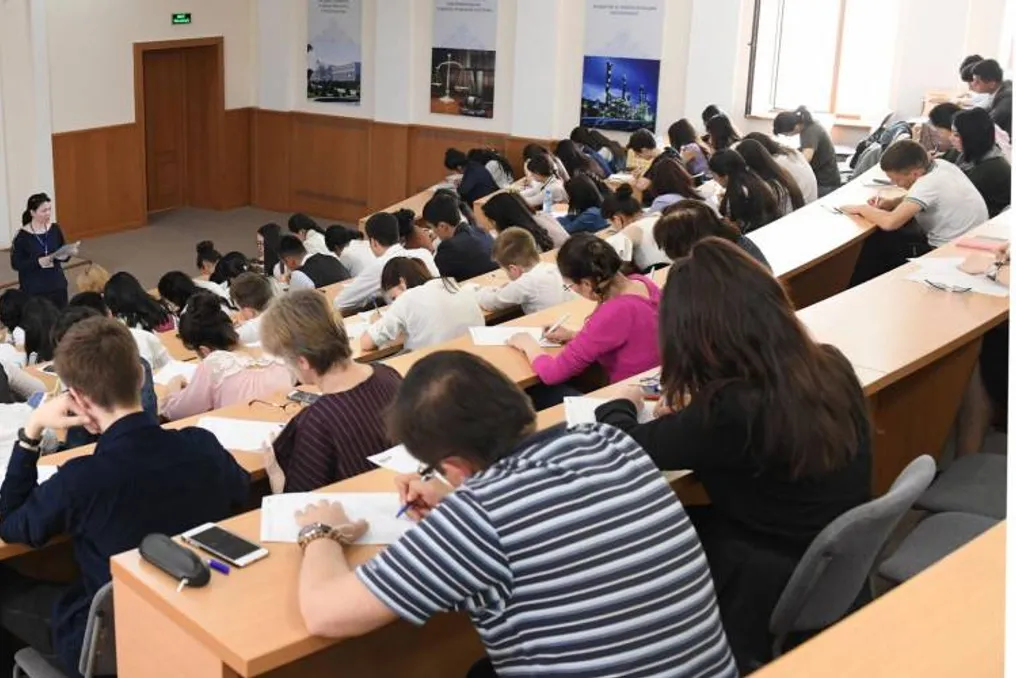
More than ten thousand state educational institutions in Uzbekistan will gain the opportunity to use the Canva for Education platform free of charge. This decision is aimed at integrating modern digital tools into the educational process.
More than ten thousand state educational institutions in Uzbekistan will gain the opportunity to use the Canva for Education platform free of charge. This decision is aimed at integrating modern digital tools into the educational process.
According to IA 'Dunyo', an agreement with the Australian company Canva was concluded during the visit of the delegation from the Ministry of Preschool and School Education to France. This document guarantees that all public general education schools in Uzbekistan will be able to use the Canva for Education platform free of charge for a three-year period.
In addition, during the visit, an agreement was signed with the French publisher Hachette Livre regarding increasing the volume of textbook supplies in French. The idea of creating a joint Uzbek-French teacher training center and opening a regional center for learning French in Tashkent was also discussed.
Previously, there were reports about plans to build new types of schools in Tashkent that could accommodate twice as many students. Furthermore, work is planned to create artificial water bodies, improve the condition of canals, and increase the area of green zones.
In Uzbekistan, parents can now apply for a preferential queue in state kindergartens remotely through the my.gov.uz public services portal. This process eliminates the need to collect documents or visit relevant institutions.
The system automatically verifies eligibility for benefits. Parents only need to specify their category when submitting an application, after which the system cross-references the necessary data with various agency databases in seconds.
The online application for benefits is available to a wide range of families. These families include children of military personnel, employees of internal affairs and customs agencies, as well as children with disabilities, orphans, and children left without parental care. Additionally, benefits are available to children from large and low-income families, students, and teachers, as well as those whose siblings already attend the chosen kindergarten.
To submit an application, one must register either on the my.gov.uz portal or in its mobile application. After registration, you should select the required service, specify the desired kindergarten and the corresponding benefit, and then submit the application.
Previously, a fully electronic procedure for accessing the Social Register was approved in Uzbekistan.
Some educational institutions in Uzbekistan have an extremely high student-to-teacher ratio, significantly exceeding the figures in state universities.
According to data from the Unified National Labor System, some branches of foreign universities lacked registered full-time teaching staff. The National Agency for Quality Assurance in Education conducted an analysis of this situation.
According to the agency, over 1.6 million students are currently studying in the country, supported by more than 61 thousand professors and teachers.
The lowest student-to-teacher ratio was recorded in state universities, where it averages 19 students per teacher. In branches of foreign universities, this figure reaches almost 33 students per teacher. The most strained situation is observed in the non-state sector, where the average ratio is 55.3 students per teacher.
The gap is even wider in some institutions. For example, at IT Park University, there are 244 students per teacher, and at Tashkent University of Economics and Pedagogy—236.6. Other noted figures include 140.1 at the Singapore Management Development Institute, 133.8 at the International School of Finance and Technology, and 127.3 students at 'Millat Umidi' University.
The agency emphasizes that such a high teaching load hinders the possibility of conducting individual work with students, organizing practical classes, and stimulating scientific activity. Furthermore, official reports on staffing do not always reflect reality.
According to the Unified National Labor System, no teachers were registered as full-time employees at Webster University and Riga Nordic University, making it impossible for the agency to calculate the ratio of faculty to students in these institutions.
Previously, a document regulating higher education was adopted in Uzbekistan, which establishes rules for the functioning of universities, covering aspects from the organization of the educational process to the rights of both students and teachers.