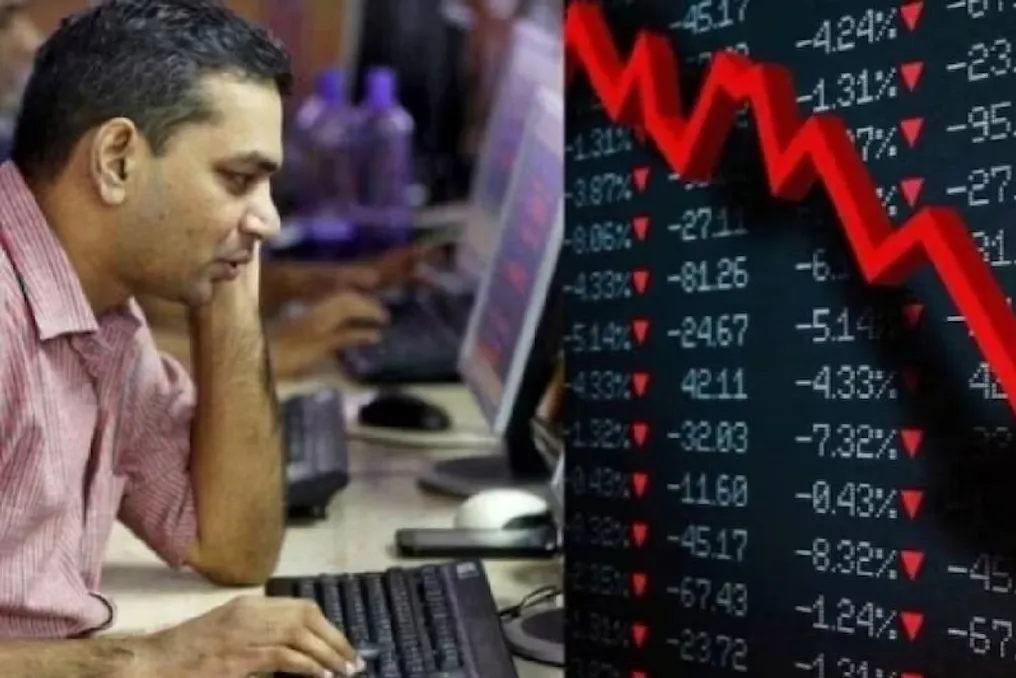
Futures stock indices opened with a dip, reflecting weak global sentiment caused by escalating geopolitical tensions between the US and Iran. By 9:40 AM, the Sensex index fell by 447 points, or 0.59 percent, reaching 77,119, while Nifty dropped by 132 points or 0.57 percent, settling at 24,071.
Index Trading Dynamics
During early trading, Sensex reached a low of 76,857.43, losing 712 points or 0.92 percent. Similarly, the Nifty index fell by 207 points or 0.86 percent, touching the 24,000.20 level. Among sectoral indices, Nifty Auto and Nifty Metal showed the largest losses, declining by 0.93 percent and 0.88 percent, respectively. However, Nifty IT moved against the general trend, showing a growth of 0.50 percent. Broader markets also corrected: Nifty Midcap 100 and Nifty Smallcap 100 fell by 0.39 percent and 0.35 percent.
Volatility and Sentiment Indicators
The India VIX fear index jumped by 8 percent, exceeding the 13 mark, indicating increased market volatility in the near term. According to NSE data, the advance/decline ratio stood at 1,352/1,539, pointing to a negative bias.
Reasons for Market Decline
The primary reason cited for the market decline was the tension in the Middle East. US military forces announced another round of strikes against Iran aimed at weakening its ability to freely attack commercial vessels passing through the Strait of Hormuz. VK Vijayakumar, Chief Investment Strategist at Geojit Investments, noted that mutual actions in the Middle East crisis have become the new normal. He emphasized that Iran's attempts to use geography for military purposes negatively affect energy importers like India, and President Trump's inconsistent stance on Iran has made stability a thing of the past.
Impact of Oil Prices and Currency
Following new exchanges between the US and Iran, and ongoing uncertainty regarding the status of the Strait of Hormuz, crude oil prices rose. Brent crude futures climbed by $2.34 or 3.08 percent, reaching $78.35, while West Texas Intermediate (WTI) crude oil increased by $2.21 or 3.09 percent, totaling $73.62 per barrel. Vijayakumar considers crude oil price a critical factor, especially for India, and warns that a significant correction could occur if Brent crosses $90.
Concurrently, the rupee weakened by 37 points to 95.70 against the US dollar as the dollar strengthened and crude oil prices rose due to heightened Middle East tensions. The US Dollar Index (DXY), which measures the value of the USD against six major currencies, remained strong for the second consecutive day, trading around 101.10.
Financial Markets and Analysis
US government bond prices declined for the second week in a row, leading to yield increases to the highest levels since mid-May amid concerns over inflation and interest rates. Dwarish Vakil, Head of Primary Research at HDFC Securities, reported that the yield on 10-year Treasury bonds closed the week at 4.56 percent, up from 4.37 percent a couple of weeks ago. The yield on 30-year bonds reached 5.06 percent, higher than the previous 4.87 percent.
Asian markets also traded significantly lower due to geopolitical tensions and supply chain issues. At the last check, South Korea's Kospi led the decline, plunging 7 percent, followed by Japan's Nikkei 225, which fell 1.1 percent, and Australia's S&P/ASX 200 dropped 0.31 percent.
Nifty Technical Analysis
Sachin Gupta, Vice President of Technical Analysis Research at Choice Broking, noted that the immediate hurdle for Nifty remains the level around 24,400, which coincides with the 200-day EMA and is a critical resistance zone. A decisive breakout above this level could trigger a new rally towards the 24,600–24,800 marks. In the downtrend, 24,000 is expected to serve as immediate support, followed by the important level of 23,800. A sustained fall below 23,800 could increase the probability of a longer consolidation phase.
Gupta also added that derivatives data continues to show a positive backdrop. The Nifty Put-Call Ratio (PCR) sharply improved from 0.94 to 1.25, indicating aggressive selling of put options and strengthening bullish sentiment among derivatives traders. A high PCR suggests that market participants continue to build supportive positions at lower levels.