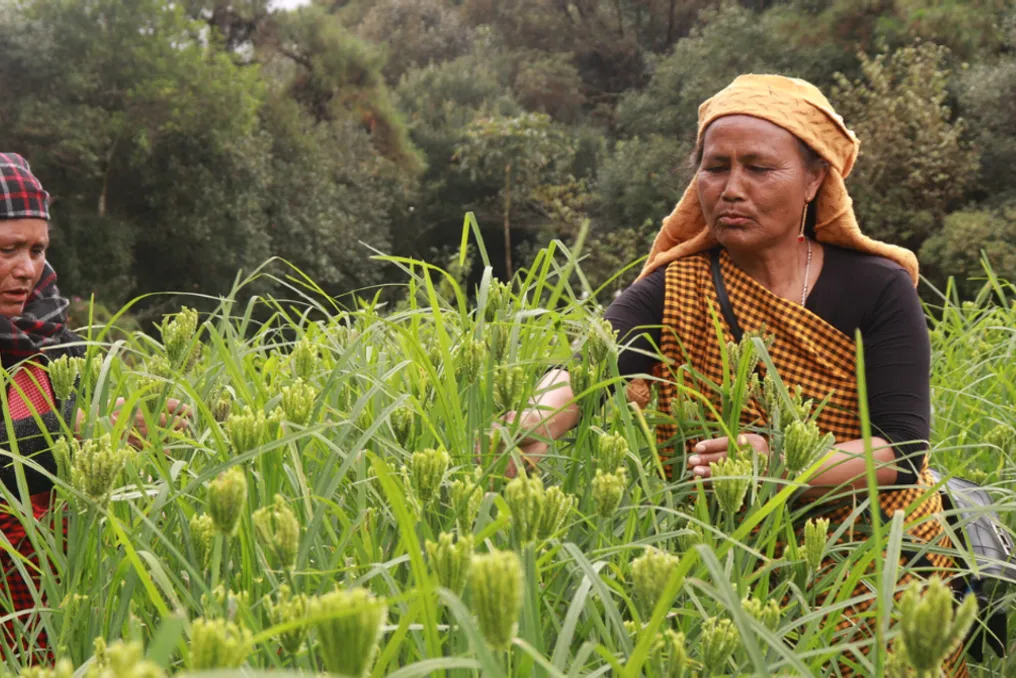
When millet harvests are gathered in the villages of Eastern Nagaland, celebrations go far beyond a simple harvest. Families gather for a post-harvest festival called Metumnyo, where millet is used to prepare traditional local drinks that are shared during gratitude rituals and offered in prayers marking the end of the agricultural cycle. The ceremonies are led by the village elder, known as the thekingpu.
Popular
Traditions in Northeast India
Throughout the hilly terrain of Northeast India, similar traditions have been passed down from generation to generation. Long before India declared millet a national priority, and the world accepted it as a climate-resilient 'superfood,' the indigenous communities of the region had already established their farming systems, festivals, and culinary traditions around these hardy grains. For them, millet was never just another crop; it provided food during uncertain seasons, withstood harsh weather conditions, fed livestock, and united communities during festivals and family gatherings.
Scientific Confirmation of Ancient Knowledge
Now science is catching up to what these communities knew for centuries. A study published in the journal Frontiers in 2026 documents the rich ethnobotanical knowledge associated with over 20 varieties of millet grown in the Northeast Himalayas region. The research demonstrates how indigenous farmers developed diverse millet-based farming systems that supported food security, nutrition, and livelihoods long before climate resilience became part of agricultural policy.
The findings offer an important perspective: while the current millet movement in India is often described as a revival, much of the Northeast never completely abandoned these grains. Here, growing millet should be understood as a continuation of a living tradition.
Agriculture Designed for the Mountains
Farming has never been easy in the mountains of Northeast India. Steep slopes, acidic soils, scattered settlements, and unpredictable rainfall require crops capable of thriving in challenging conditions. Millet is ideally suited for such environments: unlike water-intensive cereals, it grows well on mountain slopes with minimal irrigation, tolerates poor soil, and can be stored for months without loss of quality—a crucial advantage for villages that are often inaccessible during monsoons.
According to the Frontiers study, these qualities made millet a central element of the traditional jhum, or shifting cultivation, system of the region. Instead of relying on a single crop, indigenous farmers cultivated finger millet, foxtail millet, Job's tears, sorghum, and other varieties alongside legumes, vegetables, and root crops. This led to the creation of a diverse agricultural system that strengthened biodiversity and helped households maintain a stable food supply.
Researchers also found that millet served multiple purposes beyond cuisine: it was used as animal feed, bird feed, for fermented drinks, traditional medicine, and ceremonial food, forming an interconnected agricultural system refined over generations.
Variations in Millet Traditions
Millet traditions vary across the Northeast, as each community adapts the grains to its landscape, cuisine, and culture. Among the Nishi, Adi, Apatani, and Mumpa communities in Arunachal Pradesh, finger millet and foxtail millet are traditionally prepared as steamed porridge dishes and fermented drinks served during festivals and village gatherings. The Adi community also cultivates aniyat, better known as Job's tears or adlai millet, alongside ayak, or foxtail millet, through mixed cropping systems that have long been part of indigenous jhum agriculture.
In Meghalaya, the Khasi, Garo, and Jaintia peoples, as well as several Naga tribes, including the Yimkhiong community, continue to prepare finger millet and foxtail millet as porridges and local beverages. In Mizoram, millet was once the staple food before the widespread adoption of rice and is still used in traditional fermented drinks. Further west, in Assam, where rice dominates modern cuisine, hill communities such as Karbi, Mising, and Bodo continue to preserve millet cultivation for ceremonial food and traditional brewing practices.
Decline of Traditions and New Efforts
This diversity began to decline in the 1970s. With the expansion of the Public Distribution System (PDS), rice became cheaper and more accessible. Agricultural policies increasingly favored rice cultivation, while urbanization gradually changed dietary preferences. For many younger generations, rice became a symbol of modernity, while traditional grains slowly disappeared from the daily diet.
The Frontiers study points to other challenges, including the loss of local seed varieties, weak market linkages, soil acidity, and the gradual erosion of traditional ecological knowledge. Nevertheless, researchers argue that the region's millet heritage offers practical solutions to many modern agricultural problems. Millet requires significantly less water than rice, withstands climate change, improves dietary diversification, and reduces dependence on expensive agricultural resources. For farmers in the fragile mountain ecosystems of the Northeast, millet remains one of the most resilient crops in the region.
Revival Driven by Women
In the Shamator area of Nagaland, this knowledge found new life during the COVID-19 pandemic. When supply chains were disrupted in 2020, many families realized their dependence on food delivered from outside the district. By then, indigenous millet cultivation had dropped so sharply that several traditional seed varieties were nearly extinct. Members of the Self-Employed Women's Association (SEWA) began collecting millet seeds from neighboring villages, laying the foundation for what is now known as the 'Millet Sisters.' Working with the Northeast Network and the Indian Millet Network, women revived forgotten millet varieties, launched an annual Millet Festival dedicated to indigenous food traditions, and expanded millet cultivation throughout the district. By 2025, about 90 farmers were again cultivating pearl millet, finger millet, foxtail millet, sorghum, and local varieties, including Kotsaru, Phuhjem Muliam, Yetupiak, Kheak Khih Shipu, Wuh Ni Muk Athsap, and Tansung.
A Future Based on Ancient Knowledge
Similar efforts are underway in Arunachal Pradesh. Entrepreneur Dimun Pertin founded Gepo Aalia after seeing his grandmother search for aniyat—Job's tears millet—which was once a staple in Adi kitchens but became increasingly difficult to find. Today, female farmers continue to cultivate this grain using traditional mixed cropping systems. It is prepared as a porridge, served with vegetables and lentils, and also fermented into apong, a traditional beer brewed by several indigenous communities in Arunachal Pradesh and Assam. The fermentation process combines local grains such as finger millet, foxtail millet, or pearl millet, with local starter cultures from leaves and herbs, creating a drink that has been part of community life for generations. Even the husks are used as pig feed, reflecting the resource-efficient farming methods that characterized indigenous agriculture for a long time.
The revival of millet in Northeast India is not about returning to a forgotten culture. It is about recognizing that some of the most effective solutions to combating climate change, food security, and sustainable agriculture have always existed within indigenous communities. As India invests in a millet-based future, tribal farmers in Nagaland, Meghalaya, Arunachal Pradesh, Sikkim, Assam, and beyond continue to preserve knowledge that nourishes people, protects biodiversity, and strengthens resilience in the face of a changing climate. It turns out the country's millet revolution did not begin in recent years; it has been quietly unfolding in the mountains of Northeast India for centuries.