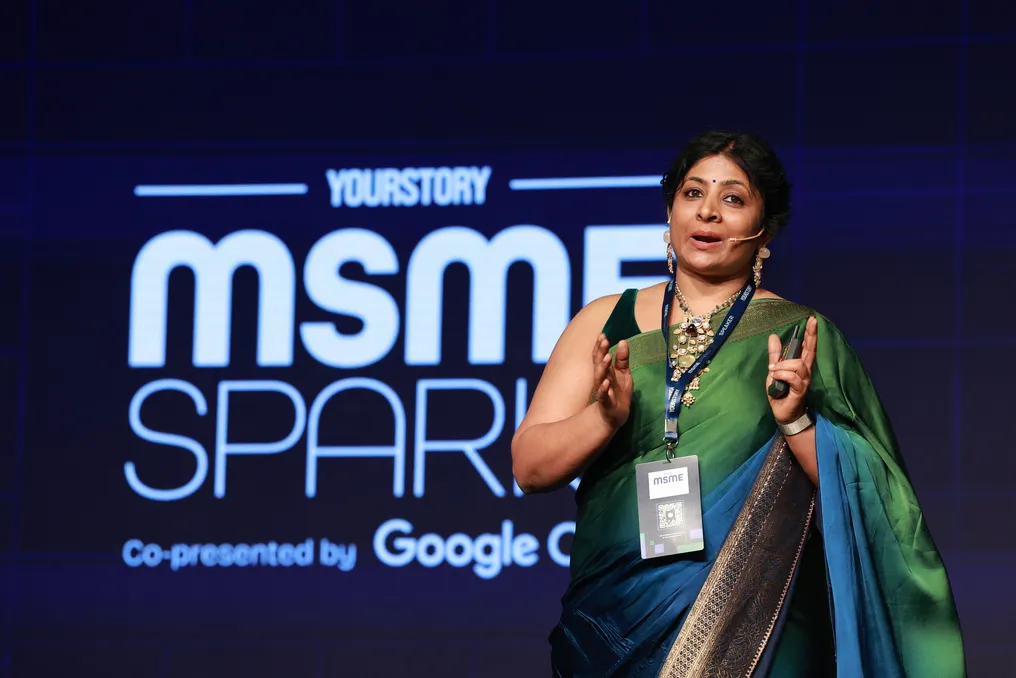
Aparna Tyagarajan, co-founder and product director of the company, stated that India is no longer aiming to merge with other cultures. These words were spoken by her at the closing event of MSME Sparks 2026, held on June 26th at ITC Gardenia in Bengaluru.
The Path to the Global Market
Speaking with an opening keynote titled 'Woven for the World: Taking Indian Traditions Global,' Tyagarajan shared her story. She began in childhood when she sewed a festive skirt from leftover sari fabric in the early 90s, which led to the creation of Shobitam—the largest cross-border ethnic fashion platform in the US and Canada.
She recalled always trying to stand out by incorporating a piece of India into her Western silhouettes, which sparked interest and pride in cultural identity among people. Tyagarajan emphasized that Shobitam is unique because it represents the full spectrum of Indian textile traditions, including Kashmiri saris, Madurai Sangudi, Ajrakh prints, and Jamdani weaves, instead of focusing only on a few popular styles.
Scaling and Customer Experience
Currently, the platform collaborates with over 75 partners and delivers to customers on six continents, including remote locations such as Fairbanks in Alaska and Wellington in New Zealand. Tyagarajan noted that many global customers consider the company local because Shobitam strives to be close to the buyer regardless of geographical location, ensuring fast and free global delivery and a strong focus on customer experience.
The company has accumulated over 13,000 five-star reviews, so many that the review system periodically requires deleting old entries to free up space. She also mentioned the role of storytelling and brand representation, naming actress Vidya Balan as a global ambassador for Shobitam. Tyagarajan shared that Vidya Balan has been able to unite people from all directions—north, south, west, and east—and possesses global appeal, which is important for the brand, not just for product advertising.
Five Pillars for SMEs Internationally
Tyagarajan highlighted the central role of small and medium enterprises (SMEs) in the Indian economy, noting that this sector accounts for nearly half of the country's exports, about 30% of GDP, and supports approximately 330 million jobs. She presented five key principles necessary for SMEs to achieve international growth.
The first principle is integration into the global value chain, meaning finding one strong link in an existing chain rather than trying to control the entire chain. The second is digital infrastructure, which she called indispensable for scaling, along with a clear approach to choosing between developing one's own solution or purchasing technology depending on the uniqueness of the business process. The third is operational excellence, as the discipline required to manage a small team does not automatically persist as the business grows.
The fourth pillar relates to trade finance and navigating global politics. Mentioning the 50% tariffs introduced by the US last year, she advised businesses to maintain flexibility, whether by establishing legal entities in jurisdictions with lower tariffs or by closely monitoring policy changes to offset costs after tariff reductions. The fifth principle is combining heritage with global aesthetics.
Tyagarajan explained that one cannot assume that a woman in Australia will instantly love a certain sari or jewelry simply because her mother liked it. She added that many women of the current generation do not even know how to drape a sari correctly. Therefore, the company develops innovations, such as ready-to-wear saris that look traditional but can be worn in a minute. Relevance must always be considered when developing any product.
Tyagarajan summarized Shobitam's approach with the phrase 'look good, do good, feel good.' This approach is based on working with local artisans in India's handloom sector, which she called the second-largest industry in the country after agriculture. By working directly with masters and completely eliminating intermediaries, the company supports both sides of the supply chain—producers and consumers—with the common goal of taking India onto the world stage.