According to a SIDBI-Crisil report published in May 2025, approximately 7.34 crore micro, small, and medium enterprises (MSMEs) in India contribute nearly one-third of the country's GDP, provide employment for about 26 crore people, and account for roughly half of the exports.
Popular
The Invisible Sector of Nano-Enterprises
However, hidden within these figures is a much larger and less visible segment of nano-enterprises—businesses so small that they do not fit into a separate category in most formal lending systems.
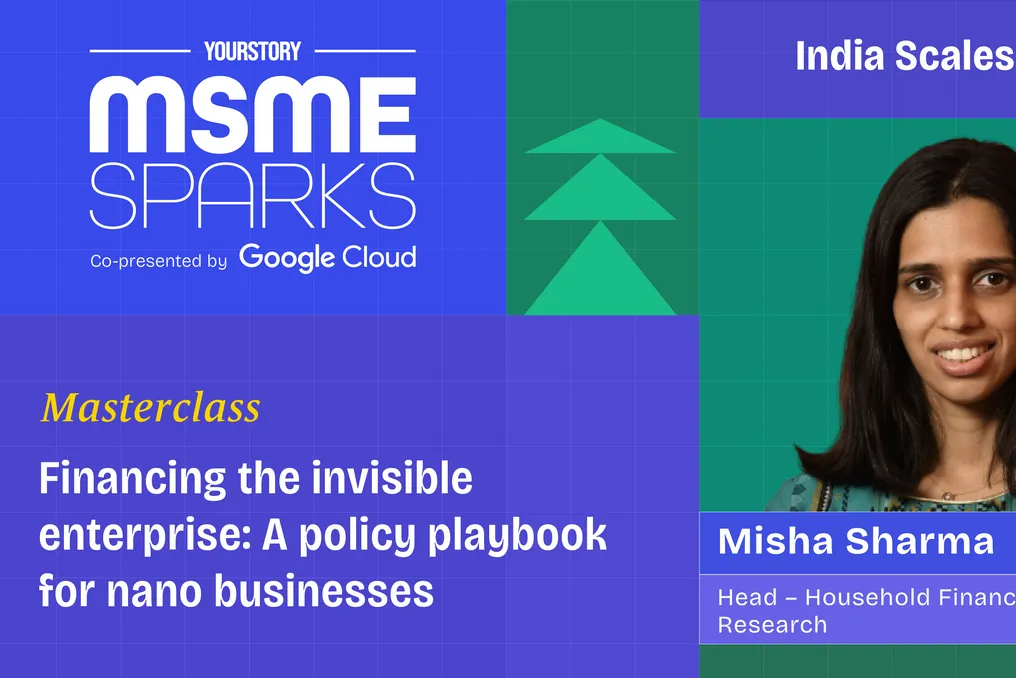
At the MSME Sparks 2026 event, during a masterclass titled 'Financing the Invisible Enterprise: A Policy Plan for Nano-Business,' Misha Sharma, Head of Family Finance at Dvara Research, presented an analysis of why this segment struggles to access official credit, while also proposing solutions for policymakers, lenders, and ecosystem participants.
Definition and Characteristics of Nano-Business
Currently, there is no official definition of a nano-enterprise; the classification of MSMEs under the MSMED Act begins at the 'micro' level, which has a turnover ceiling of up to 10 crore rupees. Dvara Research defines nano-enterprises as those whose annual turnover does not exceed 1 crore rupees. According to ASUSE data for 2023–24, there are approximately 7.3 crore such enterprises in India.
According to Sharma, 'about 88% of them are Owner-Managed Enterprises (OAEs), which typically operate with unpaid family labor, while the rest are Household Worker Enterprises (HWEs), which regularly hire at least one employee.' She emphasized that this distinction is important because it reflects the level of ambition: 'An enterprise with at least one hired employee is much more likely to have growth aspirations beyond mere survival.'
Most firms in both groups are very small: according to Dvara Research, 98% of OAEs and 72% of HWEs have an annual turnover below 25 lakh rupees.
Market Size and Credit Challenges
Determining the exact size of this market and the demand for formal credit is difficult due to the dispersed and informal nature of nano-enterprises. Nevertheless, Dvara Research estimates that nano-enterprises collectively may require loans ranging from 3.9 lakh crore to 16 lakh crore rupees—a gap that lenders cannot ignore.
Only enterprises with hired workers are estimated at 2.4–6.7 lakh crore rupees. Sharma noted that this segment should be prioritized by lenders, as it demonstrates greater growth potential: 'This is the category we refer to when talking about lack of access to finance.'
For a lender, the decision to grant a loan to a nano-enterprise depends on two questions: whether the business is viable enough to repay the debt, and whether there is sufficient information in the form of collateral, digital footprint, or formal accounting to assess it. Sharma divided nano-enterprises into three main groups based on these two factors.
The first group possesses neither: weak business viability and no means to prove creditworthiness. She warned that 'although access to finance is a problem for the nano-enterprise segment, not all nano-enterprises should receive formal credit, because there is a segment that simply lacks solvency.'
The second group already has reasonable access to formal credit, such as borrowers from microfinance institutions who have transitioned from group to individual loans over time. The third group is the one policymakers should focus on: these are enterprises that are genuinely capable of repaying the loan but remain excluded because lenders lack a reliable way to verify this due to a lack of accounting, collateral, digital footprint, and formal records.
'It is in this group that better data representation and smarter underwriting could open up credit access for businesses that can pay but lack formal proof of creditworthiness,' stated Sharma.
Three Directions for Government Policy
Misha Sharma proposed three measures to integrate nano-business into the formal credit system. Firstly, she insisted on the need for a clear regulatory definition for the nano-enterprise category, separate from micro-enterprises. Without such clarity, in her opinion, it is impossible even to measure, let alone monitor, loans intended for this segment, because 'what gets measured gets done.'
Secondly, she called for product innovation, urging lenders to move away from standardized, collateral-tied loans towards cash flow-based underwriting and flexible risk-sharing models, where the Reserve Bank of India could play a supportive role.
Finally, Sharma advocated for selective formalization. Instead of forcing all small firms into heavy compliance, she recommended practical short-term tools, such as Udyam registration and wider adoption of UPI, especially since, in her words, less than 5% of nano-enterprises currently use any digital financial services.
Blended finance, combining philanthropic capital with commercial financing through instruments like loan guarantees and concessional debt, is another way to attract commercial lenders to this sector on a larger scale, rather than just in pilot projects.
The main takeaway from the session was simple: there is no one-size-fits-all solution for nano-enterprises. Some small, home-based businesses genuinely do not want or do not need credit, and imposing formal credit on every nano-enterprise is not the goal. The real task of policy is to differentiate between these two groups and develop credit solutions only for those enterprises that want and can utilize credit for growth, instead of treating all nano-firms the same.