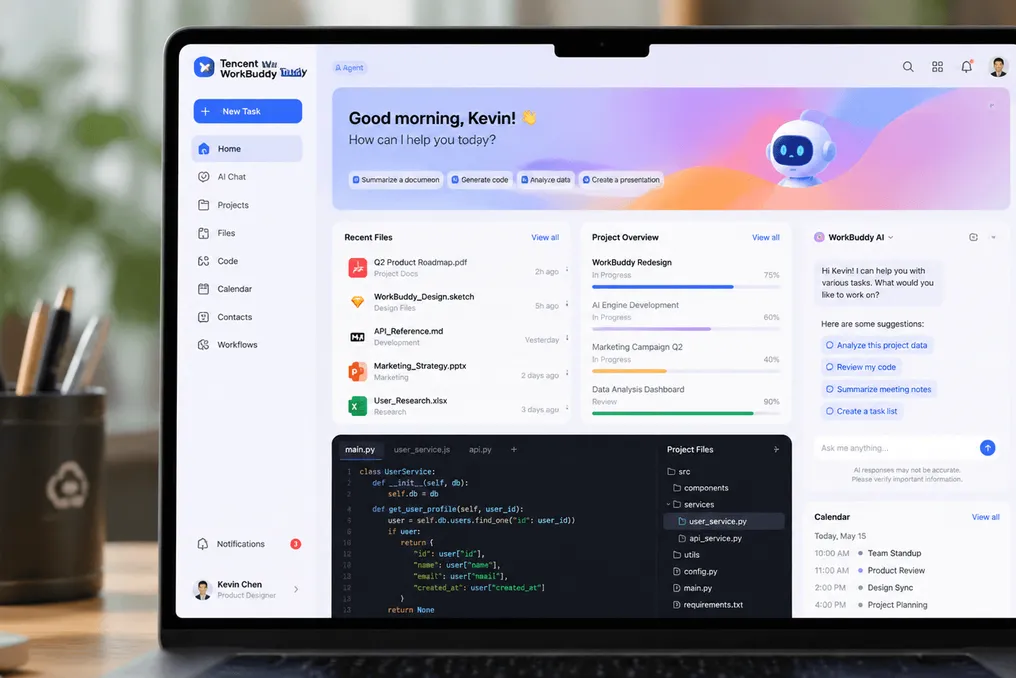
Tencent has released WorkBuddy, a local artificial intelligence agent developed on the CodeBuddy platform and utilizing the Hunyuan Hy3 model. This tool integrates with WeChat to manage files, automate processes, and execute tasks.
Tencent has released WorkBuddy, a local artificial intelligence agent developed on the CodeBuddy platform and utilizing the Hunyuan Hy3 model. This tool integrates with WeChat to manage files, automate processes, and execute tasks.
WorkBuddy represents a significant step toward making AI-based automation accessible to non-technical users in China. By leveraging the foundational Hunyuan Hy3 model, the agent combines AI task decomposition with the ability to access the local file system and invoke tools.
Unlike cloud assistants, WorkBuddy operates directly on the user's machine and features clear privacy control settings. Users define their own workspaces, isolating specific folders for AI access, and all file operations require user confirmation before execution.
The agent is capable of reading, editing, organizing, and transforming files in various formats, including text documents, images, and spreadsheets. This makes it particularly useful for researchers, content creators, and knowledge workers who process large volumes of digital material.
Key functions include intelligent file organization, which recognizes content patterns, extracts dates and categories from filenames, and structures chaotic folders into logical hierarchies. Content workers can automate news gathering by instructing WorkBuddy to read from multiple sources, remove duplicates, filter by date and relevance, and then generate structured drafts with source citations and fact-checking notes.
Another strong feature is meeting transcript processing: the agent can remove filler words, identify information gaps, and create structured to-do lists. The most distinctive feature is the integration with WeChat. Users can send commands directly from WeChat to the work computer, instructing WorkBuddy to find files, perform tasks, or forward documents via the Agent Mail service.
The WeChat ClawBot interface allows users to use natural language commands to search for files, as the agent navigates complex folder structures to locate the required documents. Furthermore, WorkBuddy supports Skill creation, enabling users without programming skills to package repetitive workflows into reusable tools. For instance, the demonstration skill 'Essay Grading Assistant' accounted for Gaokao grading criteria, created an HTML grading interface, and processed student essays, providing structured feedback including scores, strengths, improvement strategies, and paraphrasing examples.
Another example is the 'Interview Highlight Extraction' skill, which analyzes long transcripts to identify key insights, quoted moments, and areas for further research. The results of these skills are provided as standalone HTML pages that can be shared without using WorkBuddy. This creates a distribution model where experienced users can package their expertise into ready-made tools for less technically proficient colleagues. The skill marketplace model potentially could transform WorkBuddy from a personal productivity tool into a platform where subject matter expertise is packaged into executable AI workflows.
OpenAI has introduced a new AI agent called ChatGPT Work, designed to give office workers access to coding tool capabilities without significant financial cost. This agent combines OpenAI's popular chatbot with the company's Codex coding tool.
According to the company's statement, ChatGPT Work allows users to create documents, presentations, and websites. The service runs on OpenAI's most advanced model—GPT-5.6, which was also unveiled on Thursday. The launch of this model was postponed last month at the request of the US government due to national security concerns.
ChatGPT Work is a direct response to Anthropic's Claude Cowork, which launched in January and can independently plan and execute multi-step tasks. This release reflects the intensifying competition between tech companies in creating and selling AI tools for professional use. Both companies, Anthropic and OpenAI, are preparing for a potential public offering soon and are vying for corporate business, which generates more revenue than retail sales.
Both ChatGPT Work and Claude Cowork are designed for non-programmer users who wish to utilize the capabilities of coding AI tools, which often surpass standard chatbots but require specialized knowledge. OpenAI representatives emphasized that their new offerings will be more accessible and cheaper compared to competitors' products. The company released three different sizes of its 5.6 model.
Ty Gerry, Product Manager for ChatGPT Work, stated in an interview that the model can be applied to solve problems in any industry. He characterized the 5.6 model as 'competitive against models that are much more expensive, twice as fast, and much cheaper.' The announcement on Thursday also highlighted growing corporate concern over the high cost of using such AI tools. Max Weinbach, an analyst at the consulting firm Creative Strategies, noted that the smallest version of OpenAI's new model can perform tasks almost as well as the largest, but at one-fifth of the cost. He added that this was the first time he had seen small models perform such tasks.
Prior to this launch, OpenAI's agent offerings included Operator and deep research, which were later merged into ChatGPT Agent for individual users, as well as Workspace Agents for automating workflows in the corporate sector. ChatGPT Work will go live on Thursday on the web platform and mobile app, initially for Pro, Enterprise, and Edu users, before expanding to Plus and Business users in the coming days. OpenAI also announced a new ChatGPT desktop application and a website hosting feature, allowing users to create and share sites directly through ChatGPT Work.
Major Chinese internet platforms have begun shutting down their consumer applications based on artificial intelligence chatbots, signaling a strategic shift: moving from independent chatbots to integrating AI features into existing products.
In recent months, ByteDance, Tencent, and Alibaba have discontinued or scaled back consumer chatbots, abandoning a market segment that attracted hundreds of millions of users just two years ago. These moves are part of a broader industry correction.
Each company's approach differs. Some are redirecting AI capabilities into core platform products, such as content feeds and messengers, while others are pausing operations to reassess product-market fit before relaunching with updated positioning.
Experts note that the initial hype surrounding chatbots has given way to a more deliberate integration phase. Companies that invested heavily in standalone chatbots are now questioning whether embedding AI capabilities directly into existing platforms with hundreds of millions of daily active users is more beneficial.
The competitive environment is also transforming. Open-source model providers and specialized AI startups are offering chatbot infrastructure at commodity prices, reducing the strategic value of owning a chatbot as a standalone consumer product. Simultaneously, the adoption of AI in the corporate sector is accelerating, directing investment funds toward B2B AI solutions rather than experimental consumer projects.
Likely to survive are those platforms that can find the clearest synergy between their AI functions and their core business models—be it social networks, content recommendation systems, e-commerce, or workplace productivity tools.
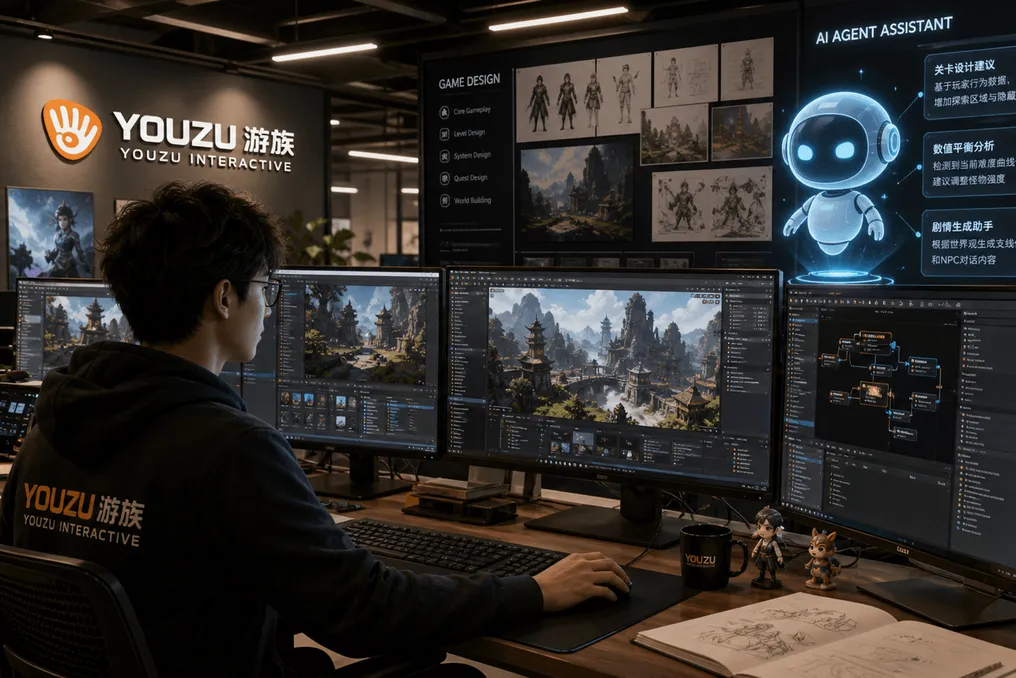
Youzu Interactive has integrated artificial intelligence agents into 75% of its staff using Tencent Cloud WorkBuddy. This integration allows the game development process to be transformed, from coding to global marketing analysis.
Youzu Interactive, one of China's pioneering foreign publishing companies that has shown international revenue exceeding domestic revenue for the past 11 years, has reached an AI agent penetration level of over 75% of its employees. CTO Wang Junzheng describes this transformation as providing each employee with their own AI agent, while the company covers all computational costs and provides unlimited access to 47 different models.
The company's journey in AI began in 2023 with the use of Stable Diffusion for image generation, and in 2024 with GitHub Copilot for coding assistance. A turning point came in August 2025 when OpenAI demonstrated an agent capable of creating a million-line product from scratch. By early 2026, agent-based tools, including Tencent Cloud WorkBuddy, were implemented across the entire company.
Currently, AI agents operate within three key business scenarios. The first is industry analytics: agents automatically collect information from multiple sources, perform sentiment analysis using large language models, and provide structured results. Youzu developed a bot with instant broadcasting functionality that delivers important industry updates to employees daily, supplemented by a portal for collecting community information.
The second scenario relates to advertising material production. Since advertising materials are the main channel for attracting users for a global gaming company, the previous creative creation process was linear and sequential: trend identification, scriptwriting, storyboarding, modeling, post-production, and editing. A delay at any stage affected the entire cycle. Now, AI covers most of this chain, significantly reducing the time from concept to first draft. However, the final decision on compliance with regional specifics, game genre, and target audience still requires human expertise.
The third scenario is operational data analysis. Although long-running games generate continuous streams of data, obtaining user metrics traditionally required waiting for report templates or coordinating time with analysts. Youzu implemented ChatBI, which allows business teams to ask questions in natural language. Recently, the company packaged the data platform capabilities into tools that business teams can install and run directly within their agents, enabling self-service in data analysis without engineering intervention.
Youzu has completed the transformation of four internal systems using AI, with another seven or eight in progress. The company also uses the WorkBuddy expert group feature, which brings together specialists from different fields into collaborative teams. Wang tested an expert group for content creation that was able to prepare a complete video based on a text prompt in just 20 minutes. According to Youzu's 2025 financial report, revenue from overseas markets grew by 8.06% year-over-year, and the company attributes part of this growth to the integration of AI technologies, which increased gross margin by 2.46 percentage points.