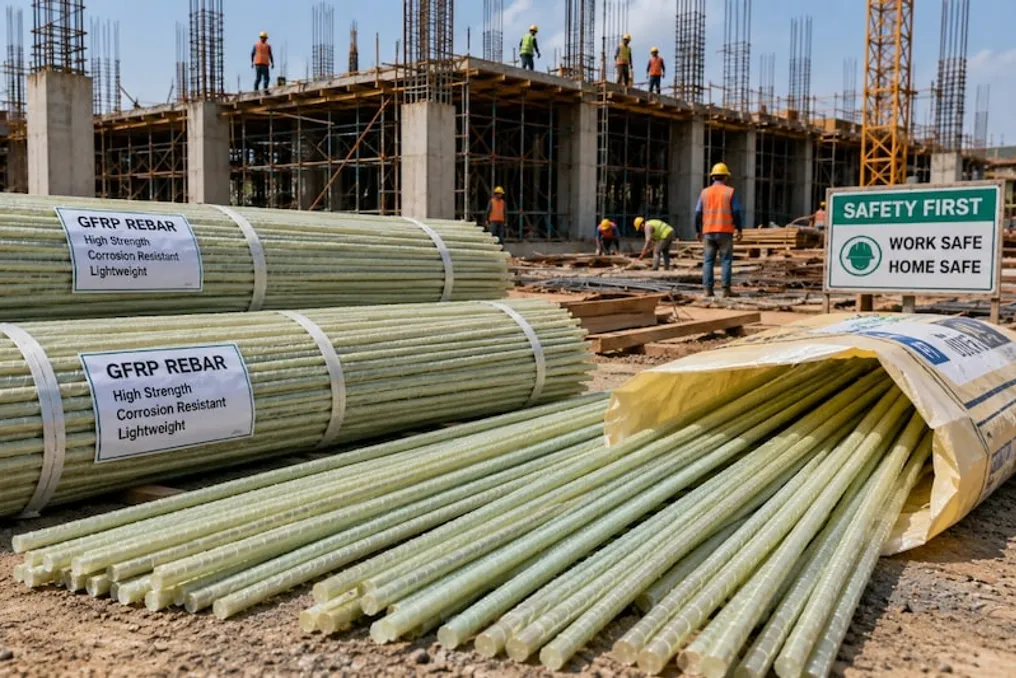
An alternative to steel reinforcement has emerged in the modern construction industry. Fiber-reinforced, or plastic rebar, is actively used in many places. The question arises whether plastic rebar can be stronger than steel, how economical it is, and what the price difference is.
What is GFRP Rebar?
Plastic rebar is known as GFRP rebar, which stands for Glass Fiber Reinforced Polymer. Simply put, plastic rebar is made from a strong mixture of glass fibers and resin. Due to its strong adhesion and strength, its use in construction is rapidly growing.
Advantages Over Steel
Compared to TMT steel rebar, plastic rebar has several advantages. Firstly, it is not susceptible to corrosion. Secondly, it is significantly lighter, which simplifies transportation and application. It is believed that its strength is twice that of steel. Furthermore, it is more durable than iron and can retain its properties for 80–100 years even when in contact with moisture.
Limitations and Applications
Another advantage is the lack of risk of electric shock. However, plastic rebar has a drawback: it is not flexible. Therefore, its application is limited to vertical structures. GFRP rebar is used in the construction of bridges, drainage systems, barriers, and other objects.
Cost and Weight Question
When comparing prices, plastic rebar is more expensive than steel both by tonnage and by piece. Nevertheless, due to its lower mass, a larger quantity of plastic rebar is required to achieve the same structure. If we consider the price per kilogram, plastic rebar will cost more, but by weight, it turns out to be more economical. For example, if TMT steel costs 40 thousand rupees per ton, GFRP rebar will cost 100 thousand rupees per ton, but the volume of plastic rebar in one ton may be twice as much or slightly more than that of steel rebar.