The successful demonstration of capabilities of a state-owned reusable rocket by CASC raises existential questions for private rocket companies regarding their role in the industry, especially against the backdrop of the CZ-10B's achievement.
The successful demonstration of capabilities of a state-owned reusable rocket by CASC raises existential questions for private rocket companies regarding their role in the industry, especially against the backdrop of the CZ-10B's achievement.
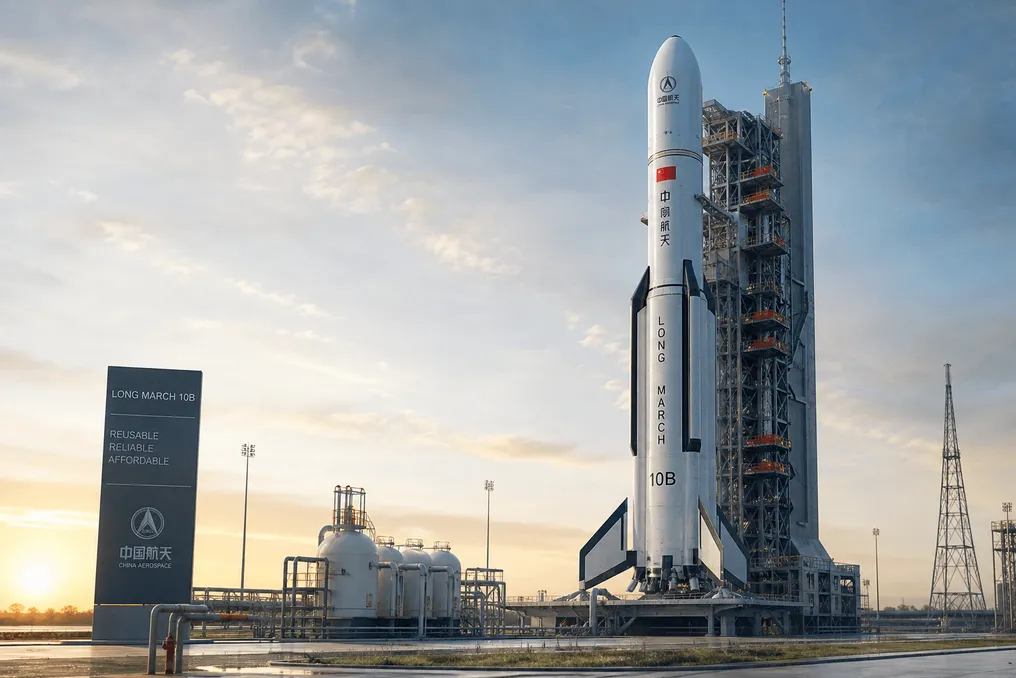
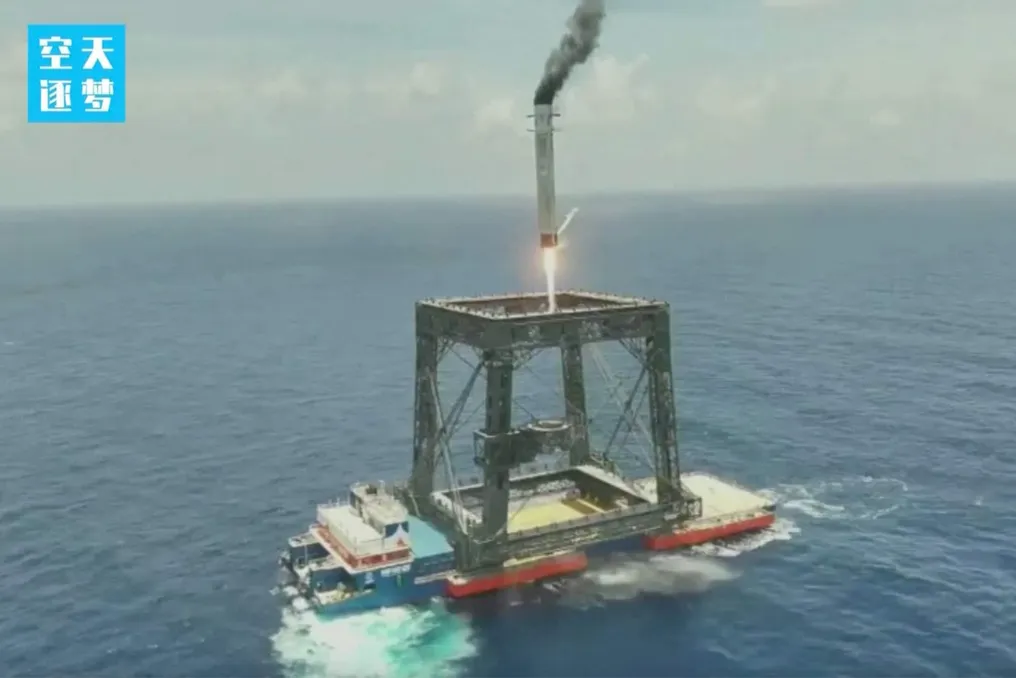
The first flight of CZ-10B, which took place on July 10, was not just a technical success but also marked a profound transformation in China's aerospace industrial structure. The rocket, developed by CASC, demonstrated exceptional maneuverability, successfully passing through a narrow opening in the Navigator recovery vehicle's tower before being caught by a tension cable system.
This success generates an urgent strategic question: since China's state-owned enterprise now possesses a reusable rocket capable of commercial launches, what competitive space remains for dozens of private startups in the country? Private companies face the problem of differentiation. If they merely copy CASC's capabilities, their value proposition will be limited to minor cost reductions or market saturation dominated by CASC.
A more sustainable path lies in developing unique technologies that expand China's overall aerospace capabilities, rather than simply reallocating existing resources and talent. It is critical to distinguish between private companies focused on replication and those engaged in incremental innovation. Potential areas for such innovation include the methane engine, where LandSpace has its own flight experience, the stainless steel construction for rapid reuse, which Space Pioneer is developing, and the 'chopstick' type shore recovery system proposed by JianYuan Technology. These developments complement, rather than duplicate, CASC's capabilities.
Another aspect is the issue of human capital. Most private rocket engineers acquired their skills in CASC or CAS Space institutions. Critics argue this is merely a reallocation of personnel, not the creation of new ones. Proponents counter that private companies offer different career paths and risk tolerance, attracting and retaining specialists who might otherwise leave the aerospace industry. However, the real test is whether private companies can create new engineering competencies, expanding the overall pool of talent and knowledge base.
The example of SpaceX shows a parallel approach: initially, the company did not compete with ULA on the cost of government contracts but demonstrated a fundamentally different method of rocket development and manufacturing, creating new opportunities rather than competing in existing ones. For private rocket companies in China, the conclusion is clear: success depends not on matching the performance of CZ-10B, but on defining and implementing a technological vision that expands the potential of China's aerospace industry.
The successful recovery of the first Long March 10B rocket flight on July 10 marked a turning point for China's commercial space industry. However, the industry faces a significant challenge: demonstrating the capability for rapid, reliable, and cost-effective reuse of recovered boosters.
In contrast to SpaceX Falcon 9, which did not recover on its first flight, and New Glenn, which only managed recovery on its second attempt, the CZ-10B achieved the world's first successful flight followed by recovery on a sea platform located 431 kilometers from Wenchang, at an altitude of 144 meters.
Chinese commercial rocket companies are actively working towards achieving reflight goals. The company LandSpace Zhuque-3 is developing a stainless steel rocket with a liquid-fuel engine running on oxygen and methane, utilizing a landing gear recovery system similar to Falcon 9. After the first attempt in December 2025 ended with an anomaly during final descent, Zhuque-3 Y2 passed static fire tests on June 29. Success in this area will allow China to become the first nation to demonstrate both pure recovery and recovery using landing legs.
Another approach is implemented by JianYuan Technology YX-1, which uses a mechanical manipulator capture method on a sea platform, similar to a 'pole' method. This method combines the fast cycle advantages inherent in Starship tower captures with the safety and flexibility of marine operations. In May 2025, YX-1 successfully demonstrated a controlled water landing, after which the recovered engine underwent four engine-firing tests, confirming the 'flight-descent-recovery-reignition' chain.
The economic viability of each method differs. Pure recovery allows for the elimination of complex sea platforms in favor of lighter rockets without the extra weight of landing gear. The 'pole' capture provides the fastest cycle, potentially taking hours instead of days. Landing legs have been proven, but they reduce payload capacity. All three approaches face the same fundamental problem—proving the possibility of multiple uses.
SpaceX has demonstrated over 600 landings and 602 Falcon 9 reflights. Collectively, all Chinese programs have only one instance of recovery. Industry analysts note that the economics of reuse become favorable after the fifth launch, but achieving ten or more launches requires solving issues related to engine life, thermal protection, structural fatigue, and corrosion from marine operations. The CZ-10B design targets over 10 reflights with a 72-hour cycle time.
Blue Origin's recent experience with New Glenn, where the second-flight booster delivered a payload to the wrong orbit, and the subsequent explosion in the test stand destroyed the sole launch pad, serves as a warning about the gap between engineering demonstration and operational reliability. The market reacted immediately: on the day of the CZ-10B recovery, 25 aerospace stocks reached daily limits on the Shanghai and Shenzhen exchanges, and the China Aerospace ETF rose by 5.74%, with trading volume exceeding the 20-day average by threefold. The technology verification phase for China's reusable rockets is complete; the commercial testing phase has begun.
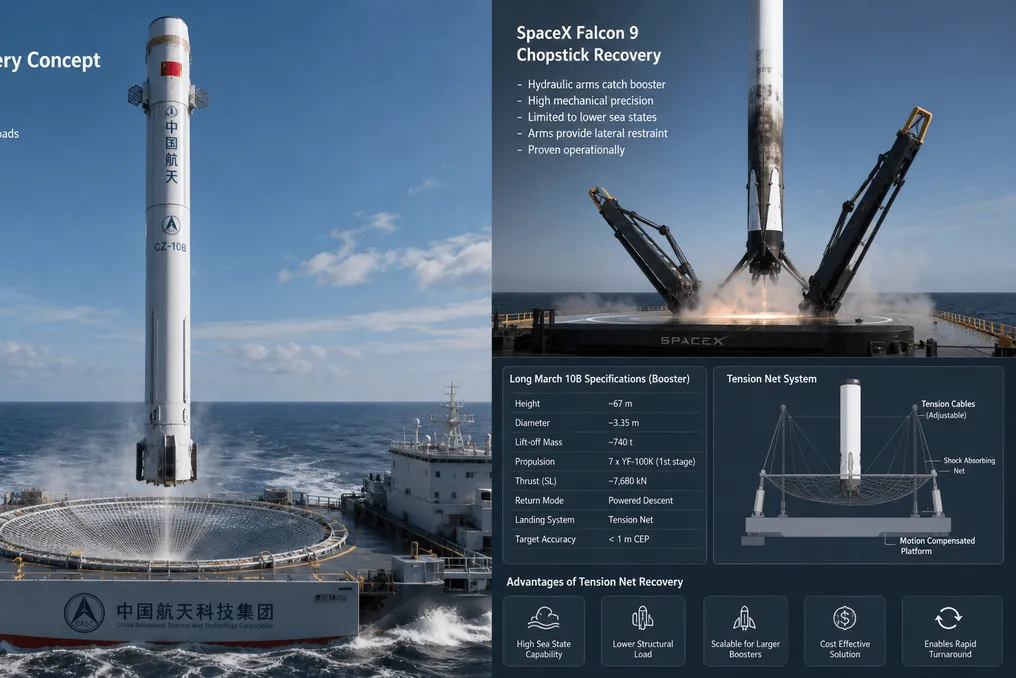
Unlike SpaceX's use of 'stick' levers to catch the Starship, China's Long March 10B rocket recovery system employs a flexible capture method, which provides greater error tolerance and gentler handling of the booster.
The Long March 10B rocket recovery technology represents a fundamentally different engineering approach compared to SpaceX's lever capture. The CZ-10B, which conducted the world's first sea recovery using a net on July 10, utilizes a flexible capture method that industry analysts characterize as a soft landing, in contrast to SpaceX's hard landing.
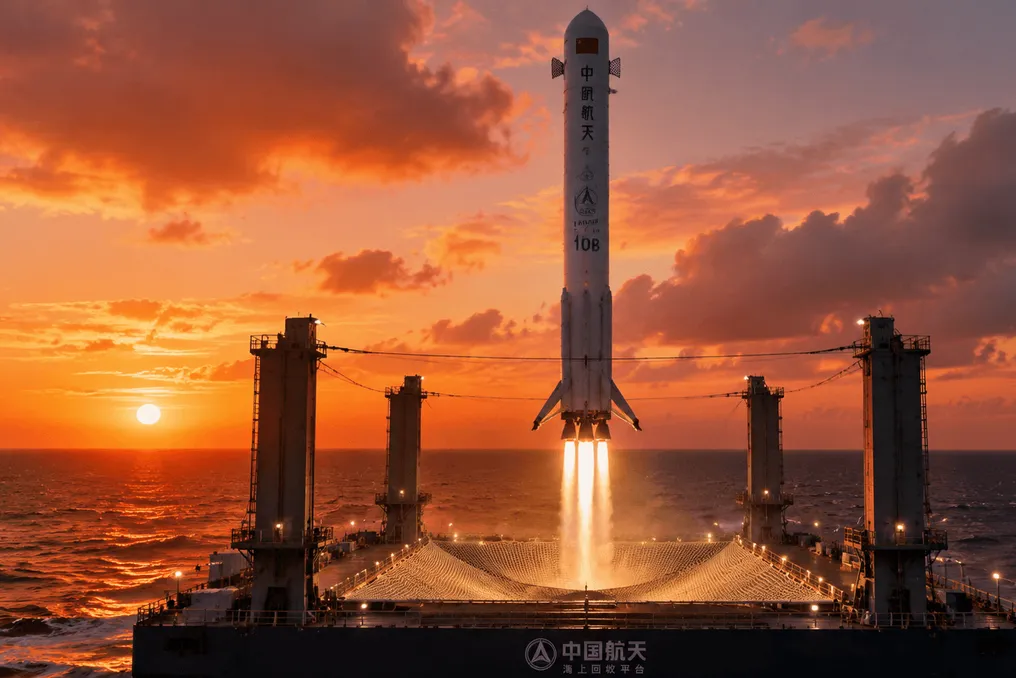
The recovery system deploys a taut net aboard the vessel Navigator, made of high-strength specialized fibers and steel cables arranged in a specific pattern. When the descending booster enters this net, kinetic energy is absorbed through the stretching of the cables, the movement of blocks, and hydraulic dampers. This system can compensate for positional errors during landing up to 10 meters, whereas lever capture requires millimeter precision.
Conversely, SpaceX's Starship recovery system uses rigid mechanical manipulators that envelop the booster. This process requires mounting pins on the rocket to precisely align with receiving slots on the manipulators. This rigid contact approach demands extreme positioning accuracy and creates high localized loads at the pin contact points. The advantage of this method is that the booster can be returned to the launch pad within a few hours for rapid reuse.
China's approach replaces heavy landing legs with light hook mechanisms installed on an intermediate section of the rocket. The absence of excess weight from landing gear allows for a larger safety margin for protecting and reusing the booster. Furthermore, net capture distributes impact forces more evenly across the rocket structure. Although net recovery requires moving from the ship's crane to shore, the gentler capture process potentially allows for more reuse cycles per booster.
The Navigator vessel itself is designed for this task. It has a length of 144 meters and a displacement of 25,000 tons, and its DP2 dynamic positioning system allows it to maintain position within 0.5 meters in waves up to 4 meters high. The net structure includes intelligent damping systems with blocks and hydraulic absorbers that limit impact load to 3G. The 54x54 meter capture zone provides a significant margin for the descending booster.
China is simultaneously developing both the net recovery system and the lever capture. The LandSpace Zhuque-3 rocket follows a landing leg approach similar to Falcon 9, while the development of the CAS Space rocket targets future lever capture. If Zhuque-3 successfully completes its upcoming recovery attempt, China will become the first nation to demonstrate two different reusable rocket technologies, ensuring diversification of risk reduction for the national space program and satellite constellation deployment.
China succeeded in testing an experimental rocket recovery system last Friday (10). The Long March 10B rocket was launched from the commercial space launch center located in Hainan, in the south of the country, at 1:15 AM Brasília time.
About six minutes after the propellant separated from the upper stage, the first stage returned vertically and was successfully recovered on a maritime platform, according to state broadcaster CCTV. With this achievement, the Chinese have reached a capability that is already the domain of American companies, such as SpaceX and Blue Origin: the ability to return the rocket to its starting point.
Beijing's purpose is to destabilize US supremacy in the reusable rocket segment. However, the method employed by China differs from that used by Americans. Unlike autonomously landing on solid ground with extendable legs or on a drone ship, the Long March 10B uses landing hooks that capture a net attached to a maritime platform.
This test represents the first successful recovery of an orbital-class propellant by China, consolidating nearly a decade of research and development in reuse technologies. Mao Ning, spokesperson for the Ministry of Foreign Affairs, described the event as a 'historic day for China's space program.' This technical advance preserves the most valuable part of the rocket—the engine-containing propellant—which results in a drastic reduction in orbital operational costs.
For comparison, SpaceX launches the Falcon 9 approximately 150 times annually, reusing its propellants dozens of times. The Long March 10B, capable of carrying a minimum of 16 metric tons of payload to low Earth orbit, was designed for the commercial market by the Chinese Academy of Launch Vehicle Technology, the country's main state rocket agency. This reuse technology is expected to decrease expenses for launching Chinese commercial satellite constellations.
China's goals are even broader: the Long March 10 line is being planned to conduct crewed missions to the Moon before 2030. In this context, the experimental model will serve to collect vital data and validate the necessary technologies for the lunar program. CCTV also reported that the country intends to reuse this same propulsion stage in another launch by the end of 2026.