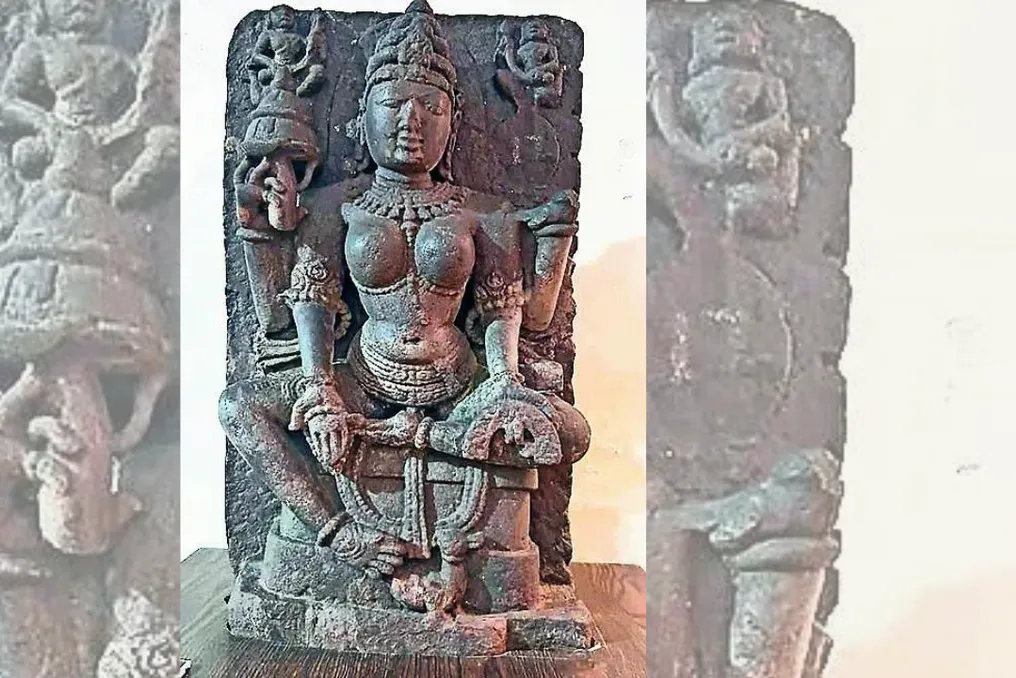
A twelfth-century sculpture from Dhara, located in the southwestern part of Madhya Pradesh, was long revered by scholars as Saraswati. However, digital analysis and the discovery of a missing fan revealed that this image belongs to the goddess Gayatri, who embodies the Gayatri Mantra and Vedic wisdom, making it one of the rarest known depictions of this deity in India.
Decoding Iconographic Features
New digital documentation and high-precision three-dimensional mapping of the reddish-sandstone sculpture at the State Museum Bhopal helped archaeologists decipher iconographic details that had gone unnoticed for centuries. The result was not merely a correction of the museum label, but the recovery of a forgotten chapter of sacred Indian art.
Features Indicating Gayatri
Archaeologist Ramesh Yadav, associated with archaeology, archives, and museums management, noted that 'the image corresponds to classical descriptions of Gayatri in Shilpashastras.' He explained that the four-armed goddess is depicted in the Lalitasana pose, holding prayer beads, a lotus, and the Vedas. A finely carved gamsa (swan) next to her symbolizes sacred wisdom, and the celestial garlands worn confirm her divinity. These attributes unequivocally point to Gayatri, not Saraswati.
Key Difference from Saraswati
Historian and archaeologist BK Lokhande emphasized that the decisive factor was the absence of a fan on this sculpture. He reported that since the Gupta period (320–550 CE), Saraswati has almost always been depicted with a fan. Instead, this image displays the Vedas and a lotus, which fully aligns with descriptions in the Shrimad Devi Bhagavata Purana and Shilpashastras. Although Gayatri, Savitri, and Saraswati all embody knowledge, the iconography leaves no doubt that we are looking at Gayatri.
Historical Context and Legacy
The sculpture was found in Dhara, the capital of the Parmar dynasty (9th–14th centuries). It combines a distinct influence of the Western Chalukyas in its graceful modeling and ornamentation while accurately reflecting the classical descriptions of Gayatri. The Rigveda preserves the Gayatri Mantra, the Satapatha Brahmana glorifies Gayatri as the source of sacred knowledge, and later Puranas revere her as Vedamata, Mantramata, Brahmanvidya, and Jaganamata.
State's Digital Heritage
The discovered icon becomes a model for the Madhya Pradesh digital heritage mission. Commissioner of Archaeology Madan Kumar Nagargodge stated that authentic three-dimensional models and digital platforms will allow people to study one of the rarest images of Gayatri in India.