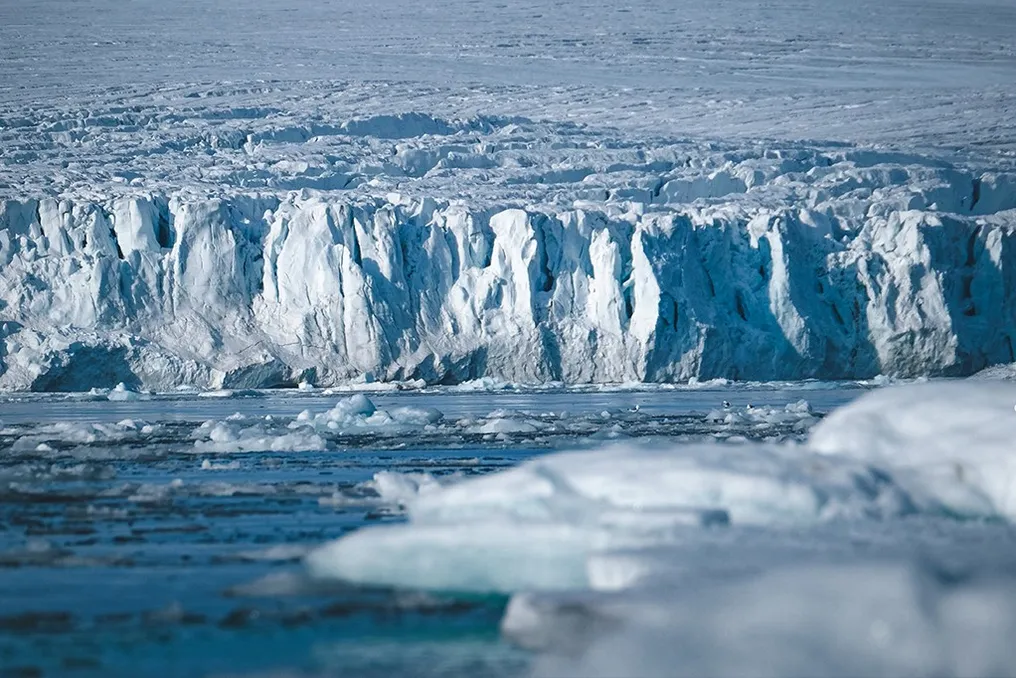
A new scientific investigation offers explanations for two enigmas related to the formation of the vast ice sheet of Antarctica, demonstrating how and why this ice established itself long before the Arctic froze.
The Antarctic Ice Sheet
East Antarctica holds the planet's largest ice reservoir, containing enough water to raise global sea levels by 52 meters if it were to completely melt. Scientists have questioned the origin of this ice sheet for decades. The problem lies in two interconnected mysteries: first, Antarctica was covered in ice about 34 million years ago, during the transition from the Eocene to the Oligocene, while the Arctic remained largely ice-free for approximately another 25 million years.
Although the drastic drop in atmospheric carbon dioxide levels was a crucial factor in cooling, if this were the only reason, both poles would have cooled simultaneously, which did not happen. This suggests the existence of a distinct initial factor that drove the Antarctic freezing.
Unexpected Ocean Temperatures
Additionally, it was observed that sea surface temperatures in the Southern Ocean remained surprisingly high for about 10 million years after the eastern ice formed. This scenario would be unlikely if the ice sheet had formed solely in reaction to global cooling, as the surrounding oceans should also have cooled significantly.
The new study, conducted in collaboration with researchers from the United Kingdom and Germany and published in the journal Science, points to a hidden cause deep within the ice: the mountains of Antarctica and the slow geological forces responsible for its formation.
Continental Movement and Mantle Waves
This geological narrative dates back about 170 million years, when Antarctica and Africa were part of the supercontinent Gondwana. The subsequent separation positioned Antarctica toward the South Pole, and this great rupture initiated a sequence of subterranean events.
As they separated, hot material from the Earth's mantle rises, cools, and then sinks. This rotational movement destabilizes the base of the neighboring continent, causing instabilities analogous to a lava lamp removing pieces of its deep roots, one by one. These disturbances, called 'mantle waves,' travel through the region beneath the continents over millions of years, traveling more than 1,000 kilometers through the hot, viscous rock beneath the continental mass.
The research team identified this phenomenon in previous work in the journal Nature, gathering independent evidence suggesting that mantle waves could cause volcanic eruptions that expelled diamonds—violent explosions launching magma from more than 150 kilometers below the surface. They also discovered that such waves could generate inexplicable peaks of land elevation distant from fault zones (rifts).
Land Uplift and Ice Formation
Using computational models that simulate landscape evolution over tens of millions of years, it was possible to map the impact of these waves on East Antarctica. Near the coast, the separation generated an imposing cliff-like structure known as a scarp, over two kilometers high. Hundreds of kilometers inland, the mantle wave displaced deep rocks. Similar to a hot air balloon losing its ballast, the ground above gradually rose, forming an extensive plateau and initiating a wave of erosion across the landscape.
This uplift continued inland, taking about 100 million years to reach the Gamburtsev Mountains, located more than 1,500 km from the coast. This mountain range is currently covered by more than 3 km of ice. Altitude is vital for ice, as air temperature decreases by approximately 1°C for every 100 meters gained in altitude. Thus, a small increase in elevation can transform a mountain range that loses snow in the summer into one that retains it year-round.
Until about 50 million years ago, most of the Gamburtsev Mountains were below 1.5 km, an altitude insufficient to sustain significant snow in the summer. However, the models show that starting from this period, the uplift wave reached this mountainous area, raising much of the range to over 2 km. At this height, snow and ice could persist and begin to accumulate. Calculations indicate that around 45 million years ago, a portion of the East Antarctic landscape had exceeded this limit, allowing the establishment and expansion of mountain glaciers.
Climate Feedback Cycles
Another analysis suggests that the ice sheet began to form exactly during this period. During the continental glaciation, global temperatures had dropped from a peak of about 30°C, which occurred 50 million years ago, to something close to 20°C. Once glaciers established themselves in the mountainous areas, two feedback mechanisms came into play. Firstly, ice and snow reflect much more solar radiation than exposed rock; therefore, as the ice sheet grew, it further cooled the surrounding region, reducing global temperatures by about 1°C, according to the modeling.
Secondly, the air over Antarctica, upon cooling, retained less water vapor, a potent greenhouse gas. Drier air resulted in a weaker insulating layer over the region, allowing temperatures to drop even further. Together, these feedback cycles enabled the ice layer to expand from its mountainous refuges to the coast, merging into the single sheet observed today.
Geological and Future Implications
Global cooling of approximately 1°C alone was not sufficient to freeze the Arctic, as the continental masses of the Northern Hemisphere lacked the adequate altitude to surpass this threshold. About 25 million additional years, along with much lower levels of CO2 and global temperatures, would be required for large areas of ice to form there as well. The temperature change caused by the ice was also not enough to cause sharp drops in the temperatures of polar oceans near Antarctica, thus resolving the two initial mysteries.
The work demonstrates how geology sets the stage for ice ages, as terrain altitude determines whether the climate is cold enough for ice formation. This concept is relevant to other past climatic events on Earth. Understanding the growth of ancient ice sheets can provide clues about the future, although it is noteworthy that when ice sheets melt, they disappear much faster than it took them to form and cannot easily regenerate.