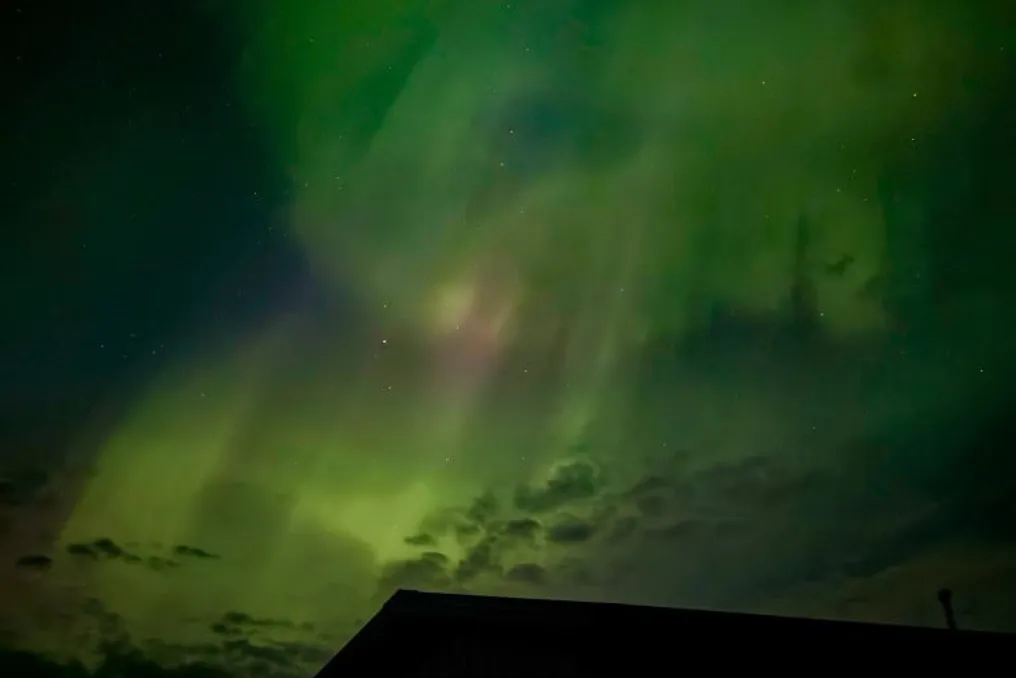
Due to solar storms recorded at the beginning of the month, there was great expectation for the formation of auroras in the northern hemisphere. The Brazilian Alexis Rottini, residing in Stephen, Minnesota, United States, captured impressive images of this phenomenon and shared them with Olhar Digital.
Event Details
Rottini reported that he was unaware of the solar storm, but learned about the possibility through an application that monitors and alerts users about aurora formation. In addition to the photos shared, two other images from the 4th were also shared.
Mechanism of Aurora Formation
Auroras, which are an optical phenomenon seen at extreme latitudes, can be observed with the naked eye in the night sky. Although they typically display greenish hues, they can also exhibit colors such as red, blue, violet, and pink. The Sun has 11-year activity cycles, and it is currently in Solar Cycle 25, which has been closely studied by scientists.
Solar Ejection Process
At the peak of solar cycles, the Sun's surface presents spots that indicate energy concentrations. When magnetic lines intertwine in these spots, they can cause a rupture, generating wind bursts. These bursts constitute massive solar flares that launch charged particles, such as protons and electrons, out of the star in plasma jets, known as coronal mass ejection (CME).
Classification and Interaction with Earth
The flashes are categorized by an alphabetical system of the U.S. National Oceanic and Atmospheric Administration (NOAA) — A, B, C, M, and X — depending on the intensity of the emitted X-rays, with each level being ten times more intense than the previous one. If the jet is directed towards Earth, the planetary magnetosphere deflects most of these particles. However, some manage to pass through the atmosphere following the magnetic lines, particularly in the polar areas, where they interact with present molecules, resulting in the production of auroras.