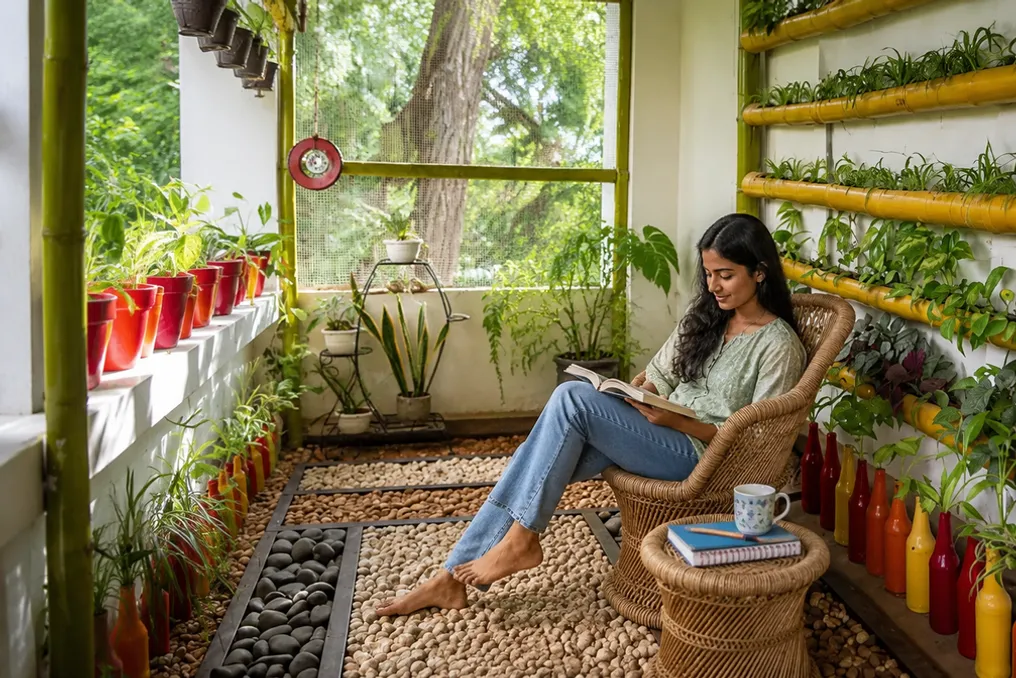
A special green space is located on the first floor of the Faculty of Botany at the Kerala University campus in Kariyavattom. Bright sunlight filters here, lush greenery grows in earthen pots, a small waterfall murmurs in the background, wind chimes tinkle, and the floor is paved with pebbles. This place, named Viridescent Haven, serves as a quiet zone for visitors to rest and recover, equipped with chairs and armchairs for students.
Research and Project Goals
This corner was created by Reshma PR, a fourth-year postgraduate student, whose dissertation is dedicated to air-purifying plants indoors, under the working title 'Testing the Effectiveness of Plants in Removing Common Indoor Pollutants.' Reshma focuses primarily on formaldehyde as an indoor pollutant. She discovered that certain air-purifying plants can eliminate formaldehyde compounds found in paints, detergents, and other materials. Reshma notes that people spend most of their time in enclosed spaces, whether at home, in offices, or in vehicles. These plants absorb formaldehyde and increase oxygen levels, thereby purifying the atmosphere.
Scientific Guidance and Plant Selection
The creation of this indoor garden was carried out under the guidance of Dr. Bindu R Nair, a professor in the Department of Botany. Dr. Nair's interests include biosystematics, taxonomy based on the study of genetic evolution of plants and animals, phytochemistry—the branch of chemistry studying plant products—and molecular biology. The vertical garden includes several local air-purifying species such as Sansevieria, spider lily, Hemigraphis, Drosera, and happy bamboo. They were selected for their purifying properties, based on NASA research cited by Reshma. Furthermore, the space complies with the university's 'green protocol,' meaning the pots and other elements used are biodegradable and eco-friendly.
Therapeutic Effect of Nature
Reshma emphasizes that the main value of this garden lies in the ability of plants and other natural elements to reduce indoor air pollutants. Studies show that the brain uses 20 percent of the body's oxygen for functioning, and cleaner air promotes mental clarity, improves concentration, and focus. Reshma describes this 50-square-foot area, funded by the university, as an indoor therapeutic garden. Dr. Bindu believes that therapeutic gardens are a popular concept in foreign countries, and when combined with medication, they help patients recover faster. They contribute to both mental and physical healing and are especially beneficial for patients after long hospital stays. Therapeutic gardens allow patients to experience temporary relief from symptoms and provide a general sense of well-being and hope.
Concept and Health Benefits
Dr. Bindu explains that therapeutic gardens are usually created abroad, especially in hospitals, and there are many varieties, such as psychiatric hospital and nursing home gardens. Therefore, they decided to adapt this concept for a home garden to enjoy the healing power of plants. Viridescent Haven is positioned as a 'collection of healing elements of nature.' Every aspect of the space is designed for relaxation and spiritual restoration, offering mental healing. Mental recovery helps reduce anxiety and stress, improve mood, promotes clearer thinking, boosts self-esteem, enhances relationships, and reduces the risk of depression. It also positively affects physical condition, sharpens memory, increases energy levels, and improves Brain-Derived Neurotrophic Factor (BDNF), which enhances neurotransmission.
Relaxation Practices in the Garden
Visitors are advised to leave their mobile phones and consciously relax in this space for at least half an hour. In addition to enjoying the pleasant aroma and visual appeal of the plants, the sound of the wind chimes has a calming effect. A small indoor waterfall also aligns with this idea. Reshma refers to the 'blue mind' theory, according to which listening to trickling water can reduce stress, lower cortisol levels, and improve sleep, as described in Wallace J. Nichols' book 'Blue Mind' in 2014. Visitors are also required to remove their shoes and walk barefoot on the pebble-covered garden. Reshma explains that this aims to achieve an acupressure effect from the earth, which is beneficial for the nervous system. This method is called Grounding or Earthing, which implies direct contact of the skin with the earth's surface. Connection with the earth's electrons causes physiological changes such as improved sleep, reduced pain and stress, decreased blood viscosity, and normalization of the daily cortisol rhythm. Dr. Bindu notes that people coming to the library are often overloaded, and here they can find peace.
Conclusion and Prospects
There are numerous benefits to such an indoor therapeutic garden, but the most important is its ability to reduce stress, which is critically important in today's fast-changing world. Dr. Bindu concludes that the garden offers both physical and mental healing, possesses restorative powers, and serves as a positive distraction. Spending time in nature also stimulates creativity and provides renewal for the mind and body. Reshma reminds us that humanity has always depended on nature—from clean air to fresh water to satisfy all needs. With her model, she hopes to popularize the concept of indoor therapeutic gardens as an alternative to general urban areas, so that people can benefit from nature rather than focusing solely on aesthetic beauty.