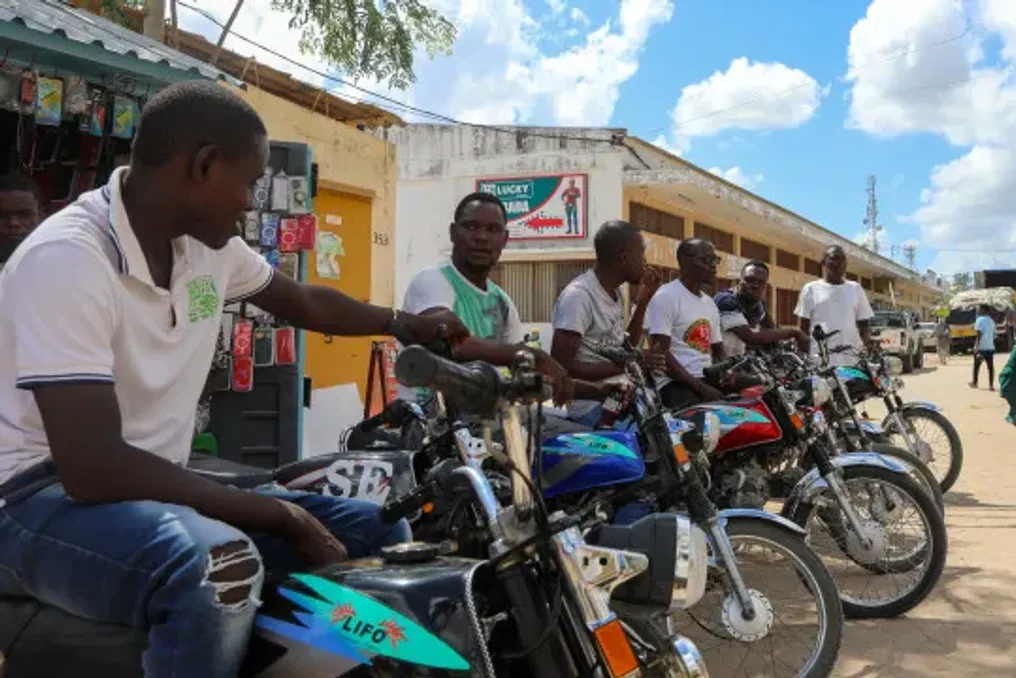
Early in the morning, around 05:00, as motorcycles begin circulating through Beira's main avenues, women take up spots at stops in areas such as Matakuane, Makurungo, and Nangau. They combine transporting passengers and goods with the responsibility of supporting their families.
Success Stories of Female Drivers
Augusta Munjela, 48, is one example, having become a notable figure in the Matakuane corridor. A former widow and mother of five, she has been driving a moto-taxi for seven years. This activity began after she lost her business at the Goto market.
A turning point was Cyclone Idai in 2019, which destroyed twelve of her stalls. Even earlier, in 2008, she lost her husband. Augusta recalls: 'Everything connected for me. I lost my husband, then I lost my business. I was left with nothing.'
In the absence of other income sources, she decided to take up motorcycle driving. Initially, she only accepted female passengers, believing it would be safer and help her avoid conflicts. However, she realized she was losing money, forcing her to overcome her own prejudices when two men needing a ride appeared.
The Impact of the Pandemic and Education
According to Augusta, the COVID-19 pandemic strengthened her decision, as small business incomes declined, and her children enrolled in higher education. She recounted: 'I didn't have money for education. I took the moto-taxi job very seriously because it was necessary. I valued this activity when I desperately needed funds.'
Currently, she uses the income from the motorcycle to fund her children's studies at Likungo University and Zambezi University, including her daughter who is studying medicine. She states: 'What seemed impossible for a mother without an education, the motorcycle gave me.'
Despite her successes, Augusta admits that the work involves difficulties and risks. She shares: 'Firstly, it requires determination and effort. Moreover, faith is everything. When I leave home, no one knows what will happen.'
Discrimination and Support
Besides the daily challenges of driving, she faces discriminatory remarks, such as, 'A woman doesn't know how to drive.' Nevertheless, she notes that when she arrives first, no one says anything.
She calls on other women wishing to start this venture: 'Let them be very strong and take me as an example. Today I feel like a powerful woman. We are not weak women. We fall, but we get up, without complaining or going from door to door. Have morale, courage, and do not be ashamed, because shame will not get us anywhere. Do your job.'
Other Examples and Economic Autonomy
In Beira, there is also Balbina Silvio, 47, who has combined teaching with a small business supported by motorcycle use for over ten years. She explains: 'You cannot live only on a salary. The cost of living is high, and I have five children to raise, as well as other family members. I thought about doing other things to help at home.'
The motorcycle, acquired by the family, became a working tool for transporting goods and supplying her own business. Balbina states: 'Life is expensive. We didn't have transport at home, only the motorcycle. I started doing this job and I still enjoy it.'
This activity allowed her to gradually expand her business, moving from selling drinks to other commercial initiatives. She shares: 'I am gradually prospering. I don't think I started that way, but I am already reaching a high level.'
The teacher also advocates for women's economic independence: 'I wish all women would think like this. Instead of us searching for losses or looking for other men, we should embrace business to survive.'
Despite the progress made, she hopes to expand her business and asks for help from those willing to support her venture honestly so she can acquire more goods and move forward.
Official and Association Comments
For Jasinta dos Remedios, President of the Beira Municipal Assembly, the increase in women in the moto-transport sector reflects a growing demand for economic opportunities. She states: 'It is an honor for me to see women fighting to overcome the country's socio-economic problems. Taking up this space is a concrete step towards achieving parity.'
The author believes that this activity is both a form of entrepreneurship and a response to unemployment. 'Women do this because there are no jobs in Mozambique. There are women with acceptable academic levels, but since there is no work, this activity functions as entrepreneurship,' she asserts.
However, Jasinta dos Remedios warned about the need to strengthen training and road safety for sector workers. 'It is important that these women are qualified and licensed. They must know the traffic rules, because without that, it is a risk,' she insists.
She also calls for more training events: 'It is necessary for the Municipal Council or legal institutions to train women, as well as men, to avoid many accidents and damage that may occur.'
The President of the Beira Moto-Taxi Association, Jacob Pereira, views the influx of more women into this sector as a positive sign for the sector. 'It is a sign of growth. It encourages other girls, other owners, to do the same and provide for themselves. It helps stimulate economic activity.'
According to the leader, the association collaborates with the National Institute of Road Transport (INATRO) and a driving school to conduct educational and retraining activities. 'The goal is to ensure that everyone knows the traffic rules and defensive driving techniques. An accident is not related to positions. Even I, as president, did not refuse training. I learned things that never occurred to me.'
Jacob Pereira adds that only specialists who complete the training will receive a fitness certificate. 'Anyone without a certificate will be punished for engaging in this activity without the appropriate qualification,' he warns.
Moto-taxi drivers surveyed by Lusa, some of whom fear speaking openly, report shifts that can exceed 12 hours a day, exposure to traffic accidents, robberies, and instances of harassment by some passengers, especially at night.
In a sector that has been associated with men for decades, the growing presence of women at Beira moto-taxi stops demonstrates gradual changes in the labor market, marked by informality, where many find a source of income to support their families and ensure the continuation of their children's education.