June 2026 was marked by an unprecedented surge in the release of embodied artificial intelligence models: 13 new foundational and world models were announced in a single month, which is roughly equivalent to one model every 48 hours.
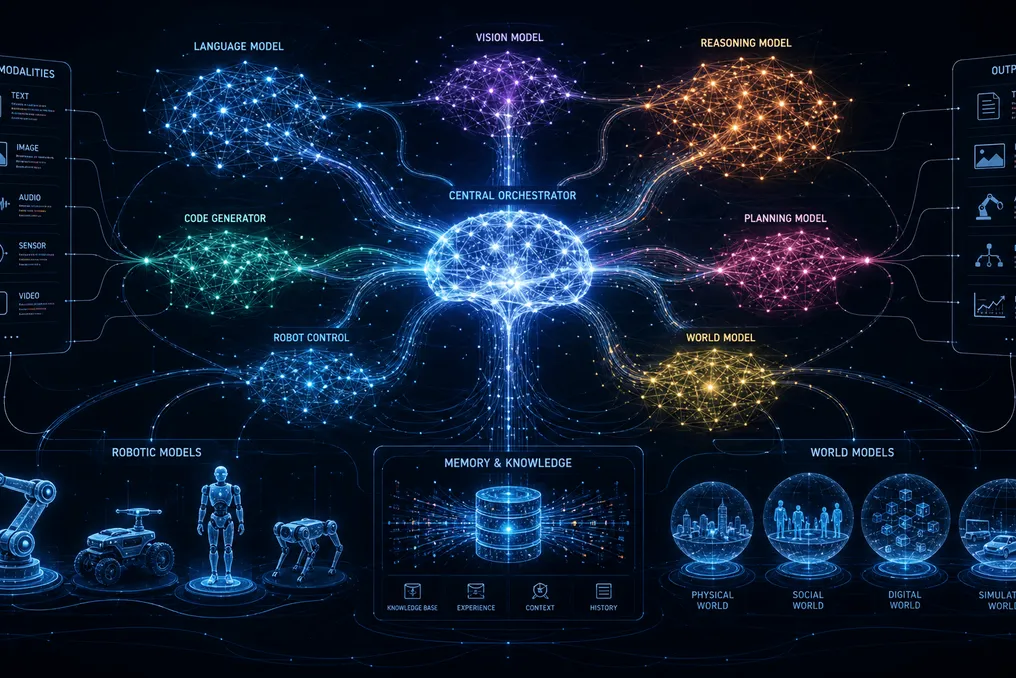
June 2026 was marked by an unprecedented surge in the release of embodied artificial intelligence models: 13 new foundational and world models were announced in a single month, which is roughly equivalent to one model every 48 hours.
This influx indicates a fundamental change in the embodied AI industry: the focus is shifting from hardware capability competitions to software intelligence competitions. Companies are now paying more attention to unique technical solutions rather than just incremental equipment improvements.
At the Zhiyuan conference in 2026, BAAI introduced two advancements in world models. The Wujie Physis-v0.1 model specializes in predicting the next physical state by compressing video, RGB-D data, three-dimensional point clouds, and tactile feedback into a unified latent space. Meanwhile, Wujie RoboBrain Orca functions as a robot's brain, possessing a unified representation, causal reasoning, and multimodal decoding by fusing language and visual representations in the latent space.
Alibaba released the Qwen-Robot set on June 16, adhering to a fundamentally different approach than the brute-force scaling favored by many competitors. Alibaba asserts that the heterogeneity of the physical world cannot be solved merely by increasing scale, but requires alignment strategies at the model level itself. Qwen-RobotNav adapts visual attention distribution for mobile control, Qwen-RobotManip standardizes the state-action space for manipulation, and Qwen-RobotWorld uses natural language action interfaces to predict world dynamics.
CasiaHand presented Brain-Si 0.5, the world's first humanoid dexterous manipulation model with a three-level architecture. This structure includes a top-level brain for planning World Language Action (VLA) models, a middle level of base models for six core manipulation capabilities (including pre-grasping, general grasping, functional operation, responsive transfer, bilateral interaction, and human-robot fusion), and a bottom level of physically interpretable models.
GalaxyBot released AstraBrain-WBC 0.5—a foundational cerebellum model for real-time humanoid body control. It is built on a GPT-style causal Transformer architecture and trained on approximately 2 billion frames of human action data, achieving 80 million parameters. RoboScience unveiled its Visics architecture with the VLOA framework, which separates the world model and operational model through object trajectory representation. The publication Current Robotics published Curl-0 for whole-body dexterous manipulation as a joint learning task. BoundlessPower introduced the MWA world model for long sequences of bidirectional physical causality.
A common thread across all these approaches is the shift in emphasis from demonstrating what robots can do to explaining why they still fail in certain tasks. Each team identifies different bottlenecks—be it tactile feedback, whole-body coordination, simulation-to-reality transfer, or long-term planning—and develops specific architectures to address these issues.