A quiet agricultural transformation is taking place on the fertile slopes of central Kenya. Amid population growth and land fragmentation, which reduces farm sizes, many smallholder farmers are rethinking traditional dairy farming.
Shift to Dairy Goats
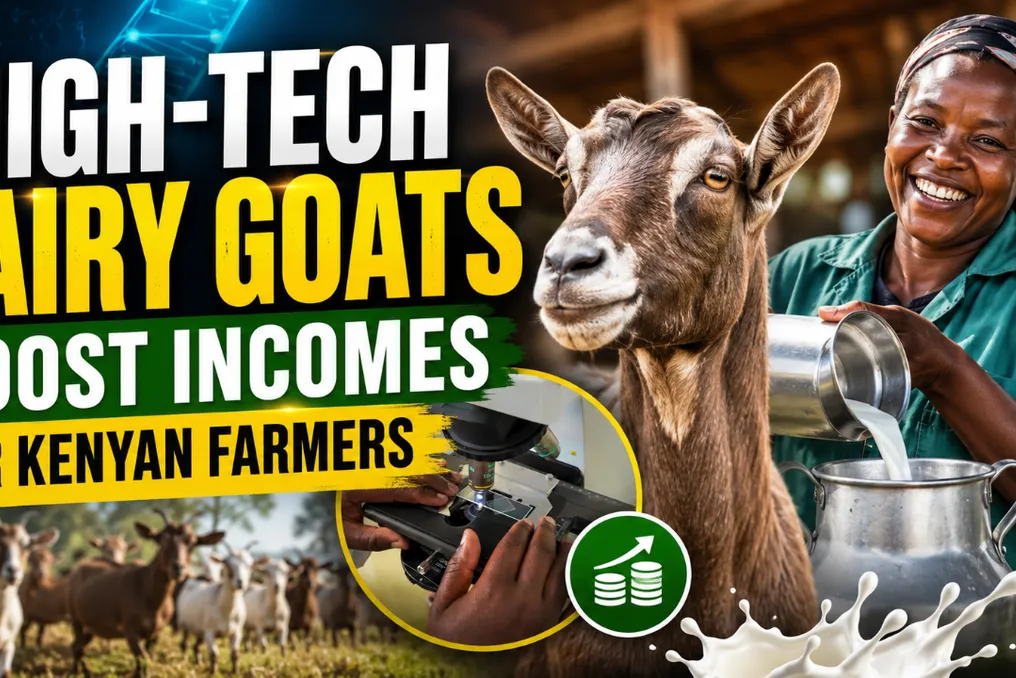
There is growing interest in high-yielding dairy goats because they require less land while providing a reliable source of milk and income. This shift is driven by artificial insemination (AI) technology, which allows farmers to improve herd genetics without owning breeding males.
The result of this process has been healthier animals, increased milk production, and greater income sources for thousands of rural households.
Advantages of AI over Traditional Breeding
For a long time, goat breeding depended on borrowing or transporting animals over long distances to access breeding males. This practice often led to the spread of diseases, caused inbreeding, and reduced overall productivity.
Today, farmers actively use AI to gain access to superior breeds such as Anglo-Nubian, Saanen, and German Alpine goats. These breeds produce significantly more milk while requiring much less feed and land compared to dairy cows.
Farmer Purity Wambuai from Kirinyaga County shares her experience: 'Ten years ago, I started raising goats with local breeds. Back then, we had to travel far to find a male for mating. Diseases spread easily, many kids died, and milk production remained low. After agronomists introduced us to goat artificial insemination, everything changed. Today, I keep three improved dairy goat breeds, some of which yield up to four liters of milk per day.'
Solving Problems Through Genetics
Livestock experts assert that artificial insemination helps solve some of the most serious problems facing goat keepers. According to Dr. Catherine Mulongi, Director of Livestock and Fisheries in Kirinyaga County, the traditional use of common breeding males led to widespread inbreeding and the transmission of reproductive diseases such as brucellosis.
She notes that thanks to the adoption of AI, farmers have been able to significantly reduce the level of inbreeding and reproductive diseases. Dr. Mulongi emphasizes that inbreeding lowers milk yield and often causes deformities in offspring, whereas AI allows for increased productivity while simultaneously reducing production costs.
The Kenya Animal Genetic Resources Centre (KAGRC), a state corporation, is responsible for conserving and disseminating high-quality genetics for livestock across the country.
Applying Science in Small Farming
At the KAGRC Goat AI Centre, every semen sample undergoes thorough laboratory testing before reaching farmers. Scientists check sperm motility, morphology, and concentration to ensure only high-quality genetic material is distributed.
Dr. Dominic Chirchir, Manager of the Goat AI Centre, states that the centre's goal is to increase both milk and meat productivity by providing farmers with the best available genes. He also points out that AI not only increases productivity but also reduces venereal diseases and eliminates the costs of maintaining breeding males, which is a significant saving for smallholder farmers.
Economic Opportunities in Kirinyaga County
Positive changes are already visible in Kirinyaga County, where 58 groups of goat farmers, numbering over 60,000 people, now raise improved dairy goats. Local officials consider this region one of the leading centers for dairy goat production in Kenya.
For many families, especially women, dairy goats represent a practical alternative to dairy cattle. Dr. John Gachara, a member of the Kirinyaga County Agricultural Executive Committee, notes that a dairy cow can cost up to 200,000 Kenyan shillings (about $1,550 USD), which is unaffordable for many rural families. However, five dairy goats can provide milk equivalent to one cow while requiring significantly less space and capital. This has become an important program for economic empowerment, especially for women and vulnerable households.
Goat milk is also sold at premium prices ranging from $0.77 to $0.93 per liter, often nearly double the price of regular cow's milk in many local markets.
Income Stability and Price Increase
Farmer Peter Nyoroge shared how dairy goats transformed his family's life. He reported that he now keeps 21 dairy goats and sells the milk to a processor for 100 shillings per liter. He added that before AI was implemented, diseases spread easily through breeding males, and their kids were weak. Now, calving rates have improved, the animals are healthier, and he receives a stable monthly income.
Prospects for Sector Development
Kirinyaga County Governor Anne Waiguru stated that the county will continue to invest in artificial insemination programs to further boost dairy goat productivity. She mentioned that previously, when dairy goats were introduced, many farmers received only about two liters of milk from their livestock at low milk prices. Thanks to AI and improved breeds, they are working to increase yields from the current average of two liters to five to seven liters per day.
As climate change, shrinking arable land, and rising production costs alter Africa's agricultural landscape, dairy goats are becoming a sustainable solution for smallholder farmers. The use of artificial insemination in Kenya demonstrates how improved livestock genetics can contribute to increased productivity, enhanced food security, and the creation of new economic opportunities for rural communities.