Unlike SpaceX's use of 'stick' levers to catch the Starship, China's Long March 10B rocket recovery system employs a flexible capture method, which provides greater error tolerance and gentler handling of the booster.
Unlike SpaceX's use of 'stick' levers to catch the Starship, China's Long March 10B rocket recovery system employs a flexible capture method, which provides greater error tolerance and gentler handling of the booster.
The Long March 10B rocket recovery technology represents a fundamentally different engineering approach compared to SpaceX's lever capture. The CZ-10B, which conducted the world's first sea recovery using a net on July 10, utilizes a flexible capture method that industry analysts characterize as a soft landing, in contrast to SpaceX's hard landing.
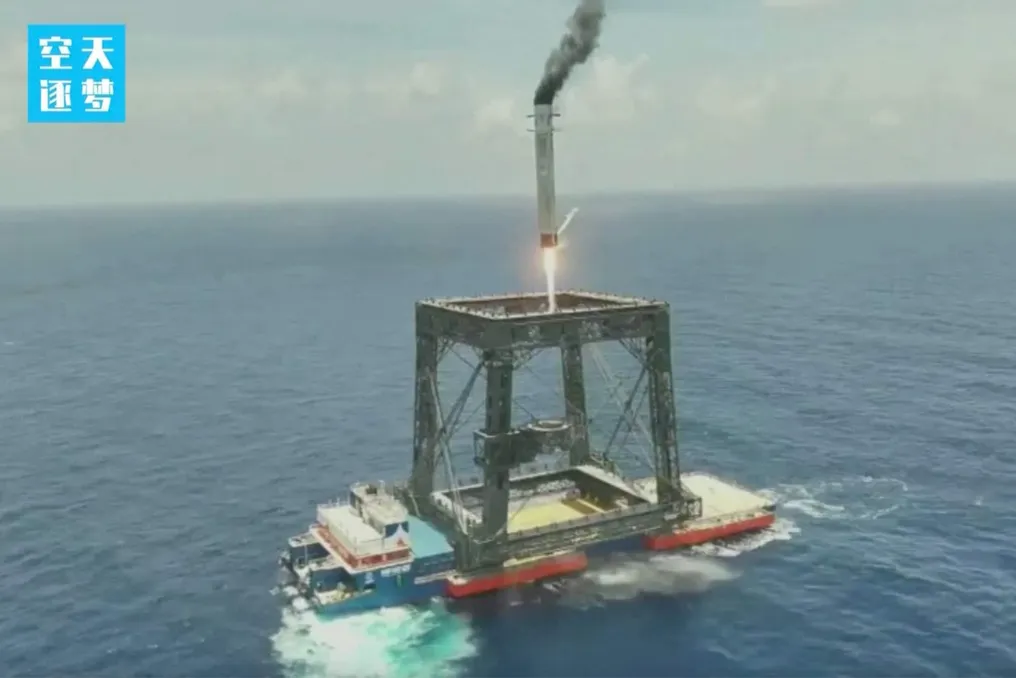
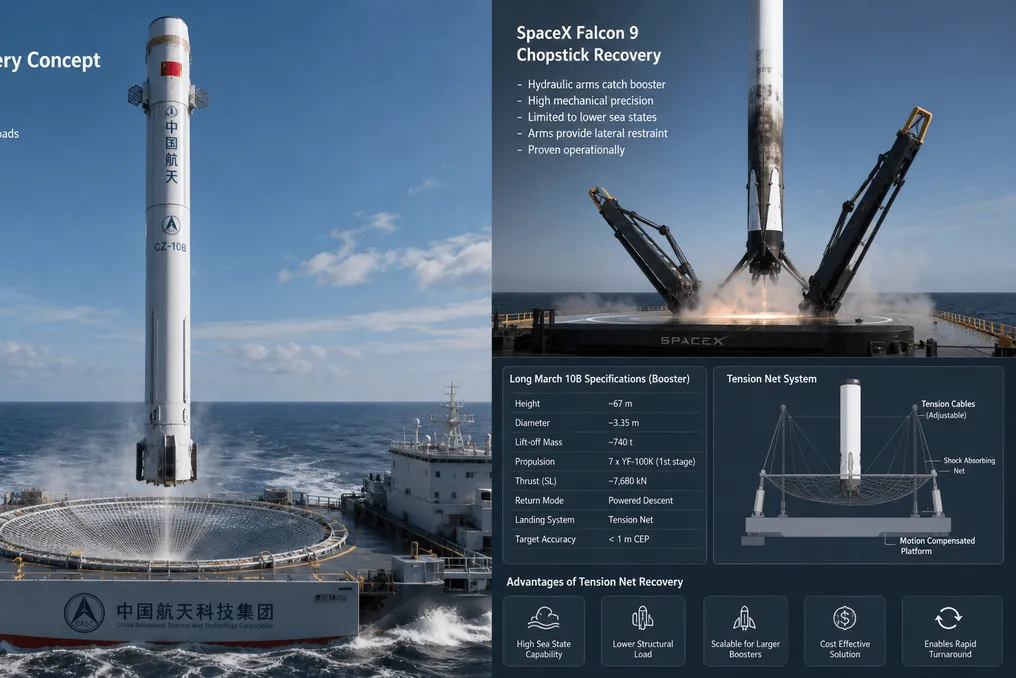
The recovery system deploys a taut net aboard the vessel Navigator, made of high-strength specialized fibers and steel cables arranged in a specific pattern. When the descending booster enters this net, kinetic energy is absorbed through the stretching of the cables, the movement of blocks, and hydraulic dampers. This system can compensate for positional errors during landing up to 10 meters, whereas lever capture requires millimeter precision.
Conversely, SpaceX's Starship recovery system uses rigid mechanical manipulators that envelop the booster. This process requires mounting pins on the rocket to precisely align with receiving slots on the manipulators. This rigid contact approach demands extreme positioning accuracy and creates high localized loads at the pin contact points. The advantage of this method is that the booster can be returned to the launch pad within a few hours for rapid reuse.
China's approach replaces heavy landing legs with light hook mechanisms installed on an intermediate section of the rocket. The absence of excess weight from landing gear allows for a larger safety margin for protecting and reusing the booster. Furthermore, net capture distributes impact forces more evenly across the rocket structure. Although net recovery requires moving from the ship's crane to shore, the gentler capture process potentially allows for more reuse cycles per booster.
The Navigator vessel itself is designed for this task. It has a length of 144 meters and a displacement of 25,000 tons, and its DP2 dynamic positioning system allows it to maintain position within 0.5 meters in waves up to 4 meters high. The net structure includes intelligent damping systems with blocks and hydraulic absorbers that limit impact load to 3G. The 54x54 meter capture zone provides a significant margin for the descending booster.
China is simultaneously developing both the net recovery system and the lever capture. The LandSpace Zhuque-3 rocket follows a landing leg approach similar to Falcon 9, while the development of the CAS Space rocket targets future lever capture. If Zhuque-3 successfully completes its upcoming recovery attempt, China will become the first nation to demonstrate two different reusable rocket technologies, ensuring diversification of risk reduction for the national space program and satellite constellation deployment.
China succeeded in testing an experimental rocket recovery system last Friday (10). The Long March 10B rocket was launched from the commercial space launch center located in Hainan, in the south of the country, at 1:15 AM Brasília time.
About six minutes after the propellant separated from the upper stage, the first stage returned vertically and was successfully recovered on a maritime platform, according to state broadcaster CCTV. With this achievement, the Chinese have reached a capability that is already the domain of American companies, such as SpaceX and Blue Origin: the ability to return the rocket to its starting point.
Beijing's purpose is to destabilize US supremacy in the reusable rocket segment. However, the method employed by China differs from that used by Americans. Unlike autonomously landing on solid ground with extendable legs or on a drone ship, the Long March 10B uses landing hooks that capture a net attached to a maritime platform.
This test represents the first successful recovery of an orbital-class propellant by China, consolidating nearly a decade of research and development in reuse technologies. Mao Ning, spokesperson for the Ministry of Foreign Affairs, described the event as a 'historic day for China's space program.' This technical advance preserves the most valuable part of the rocket—the engine-containing propellant—which results in a drastic reduction in orbital operational costs.
For comparison, SpaceX launches the Falcon 9 approximately 150 times annually, reusing its propellants dozens of times. The Long March 10B, capable of carrying a minimum of 16 metric tons of payload to low Earth orbit, was designed for the commercial market by the Chinese Academy of Launch Vehicle Technology, the country's main state rocket agency. This reuse technology is expected to decrease expenses for launching Chinese commercial satellite constellations.
China's goals are even broader: the Long March 10 line is being planned to conduct crewed missions to the Moon before 2030. In this context, the experimental model will serve to collect vital data and validate the necessary technologies for the lunar program. CCTV also reported that the country intends to reuse this same propulsion stage in another launch by the end of 2026.
The Long March 10B rocket successfully launched during its maiden flight and demonstrated China's capability to perform the country's first marine recovery of a first-stage booster, thereby joining the club of reusable rockets.
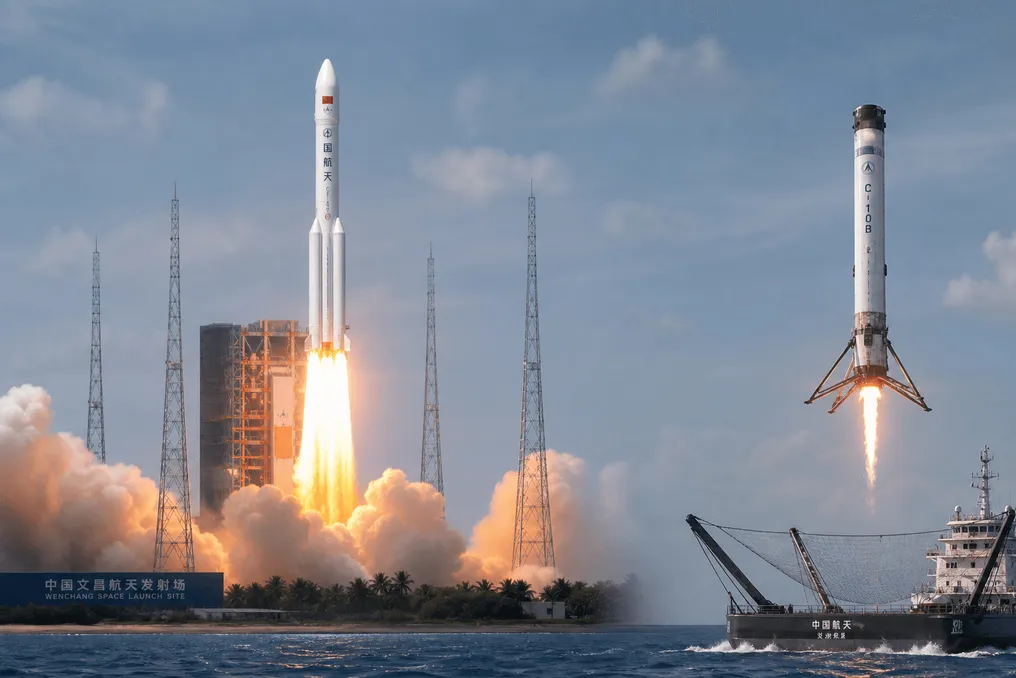
The launch of the Long March 10B CZ-10B Y1 took place on July 10 at 12:14 Beijing time from the Wenchang Commercial Space Launch Site Pad 2. This flight marked the first successful instance of marine recovery of a rocket booster in China.
Approximately eight minutes after liftoff, the first stage of the rocket descended vertically onto the recovery vessel Navigator in the South China Sea, located 431 kilometers southeast of the launch site. During this process, grappling manipulators cleanly engaged the tension cable system.
The Long March 10B is a commercial modification of the CZ-10A. It retains the five-meter main body and seven YF-100K engines, which operate on liquid oxygen and kerosene, providing a thrust of 850 tons at liftoff. Unlike the CZ-10A version designed for crewed flights, the 10B model eliminates redundant life support systems and replaces the upper stage engine with a liquid methane engine to achieve a higher specific impulse and cleaner combustion. In reusable mode, the rocket is capable of delivering 16 tons to low Earth orbit.
Instead of landing legs used by the Falcon 9 rocket, the CZ-10B employs a net capture system. The booster descends using netting fins and retro-thrusters toward the Navigator vessel. This vessel measures 144 meters long and 50 meters wide, equipped with a DP2 dynamic positioning system that allows it to maintain position within 0.5 meters even with 4-meter waves. The vessel's tension cable system uses mobile wagons with six-degrees-of-freedom motion compensation algorithms for precise synchronization with the descending booster. This approach avoids the additional mass associated with landing legs, contributing to increased payload capacity and achieving the target of 10 or more booster reuses with a 72-hour turnaround time.
This success makes China the second country, after the United States, to demonstrate operational high-precision marine rocket recovery. Previously, Chinese attempts using LandSpace Zhuque-3 and CZ-12A in December 2025 resulted in controlled submergence but not recovery. The CZ-10B first stage will subsequently be used as side boosters for the heavy-lift CZ-10 configuration, designed to deliver over 70 tons to LEO, supporting China's crewed lunar landing before 2030 using the Mengzhou spacecraft and the Lanyue lunar module.
The CZ-10B, unofficially named Tianma, is intended for deploying China's satellite internet constellation and lays the foundation for fully reusable launch vehicles. The development team achieved this milestone through iterative improvements to the YF-100K engine using pump-after-swing technology, which ensures deep throttling and precise attitude control. Previously, the CZ-10A underwent a controlled soft splashdown test in February 2026.