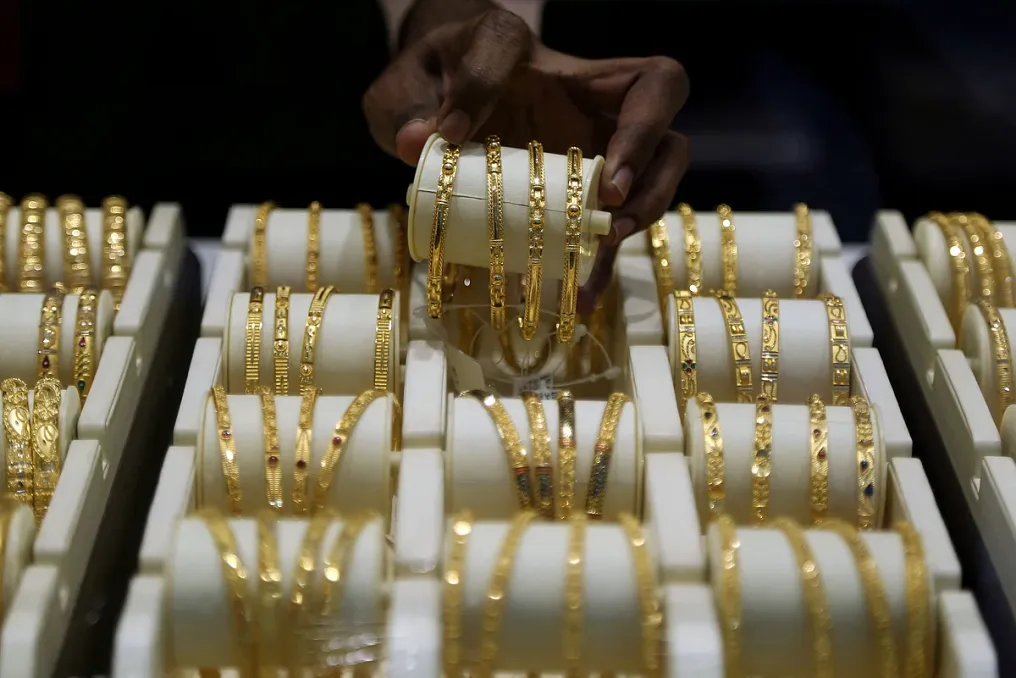
As summer holidays gain momentum and a large number of Indian expats head home, a familiar trend is observed in the gold markets of Dubai and Sharjah: many residents are stocking up on jewelry before flying out.
As summer holidays gain momentum and a large number of Indian expats head home, a familiar trend is observed in the gold markets of Dubai and Sharjah: many residents are stocking up on jewelry before flying out.
According to experts, purchasing gold in the United Arab Emirates can be up to 13 percent cheaper than in India. Although the exact savings depend on the seller and the type of item, most specialists agree that the UAE offers a significant price advantage over India, prompting informed buyers to take advantage of the opportunity.
Tanvir KP, founder and chairman of the board of directors of Arakkal Gold & Diamonds, personally witnessed this surge. He noted: 'If you look at the prices of gold jewelry, they are 8–10 percent cheaper when bought in the UAE.' He added that his store has seen many people buying jewelry before returning.
However, these purchases are not spontaneous. According to Tanvir, buyers act strategically. 'They mainly prefer to buy unstoned jewelry or choose very simple designs because they plan to take them to India for exchange,' he explained. Simple gold chains are particularly popular as they are easy to exchange in Indian jewelry stores without the complications associated with intricate or gemstone-studded designs.
The price difference is due to several reasons, including the UAE's zero import duty on gold and lower manufacturing charges compared to India, where customs duties and taxes significantly increase retail prices. Tanvir also reported that when buying gold bars or coins, savings can reach 13 percent, but these items may be taxed upon transport to India.
For expats, this means significant savings, especially during wedding seasons or family visits when gifting gold is customary. One purchase can save hundreds of dirhams, making a visit to the gold market a practical addition to any travel plan. Amina Mohammad Ali, Managing Director of MFar Jewellers, estimates the savings at approximately 13 percent, which strongly attracts budget-conscious travelers. She mentioned that many sellers run 'return home' promotions. Her own store capitalizes on this demand by offering discounts of up to 50 percent on manufacturing charges on selected designs, as well as a 50 percent discount on diamond jewelry plus free branded watches when purchasing diamond items worth 5000 dirhams until July 31.
The trend of buying gold in the UAE before traveling to India is not new, but it has intensified following the resumption of travel and favorable gold prices after the war between the US, Israel, and Iran. Furthermore, earlier this year, India eased baggage rules, allowing eligible passengers who have lived abroad for more than a year to bring in more jewelry without paying duties. Women can now carry 40 grams of jewelry, and men up to 20 grams.
Gold holds deep cultural and financial significance in Indian families, serving as a symbol of prosperity, a necessity for weddings, and a portable savings medium. Sellers strive to meet this demand, so display cases are dominated by simple designs, lightweight pieces, and smooth chains so that customers can easily exchange or resell the jewelry in India without losing value.
Since the cost of gold jewelry in the United Arab Emirates (UAE) can be up to 13 percent lower than in India, many UAE residents returning home this summer are interested in the legal amount of gold they can bring into India.
This issue has become more relevant after India introduced significant changes to its baggage rules in 2026, including a review of duty-free norms for gold jewelry. Understanding the new restrictions, declaration requirements, and duty rules will help passengers avoid unexpected charges, delays, and fines at Indian airports, especially during school holidays, reunions, and the upcoming wedding season among the large number of Indian expats in the UAE.
According to the new Baggage Rules of 2026, passengers who have resided abroad for more than one year are entitled to import a certain amount of gold jewelry. The most significant change is that the limit is now set exclusively by weight, and previous monetary value restrictions have been abolished.
The right to duty exemption by weight applies to returning Indian residents who have been abroad for more than a year, as well as to Non-Resident Indians (NRIs) and Indian origin tourists who meet the criteria of the baggage rules. Passengers returning after a shorter stay are not entitled to this special jewelry benefit.
It is important to note that this exemption applies only to jewelry worn or carried as personal adornment. Gold bars, coins, biscuits, and ingots are treated differently under customs legislation and do not fall under the duty-free norm for jewelry. Requirements for declaration and payment of customs duties may apply when transporting such items.
Previously, there were value restrictions: women could import jewelry worth up to 100,000 rupees (equivalent to Dh3,850–Dh3,860), and men up to 50,000 rupees (Dh1,925–Dh1,930), provided weight limits were observed. The new rules have abolished these price ceilings, leaving only weight limits of 40 grams and 20 grams, respectively. This means that customs inspectors are no longer required to determine the market value of the respective jewelry for duty exemption purposes.
If a passenger carries gold jewelry exceeding the permitted duty-free limit, it is not prohibited, but such items must be declared, and the corresponding customs duty must be paid on the excess amount. Failure to declare excess gold may result in action under customs legislation, including confiscation or other measures.
To ensure safety, travelers are advised to carry valuable jewelry in hand luggage or on their person, rather than in checked baggage. It is also helpful to have purchase invoices or receipts with you if customs officials require clarification regarding the items being transported.
In addition to gold, the 2026 reforms introduce several changes favorable to travelers. These include an increase in the general duty-free allowance for most passengers, simplification of electronic and advance baggage declaration, clearer regulation of genuine personal belongings, including personal watches, and duty-free import of one laptop for eligible passengers over 18 years of age. Furthermore, relocation benefits for those moving to India have been simplified.
Since the UAE is one of the world's largest gold jewelry markets, where prices are often 13 percent lower than in India due to low taxes and a competitive retail market, the abolition of the price limit removes the need to worry about gold price fluctuations when determining the right to duty-free exemption, making the rules clearer and easier to comply with.
A woman arriving from Dubai in Mumbai was found smuggling gold hidden in her trousers. The woman's plans were thwarted by the Directorate of Revenue Intelligence (DRI), which had increased vigilance at the airport in advance.
During the search, 4 kilograms of gold were seized, valued at approximately 60 million rupees. The woman was arrested, and investigators are determining whether she was merely a carrier or part of a larger network.
According to the agency, the DRI received information that a passenger arriving from Dubai might be involved in gold smuggling. Based on this report, security checks were intensified at Chhatrapati Shivaji Maharaj International Airport in Mumbai on Tuesday. As soon as the woman arrived from Dubai, DRI officers stopped her for inspection.
During the inspection, four foreign-marked gold bars were discovered, carefully concealed inside the woman's trousers. The total weight of these bars was about 4 kilograms. According to DRI estimates, the market value of these gold bars in the Indian market reaches 60 million rupees. After the gold was seized, the woman was detained in accordance with the Customs Act.
A serious question faces the investigators: is the woman a participant in the entire scheme, or was she transporting the gold for someone else? The DRI is currently working to find out who sent the gold from Dubai, where it was supposed to go in India, and what network is behind this operation. Officers suspect that names of other individuals connected to this network may emerge during questioning. In recent years, there have been numerous cases of gold smuggling at airports: sometimes gold is hidden in shoes, sometimes in electronics, and sometimes in clothing. This time, smugglers attempted to evade customs control by hiding the gold bars in the woman's trousers. Questioning is ongoing, and the DRI is also checking whether she has previously delivered similar consignments to India or if this was the first instance.