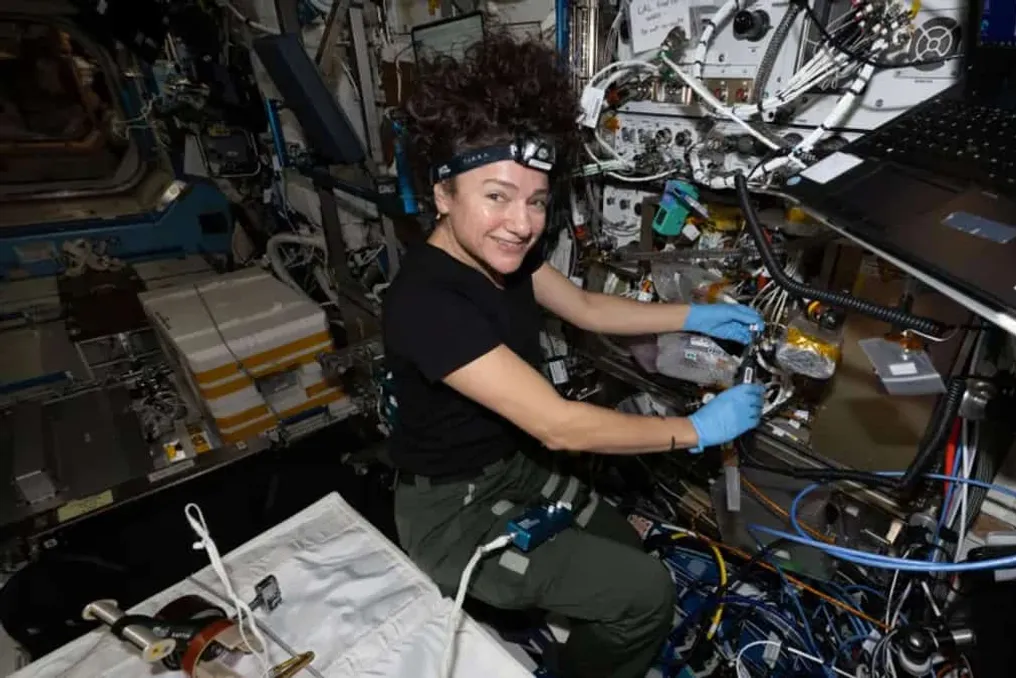
NASA is making efforts to create and study Bose-Einstein condensate, a state of matter that differs from the known solid, liquid, gaseous, and plasma states. This study is being conducted inside the International Space Station using a compact laboratory called the Cold Atom Laboratory.
Project Details and Updates
The Cold Atom Laboratory project received its fourth major update in June 2026, as announced by NASA. The equipment was dispatched to the station in April and is already installed, conducting scientific measurements.
Bose-Einstein Condensate and Absolute Zero
Absolute zero represents the lowest possible temperature in the universe, corresponding to -273.15°C, the point at which atoms cease all energetic movement. The Cold Atom Laboratory uses lasers to cool rubidium and potassium gases to temperatures near this limit, achieving conditions that do not occur naturally.
At these extreme temperatures, an unusual phenomenon occurs: instead of presenting as isolated entities, multiple atoms begin to manifest as a single wave of quantum matter, characterizing the Bose-Einstein condensate, or the fifth state of matter.
Advantages of the Space Environment
Conducting research on Bose-Einstein condensates on Earth presents significant difficulties due to the influence of gravity and ambient heat, factors that can disturb the quantum behavior of atoms before they can be accurately measured.
In space, near-zero gravity in low orbit allows these waves of matter to develop and expand for significantly longer periods without interference, something unfeasible in terrestrial laboratories.
Jason Williams, a scientist involved in the project at NASA's Jet Propulsion Laboratory, stated that at the lowest temperatures, matter adopts a radically different behavior than previously experienced. He added that the wave nature of matter prevails, allowing for highly precise measurements of time, gravity, and motion.
The updated version of the laboratory includes substantial improvements, such as a redesigned magnetic trap to confine the atomic cloud, enhanced atom sources, and more refined measurement capabilities. These improvements represent an advancement over previous versions, which have been operational since the equipment's arrival in 2018, according to Live Science.
Future Applications of the Research
The studies conducted in the Cold Atom Laboratory go beyond basic science. The ultra-refined measurements of time, gravity, and motion enabled by these experiments are crucial for the development of future quantum technologies.
Potential applications include navigation systems capable of operating on the Moon without relying on GPS, as well as detailed maps of the Earth's gravitational field, useful for monitoring climate change, underground water reserves, and tectonic movements.
Ethan Elliott, another scientist on the project at JPL, compared the current work to the quantum revolution of the last century, which gave rise to lasers, cell phones, and magnetic resonance imaging for medical diagnosis. He stated that they are experiencing 'Quantum 2.0'—the direct manipulation of large quantum states—and hope to achieve technological advances similar to those made by progressing in this science in orbit.