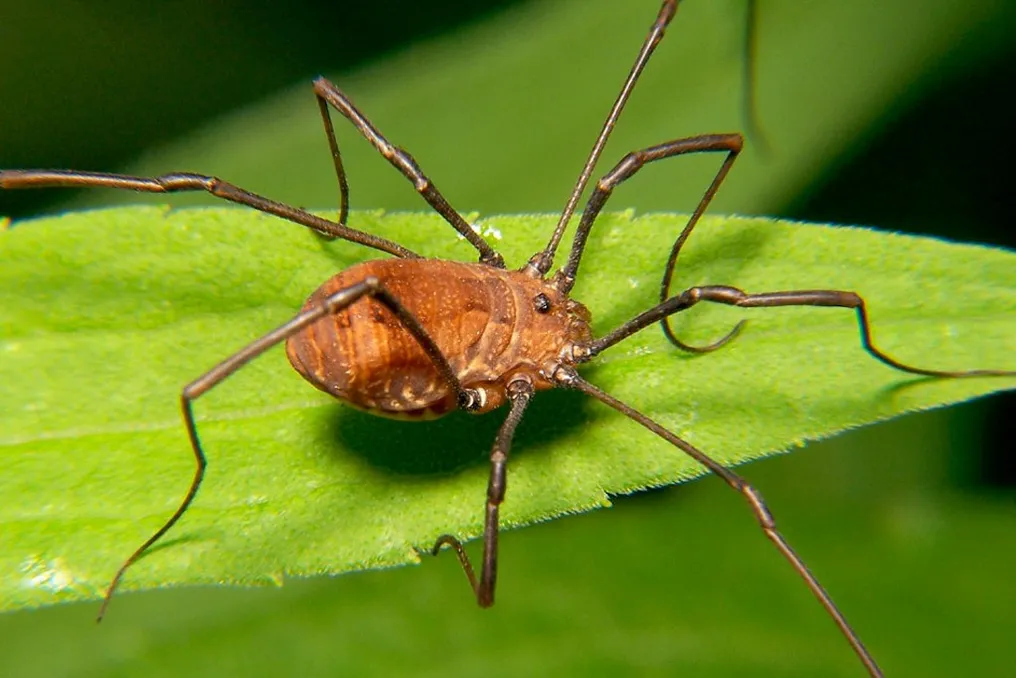
The harvestman is a small arthropod that often causes visual confusion due to its resemblance to spiders, but it is not a type of spider. This arachnid does not possess venom or webs, and its legs are capable of detaching to aid in escaping predators.
Popular
Taxonomic and physical differences
Although they can be confused due to appearance—small body, brown or reddish tones, and eight thin legs, the latter being notably long, in addition to having chelicerae in the mouth—the harvestman belongs to the order Opiliones, distinct from the order Araneae, to which spiders belong.
Biologists can quickly identify harvestmen by crucial traits: they do not produce silk or webs, and they are harmless, neither biting nor possessing venom. Their mouth is very small, suitable only for ingesting food fragments.
Sensory and bodily characteristics
In terms of vision, harvestmen have only two eyes with limited visual capacity, unlike spiders, which typically have between six and eight eyes. There are also distinctions in body structure: while spiders can have large bodies and are clearly divided into an abdomen and cephalothorax, harvestmen generally maintain a small body, less than two centimeters (excluding the long legs), and lack this structural division.
Defense and locomotion mechanisms
When threatened, these creatures release a substance with an intense odor to deter predators. Some species use their legs defensively, as these contain small spines capable of causing superficial injuries. The legs are remarkably flexible, due to their multiple segments called 'tarsi', allowing the animal to move in various environments.
This flexibility facilitates leg loss in nature. However, since they have eight limbs, the harvestman can continue moving even after amputation, sometimes even with better performance. The loss of a limb can be a survival tactic: when grabbed, the detached limb continues to move, distracting the predator and giving the harvestman a chance to escape.
Habits and global distribution
A curious detail is that the second pair of legs, often the longest, acts as a tactile organ, assisting the animal in orientation. There are thousands of species of harvestmen distributed worldwide. Generally, they inhabit dimly lit and humid places, feeding on organic matter such as seeds, leaves, and small insects.