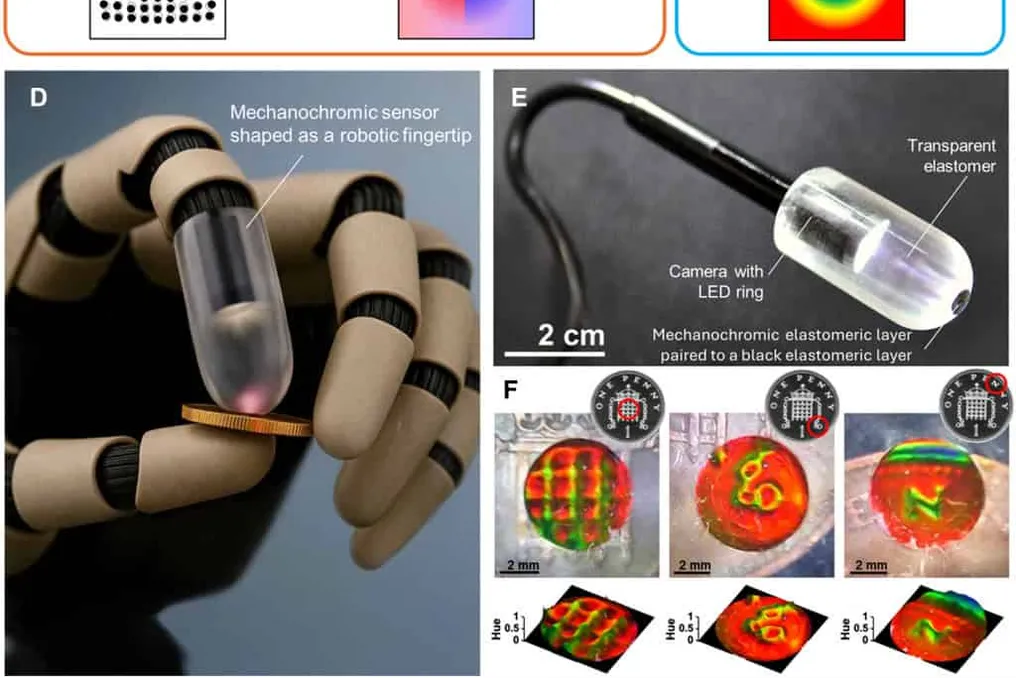
Robots are currently capable of analyzing their surroundings with high accuracy using cameras and other visual sensors, but they still struggle to replicate the sensation of human touch. A study published in Science Advances proposes a solution to this problem by developing a soft material that changes color when pressed, allowing machines to detect touch in real time without the need for complex data processing.
Researchers led by Giacomo Sasso, a postdoctoral researcher from Queen Mary University of London (QMUL), assert that this technology directly converts applied pressure into a color pattern, enabling fast and detailed readings. This development opens prospects for use in surgery, prosthetics, and high-precision handling, where even slight changes in force matter.
The material's function does not depend on pigments or dyes. The color change occurs due to the microscopic structure of the material itself—a phenomenon known in physics as structural color. Inside the sheet are layers organized into structures smaller than the thickness of a hair, which reflect specific wavelengths of light. When pressure is applied, these layers come closer together, changing the reflected color at that point.
This feature allows immediate visualization of applied pressure on the surface without the need for software data reconstruction, which typically causes delays in traditional sensors. To interpret touches, scientists used an inexpensive USB camera placed beneath the material. The system constantly records color changes and forms a real-time pressure map, allowing robots to perceive touch quickly and in detail.
In tests, the system was able to reproduce very fine details, such as the relief of a coin. In another experiment, the surface clearly registered the ridges of a fingerprint—a level of detail that previous sensors could not achieve. Sasso stated in an interview with Earth.com: 'We are not just detecting a touch; we are visualizing its dynamics.' He clarified that the technology not only registers contact but also allows observation of its dynamics during the process.
Traditional vision-based tactile feedback systems register the deformation of a soft gel and use algorithms to reconstruct the shape and intensity of the contact. This process requires significant computational power and can increase response time. The new method eliminates this necessity because the surface itself provides all the necessary information through colors, excluding subsequent data reconstruction, making robot tactility faster and more efficient.
According to Sasso, this approach brings closer the concept of embedded intelligence, where the ability to detect becomes part of the material itself, simplifying system operation.
The researchers indicate that one of the most promising areas of application is robotic grippers used for manipulating small and fragile objects. The sensor could immediately signal when the applied force approaches the limit capable of damaging a component. In medicine, the material could also increase the sensitivity of prosthetics to touch and provide additional information for surgical instruments. The authors note that subtle differences in stiffness between healthy tissue and a potential tumor can be converted into visible color changes during a procedure.
Despite the achieved results, Sasso emphasizes that the technology is in its early stages. He noted in an interview with Earth.com: 'Of course, it is still a prototype, so there is a lot of engineering work ahead before we can think about commercial or clinical application.' According to him, engineering solutions must be developed before the material can reach the market or be used in medical settings.