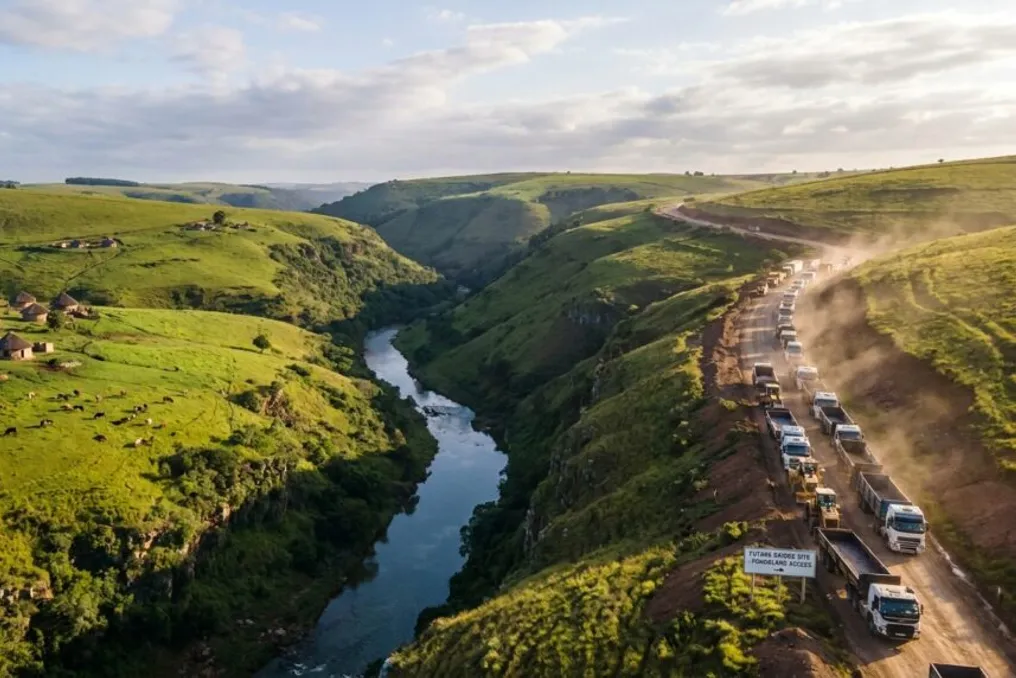
The Msikaba Bridge, valued at 1.75 billion rand, which was initially planned as a three-year project, has now been postponed to 2029 after seven years. This bridge, the longest suspension bridge in Africa, crosses the Msikaba River gorge approximately 20 km northeast of Lusikisiki in the Eastern Cape.
Project Implementation Challenges
The 1.75 billion rand structure is part of the N2 Wild Coast Toll Road Project, a 410 km stretch from East London to the Mthambuna River on the KwaZulu-Natal border. According to SANRAL media relations manager Lwando Mahlasela, the delays are linked to the state of South Africa's steel sector.
Mahlasela told Engineering News that the main difficulties stem from production limitations and cash flow problems, which are slowing down work. He emphasized that the project is feeling the impact of the partial collapse of the South African steel industry.
Impact on Construction
Mahlasela named Aveng Steel Fabricators (formerly DSE), Genrec Engineering, and Endeto among the affected companies. Since the bridge segments are manufactured in Mpumalanga and then transported to the construction site, any disruption in the steel sector's production capacity directly halts the bridge's erection.
The contract, signed through a partnership between Concor and Mota-Engil Construction South Africa, remains valid, and the budget is fully allocated, although new cost figures have not been publicly disclosed.
Significance of the Bridge and Ecology
Upon completion, the bridge will rise 192 meters above the valley floor, supported by two 127-meter pillars, making it the third tallest bridge in Africa. The route between Durban and East London will be shortened from 69 to 85 km, allowing for savings of 1.5 to 3 hours of travel time depending on the vehicle type.
The bridge's location is within the Pondoland Endemism Centre, one of the least protected and most biodiverse coastal areas in the world. These grasslands and forests host about 200 plant species found nowhere else on Earth. Pondoland's isolation has long served as its primary protector, but the construction of the toll road and bridge is changing this situation.
Conflicts with Conservation Initiatives
Wild Child Africa, which manages the Pond trail, notes that high-end, low-impact tourism is the only sustainable way to preserve the region, and Pondoland's remoteness is its value. However, the 580-meter suspension bridge and the associated toll road contradict the concept of low impact. Through the Pondoland Conservation Fund, every tourist contribution supports community gardens, libraries, and a Wi-Fi hub in Msikaba, as well as coastal protection, where less than 10% of the area is formally protected.
For Wild Child, trail enthusiasts, and everyone who values Pondoland's pristine landscapes, the two-year delay is perceived not as a failure, but as a welcome respite.
Protests and Environmental Violations
The Amadiba Crisis Committee, representing 14 villages in the area, is officially campaigning in Parliament. In August 2025, the Committee submitted a petition challenging the N2 route through Pondoland, which remained active as of May 2026, demanding the highway be moved inland. In December 2025, 'Green Scorpions' confirmed 'serious non-compliance' with environmental legislation at the site, including water resource pollution and wetland destruction.
Several weeks later, ecologist Sinegugu Zukulu discovered that contractors had cleared a colony of endangered Pondoland cushion plants, as well as two other Red Data Book species. Zukulu stated that all three species are extremely vulnerable and threatened with extinction, noting that this was the third such incident since May 2025.
Mahlasela assured that SANRAL expects public understanding of the complex nature and scale of this infrastructure project and hopes for continued support for the development of critical public infrastructure.
Thus, the project, which was supposed to take three years, risks stretching over ten years, meaning Pondoland will retain its ancient appearance for another two years.