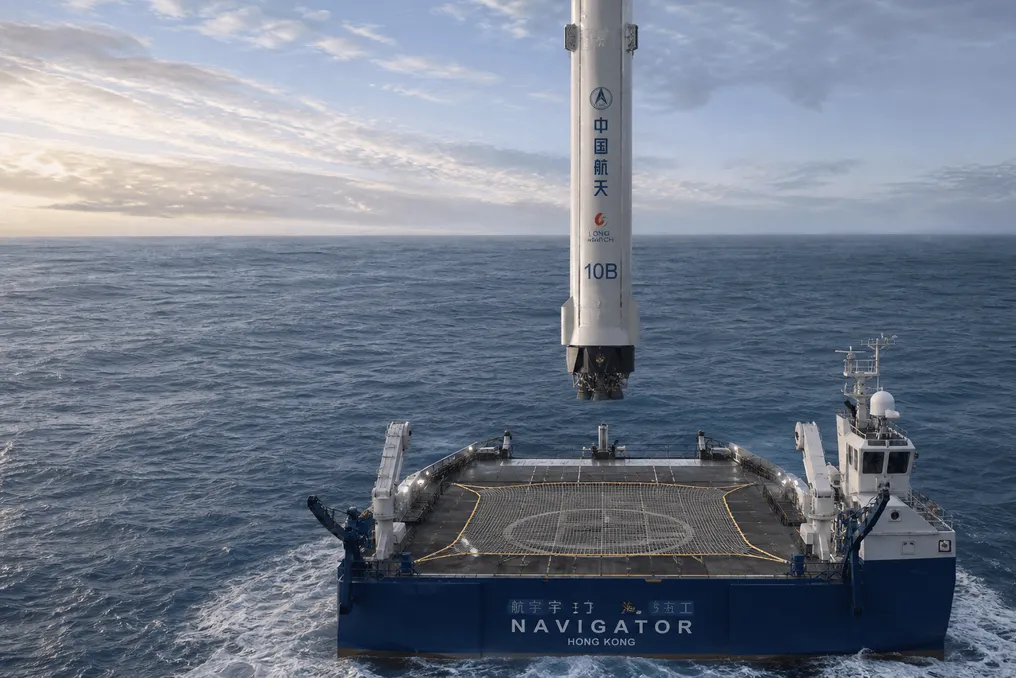
China has reached a significant milestone by entering the era of reusable rockets through the development of a marine net recovery system. The system, implemented on the Long March 10B rocket, is the first of its kind globally and eliminates the need for landing legs, allowing for increased payload capacity and enhanced reliability.
Technical Features of the Recovery System
Instead of following the landing leg design used by SpaceX, the CASC-developed CZ-10B utilizes a net capture mechanism. Industry experts note that this approach offers advantages in terms of reliability and payload capacity. This booster stage completely foregoes heavy landing legs, replacing them with capture mechanisms at the base.
Return Process and Platform
After separation, the booster uses net stabilizers and engines to slow down during atmospheric entry and perform precise maneuvering, descending vertically toward the collection vessel Navigator. This ship is the world's first marine platform for rocket recovery. Navigator measures 144 meters long, 50 meters wide, and has a displacement of 25,000 tons. It is equipped with a DP2 dynamic positioning system, which allows it to maintain position within 0.5 meters even in waves up to 4 meters high.
Advantages of the Net Approach
The net tensioning system on the deck uses mobile wagons with six degrees of freedom compensation for precise alignment with the descending booster. The capture area is a target window measuring 54 by 54 meters. This method requires high precision from both the rocket and the ship. The net capture mechanism absorbs most of the kinetic and potential energy through onboard damping systems, reducing stress on the booster landing structure and solving the landing accuracy problem. The absence of extra weight from landing legs increases payload capacity and allows for more frequent reuse cycles, targeting 10 or more launches with a turnaround time of 72 hours.
Technology Comparison and Future Plans
Industry analysts point out that while net recovery demands high precision from the rocket and the ship, once mastered, it demonstrates greater reliability compared to landing legs for larger rockets. Currently, there are three global methods for recovering reusable rockets: landing legs (SpaceX Falcon 9, LandSpace Zhuque-3), tower-based 'pole' capture (SpaceX Starship), and the Chinese net recovery method. If LandSpace Zhuque-3 successfully completes its upcoming recovery, China will become the first country to master two different reusable rocket technologies.
Significance for Space Programs
The technical significance of this development extends beyond the rocket itself. The design of the CZ-10B first stage and engine standards are used in the crewed lunar variant CZ-10. This version will consist of three such stages, designed to deliver over 70 tons to low Earth orbit as part of China's crewed lunar mission program by 2030. The reusable technology will also serve the needs of large-scale deployment of the Qianfan (over 15,000 satellites) and GW (over 13,000 satellites) satellite constellations, with each rocket carrying about 20 satellites, requiring approximately 1400 launches.