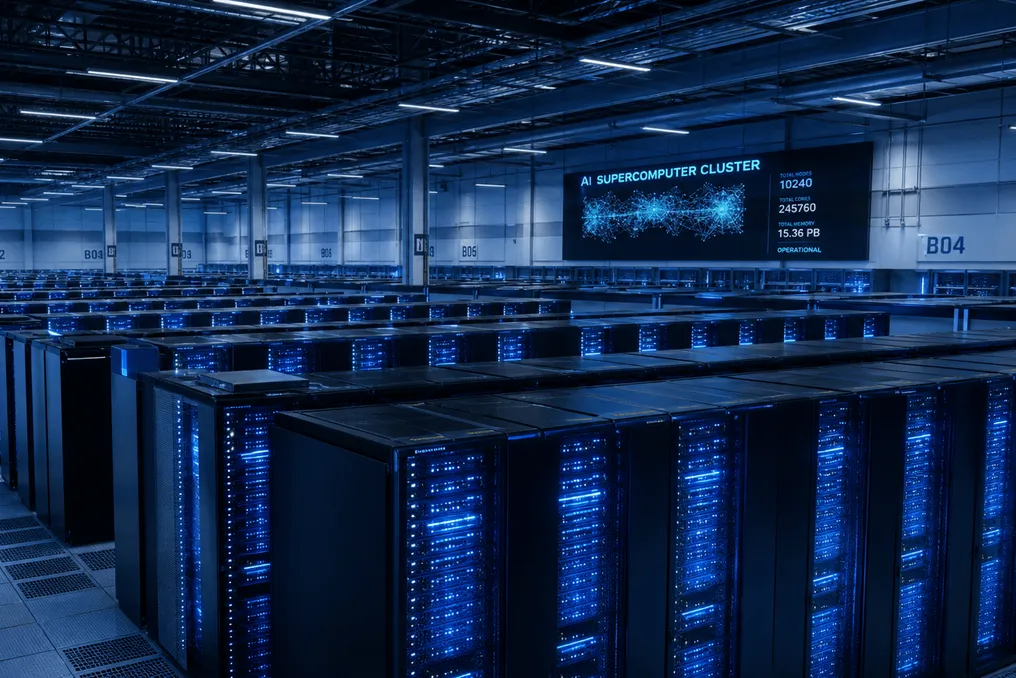
Sugon Company has introduced Dawn 8000, which is the first fully domestic artificial intelligence supercluster in China consisting of 100,000 cards. This cluster integrates high-performance computing and AI computation on a unified architecture connected to the national computing network.
Cluster Presentation and Integration
At the Photosynthetic Organization 2026 Intelligent Computing Application Conference, held on July 10th, Sugon announced the completion of Dawn 8000 in Dafen. This cluster has been integrated into the national unified computing network from its first day of operation and is connected to the National Supercomputer Internet.
Architecture and Functionality
Dawn 8000 marks the first production-level implementation of a native super-AI fusion architecture. This architecture differs from the traditional segregated approach, which resulted in two types of computing power: clusters for high-precision scientific work that struggled with core AI tasks, and AI-oriented clusters that lacked the precision for scientific calculations. By unifying FP64 precision through INT8 on a single platform, Dawn 8000 can handle tasks ranging from high-precision scientific modeling to low-precision AI training and inference.
Components and Development Approach
The entire cluster is built using domestic components. The basic computing power is provided by Hygon processors, while high-speed internal communication among 100 thousand cards is guaranteed by the scaleFabric IB-like native RDMA networking solution. The massive volume of data is processed by the ParaStor distributed storage, which received two awards in the Global IO500 production list for 2026. Furthermore, the system supports megawatt-level power density per rack thanks to advanced liquid cooling technology.
Flexibility and Achievements
Unlike vertically integrated solutions that restrict users to a single vendor's ecosystem, Sugon chose an open computing approach. This allows for the use of various brands of AI accelerators and core AI software ecosystems, giving users freedom in choosing hardware and migrating workloads. Despite the greater complexity of integration, this method proved more convenient for developers at scale.
Dawn 8000 has already enabled the optimization of over 300 super-AI fusion applications across more than 20 fields, including robotics, automotive industry, new drug development, new materials, and quantum computing, as well as large language models. More than 70 applications have been successfully scaled up to 100 thousand cards. The cluster has demonstrated breakthrough results in solving global research problems, such as protein folding simulation, dynamics of water molecules in trillions of atoms, and simulation of turbulent flow on a grid of 100 trillion cells.
Future Infrastructure Development
Sugon also announced the start of developing a second fully domestic super-AI fusion system with 100,000 cards in collaboration with the Beijing Academy of Science and Intelligence. This indicates that the super-AI fusion architecture is becoming the standard template for future AI infrastructure in China.