The United Arab Emirates (UAE) ranked first among Arab countries in the Environmental Performance Index (EPI) for 2026. This global sustainability indicator, published by Yale University, assesses 177 countries across 47 criteria covering ecosystem health, ecosystem vitality, and climate change.
Achievements in Waste Management and Marine Environment
The country demonstrated a perfect score of 100 in waste management, becoming the first in the world in this category. Furthermore, the UAE scored 100 points on the bottom trawling fisheries indicator, signifying no capture of marine life using this method in UAE waters. The wastewater treatment rate was 94.99%, allowing the country to secure 19th place in the global ranking.
The Emirates became the regional leader and ranked ninth globally for the protection of key marine biodiversity areas, as well as second regionally for the protection of marine habitats.
Values and State Strategy
The Minister of Climate Change and Environment, Dr. Amna bint Abdullah Al Dhaher, noted that this rating reflects values embedded in the nation's consciousness and is not the result of recent changes. She emphasized that environmental care in the UAE is not a new phenomenon but a fundamental value integrated into the state's foundation, crediting this long-term legacy to the late Sheikh Zayed bin Sultan Al Nahyan and his early understanding of the importance of preserving natural resources.
According to her, the achievement resulted from a comprehensive approach combining the efforts of the entire government and society, including local communities, private enterprises, and federal structures, which focused on the country's environmental goals. Dr. Al Dhaher added that their journey does not end here, and they will continue to implement global standards, proving that economic prosperity and environmental sustainability can and must go hand in hand.
Energy and Water Security
The UAE's energy strategy until 2050 plans to triple the share of renewable energy, supported by investments ranging from 150 to 200 billion dirhams by 2030. Between 2022 and 2025, the installed capacity of renewable energy sources increased by 117% thanks to major projects such as the Mohammed bin Rashid Solar Park and the Noor Abu Dhabi project.
This progress will continue with a recently announced $6 billion project near Abu Dhabi. It will be developed by Masdar in collaboration with EWEC and will combine 5.2 GW of solar photovoltaic capacity with an energy storage system of 19 GWh. Upon completion, this facility will become the world's largest continuous solar power plant with energy storage, capable of providing clean baseload power around the clock.
Water supply remains a national priority. Facilities like Al Tavelia, one of the world's largest reverse osmosis desalination plants, help reduce the environmental impact of desalination while strengthening long-term resilience to climate change.
Biodiversity Conservation Through Technology
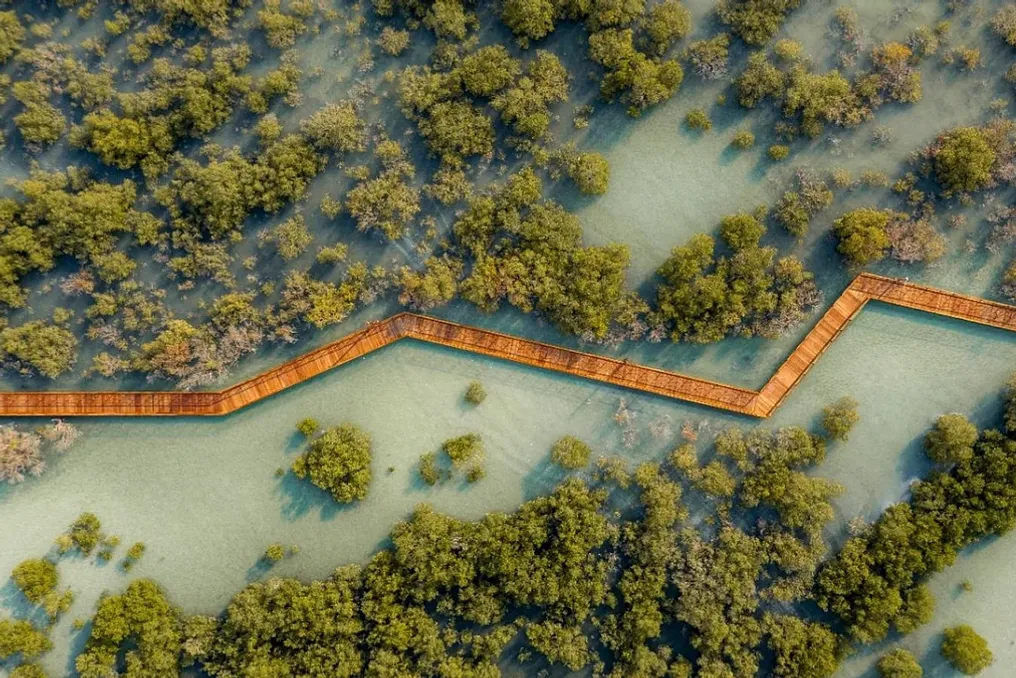
The UAE's biodiversity conservation efforts are based on the goal of planting 100 million mangrove trees by 2030. Half of this volume has already been achieved, with over 50 million trees planted across seven emirates. Terrestrial and marine protected areas now cover more than 19% of the UAE's territory.
Technology has accelerated this work. Heavy drones developed in the UAE and equipped with artificial intelligence distribute special mangrove seeds in hard-to-reach coastal areas. Machine learning systems and satellite monitoring track blue carbon absorption, seedling growth, and air quality patterns in real time.
The 2026 EPI notes that while wealth and environmental performance correlate closely globally, it is strategic management that distinguishes leaders from others. The UAE asserts that its policies, including the National Air Quality Program until 2031 and the Circular Economy Policy until 2031, are built precisely to prove this.