Small and medium-sized enterprises (SMEs) today face competition not only from their local neighbors but also from large corporations and digitally focused brands and online platforms that are encroaching on niche markets.
Small and medium-sized enterprises (SMEs) today face competition not only from their local neighbors but also from large corporations and digitally focused brands and online platforms that are encroaching on niche markets.
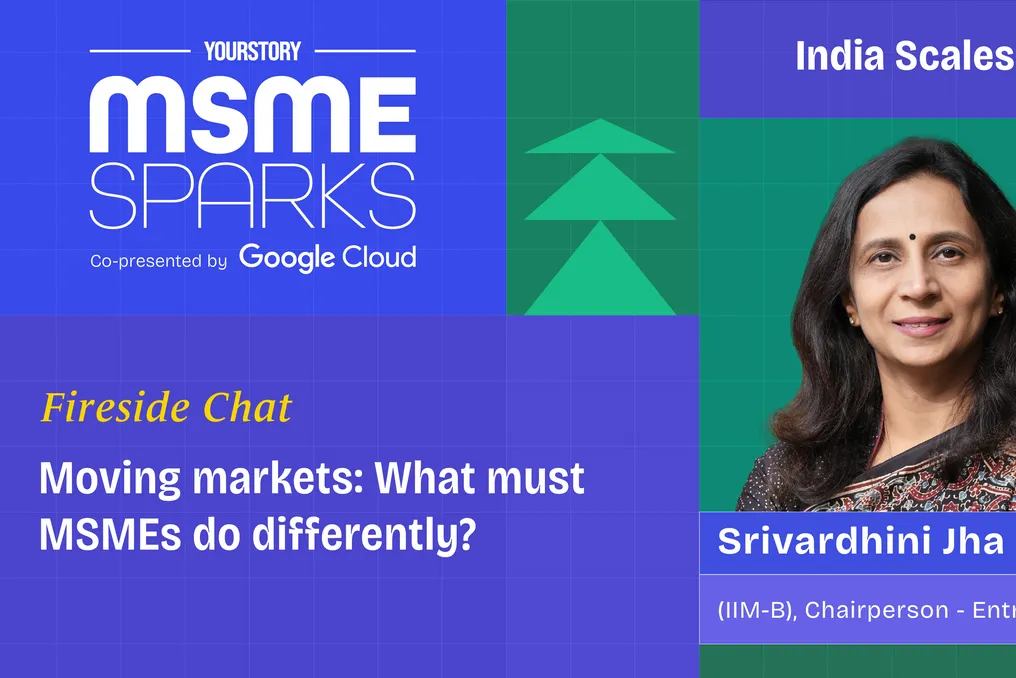
During the MSME Sparks 2026 event, which was held virtually from June 22 to 25 and concluded on June 26 at ITC Gardenia in Bengaluru, Srivardhini Jha, Chair of Entrepreneurship at IIM Bangalore, noted that the current market transformation is forcing SMEs to rethink their unique advantages.
In the session 'Market Shifts: What Should SMEs Do Differently?' in a discussion with Shivani Mutanna, Senior Director of Strategic Partnerships and Content at YourStory Media, Jha emphasized that founders must analyze which traditional strengths remain relevant and which require development.
According to Jha, one advantage that retains its significance is the high degree of trust upon which transactions in SMEs have always been built. This factor remains important despite the decrease in localized competition.
Jha acknowledged the necessity of adopting technologies but cautioned founders against investing solely because others are doing so. Instead, she strongly recommended that SMEs develop sufficient digital literacy to be able to evaluate technology providers and understand their business's real needs, as many existing solutions are designed for much larger companies.
She clarified that technology alone will not increase company efficiency; corresponding processes and personnel are also necessary. Without established standard operating procedures, technology will not yield significant results, and employees must possess a basic level of digital literacy.
A similar remark was made regarding artificial intelligence (AI). According to Jha, the effectiveness of AI directly depends on the quality of the data it is trained on. The data infrastructure does not necessarily need to be complex; even a well-maintained Excel spreadsheet can serve as a foundation.
She predicts that the adoption of AI among SMEs will be easier than previous waves of technological progress, especially for routine tasks related to preparing Requests for Proposals (RFPs), contract management, and market research. Nevertheless, she advised founders to exercise caution when using AI for creative work or functions that directly interact with customers.
Jha concluded that adaptation has become an almost universal requirement: experiments should be conducted on a small scale, tested on a limited group of customers, feedback analyzed, and then application expanded. This approach is universally applicable.
When asked what SMEs should focus on in the coming year, Jha outlined three key areas. The first is mission clarity. Many businesses are created around fleeting opportunities, but founders must periodically pause to understand why the business exists and what value it creates. This clarity dictates decisions regarding positioning, expansion, and products.
The second piece of advice was strengthening the data foundation. She stated that it is necessary to build a reliable data architecture that does not require large capital investments, and even basic tools like Excel can suffice.
The third priority is adopting an entrepreneurial mindset. Founders must constantly monitor changes in customer needs, forecast market developments for the next three to four years, and adapt before these changes become obvious.
Jha also touched upon a common problem in family businesses. She described the so-called 'king mentality,' where founders strive to maintain complete control, avoiding delegation, attracting external capital, or professional management. While this approach is understandable, it can limit long-term growth.
Business expansion often implies giving up some control, whether by bringing in experienced managers with equity stakes or attracting external investment in exchange for creating a significantly larger structure. Concluding her speech, Jha expressed optimism about the growing accessibility of technology for SMEs, noting that many technologies are already affordable, and the key factor is the willingness to adopt them. She added that building a basic data architecture does not require much, and she hopes that AI will make technologies even more accessible to SMEs in the coming years.