Zhipingfang, a company specializing in embodied artificial intelligence, has completed a new funding round of approximately 5 billion yuan, which raised the company's total valuation above the 20 billion yuan mark, or about $2.8 billion. This breakthrough marks an important moment for the embodied AI sector in China, as Zhipingfang is the first company in the Greater Bay Area whose embodied AI unicorn has exceeded the threshold of 200 billion yuan.
Funding Sources and the NeuroVLA Architecture
The funding round demonstrated an unprecedented combination of various capital sources. These included state industrial funds, such as the National Small and Medium Enterprise Development Fund and the Chinese Culture System Fund, as well as provincial AI funds, insurance companies, securities firms, and industrial investors like China Biologic Products (CP Group), Pharmaron, Moutai Group, and China Merchants Capital. Existing investors, including Fortune Capital, Dunhong Asset Management, and Daodeli Investment, also participated in the round.
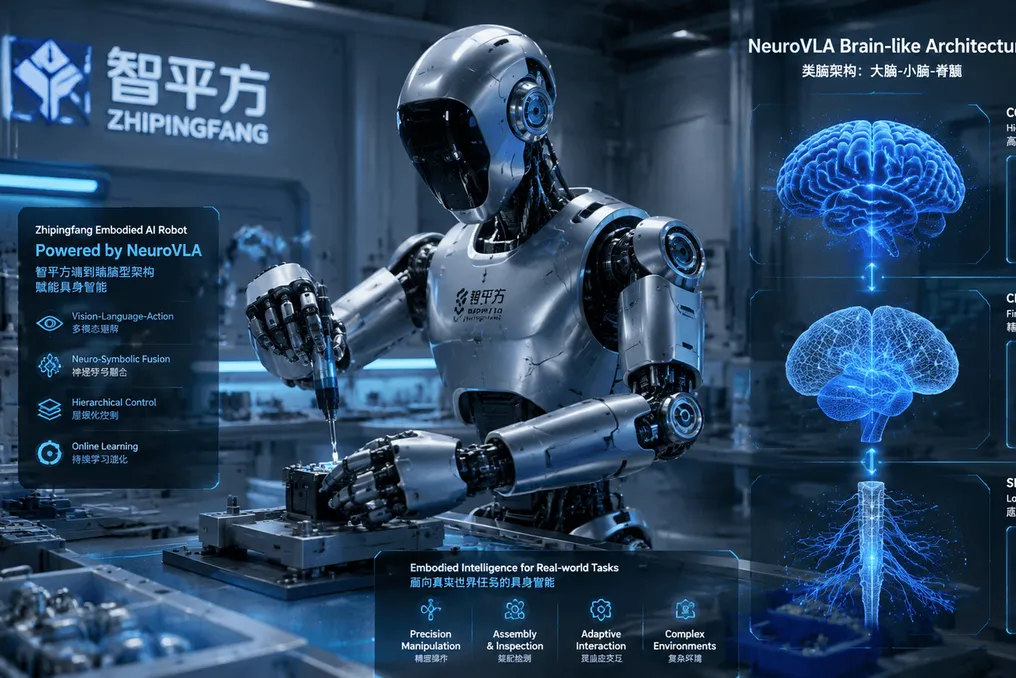
Zhipingfang's rapid growth is driven by the NeuroVLA technology, which the company positions as the world's first brain-mimicking embodied intelligence architecture. This system draws inspiration directly from the human nervous system, structuring computations into three distinct levels: a cortical module for high-level semantic reasoning ('the brain'), a cerebellar module for coordinated motor control, and a spinal impulse module for ultra-low latency reflex responses.
Innovations and Recognition
Zhipingfang's CEO and founder, Dr. Guo Yandun, presented this technology at the Davos Forum in the summer. Premier Li Qiang specifically highlighted Shenzhen's Robotics Valley—where Zhipingfang is headquartered—as an example of China's innovative ecosystem.
The core idea behind NeuroVLA is that traditional AI architectures process the entire incoming data stream without discrimination, consuming full computational power regardless of task complexity. In contrast, the human brain functions based on event-based processing, using approximately 86 billion neurons while consuming only 20 watts. NeuroVLA replicates this efficiency by directing high-frequency, low-latency feedback control to lower processing levels, freeing up the higher 'cortex' for complex semantic analysis.
Company Market Trends
Zhipingfang's sharp rise in valuation—from 10 billion yuan to over 20 billion yuan in just four months—indicates a broader market shift. The focus is now moving from discussing the future of robotics to identifying the companies that can realize that promise. The company has conducted 12 funding rounds in one year, making it the fastest and most scalable embodied AI startup in the industry in terms of fundraising pace.