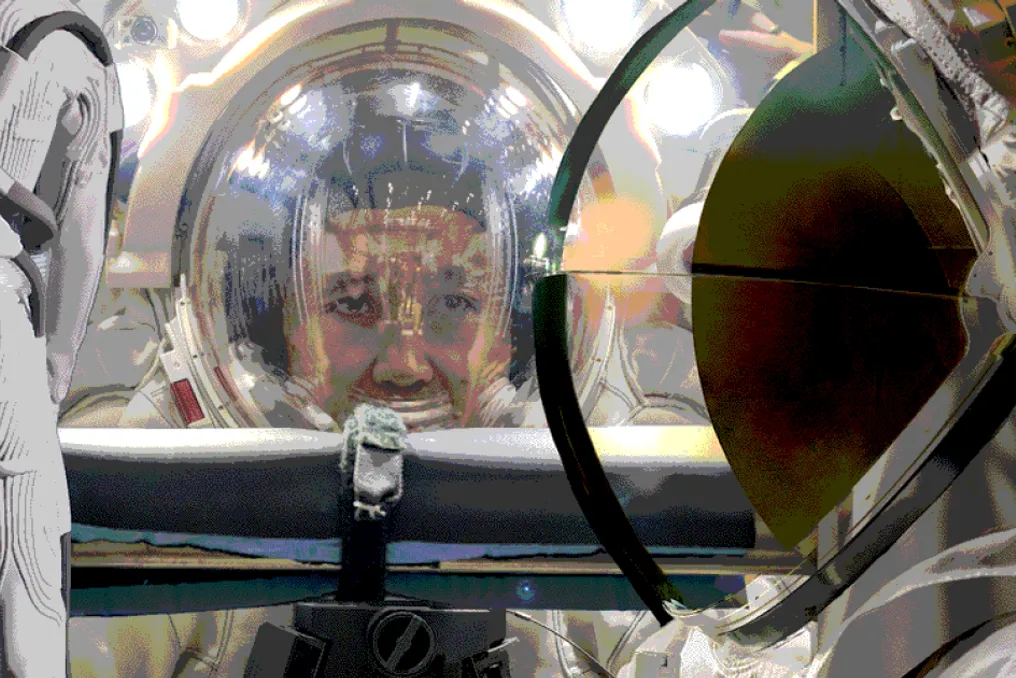
On June 7, 2026, in New York, Axiom Space, in collaboration with the fashion house Prada, presented a key element of the AxEMU lunar spacesuit—a jumpsuit designed for water cooling and ventilation. This presentation confirmed the developers' statement from April 15, 2026, regarding the spacesuit's readiness for orbital tests for Artemis.
Concept and NASA's Role
AxEMU is positioned as the first next-generation planetary spacesuit, surpassing its orbital counterparts in durability and mobility. However, no fundamental engineering breakthroughs are expected in it, as AxEMU is based on adapting existing technologies to lunar environmental conditions. NASA deliberately declined the role of general designer, adopting the status of a conceptual client. This shift in approach, formalized in the xEVAS (Exploration Extravehicular Activity Services) service model, delegates design and manufacturing to private contractors, with Axiom Space playing a leading role.
Axiom Space's Strategy
For Axiom, this contract is part of a broader strategy to establish a monopoly on near-Earth infrastructure. The company is already releasing initial commercial modules, including the AxPPTM power unit and the AxH1 habitat, which will first be attached to the ISS and then form an independent private station. By using the AxEMU lunar spacesuit as a unified technological foundation, Axiom engineers are simultaneously modifying a lighter version for use in near-Earth orbit. Thus, by providing the contract, NASA is effectively co-financing the creation of a comprehensive ecosystem where one contractor is responsible for both the commercial station and the spacesuit servicing.
AxEMU's Engineering Conservatism
AxEMU lacks breakthrough innovations such as new materials, fundamentally different cooling schemes, or active compensation for muscle strain. This is due to the xEVAS model: the company, which previously lacked experience in creating space suits, could not create a revolutionary product within four years under a fixed-price contract. NASA consciously chose engineering conservatism to ensure the timely release of a working product. AxEMU represents a rational assembly of elements refined over five decades, including the back entry from 'Orlan', bearings from xEMU, and a sublimator from Apollo.
Addressing Obsolete Equipment Issues
The transition to the AxEMU system for the Artemis-3 mission is viewed not merely as a change of model but as an attempt to resolve issues related to maintaining old American EMU suits, whose service life on the ISS has exceeded half a century. Critical component wear leads to the regular discovery of hidden malfunctions in life support systems, resulting in frequent cancellations and postponements of planned spacewalks. Experience on the International Space Station has shown that repair costs often outweigh the benefits of extended stays.
Comparison with Russian Counterparts
Astronaut Mike Barratt compares the Russian 'Orlan' type suit to a reliable old SUV, where any component can be serviced with standard tools. Western developments aim to incorporate this lesson through modularity, yet the technical complexity of Axiom Space's life support systems remains excessive, which could become a critical factor in conditions of pervasive lunar dust contamination.
Entry Architecture and Balance Problems
The main structural difference between AxEMU and its orbital predecessors is the back entry scheme, unlike traditional American systems that use a waist hatch. The architecture of older systems, consisting of a rigid cocoon with attached soft elements, severely restricts torso movement and astronaut inclination, which is critical for planetary missions. In AxEMU, the backpack, which is an autonomous life support system, functions as a sealed entry door, forcing the crew to literally 'climb' into the rigid frame.
The back entry scheme is not an Axiom invention, as it has been used in Russian 'Orlan' suits since 1977. Axiom's engineering contribution lies in transferring the docking node from the waist to the backpack and adapting the rigid body for commercial production. However, integrating the massive backpack, weighing 61 kilograms on Earth, creates a serious problem—critical center of gravity shift. In lunar conditions, where gravity is one-sixth of Earth's, this weight shifts the center of mass upward and backward. Kate Rubens confirms that with any movement, the backpack tends to tip the person over, and placing loads in front only exacerbates the problem.
Biomechanical Difficulties and Mass
Any natural movement transforms into a complex biomechanical task, requiring the brain to transmit a series of compensating micro-commands to the muscles to avoid falling due to the inertia of the massive body. The total weight of the structure exceeds 136 kilograms (some unofficial estimates suggest over 180 kg), making the suit more of a heavy mechanical apparatus than walking attire. The most noticeable technical improvement in AxEMU is the advanced toroidal bearings in key joints. They ensure the maintenance of constant internal volume, allowing sections of the suit to rotate freely, unlike Apollo suits where rubber bellows and steel cables created resistance to every movement.
Testing Experience and Limitations
The original technology of toroidal bearings was developed by NASA as part of its xEMU program in 2019, but due to delays, the contract was transferred to Axiom Space in 2022. Physical testing of prototypes conducted by Kate Rubens showed that while the suits are better than older models, they are 'barely very good at the moment,' retaining 'many flexibility issues.' Rubens also warns that people will fall due to the shifted center of gravity.
Even though the suit will weigh about 23 kilograms on the Moon, its inertial properties remain high. This requires significant effort from stabilizing muscles to stop or change direction. Rubens emphasizes that the main load falls on the leg muscles. Unlike on the ISS, where movement often depends on the arms, on the Moon, the researcher returns to natural methods of locomotion, but under extremely unnatural conditions. Total accumulated time in thermal vacuum chambers exceeded 700 hours, but the hydro laboratory cannot fully reproduce real dynamics because water dampens the inertial jerks of the backpack.
Physical Strain and Polar Conditions
Kate Rubens insists on conducting parabolic flights to assess real mass displacement vectors. Furthermore, she warns of immense physical strain: working in the suit on the ISS is comparable to a marathon, and on the Moon, the load will be higher. Astronauts will have to conduct surface excursions for 8–9 hours daily, leading to 'extreme physical stress.' Testers deem it necessary to use aids, such as trekking poles, to maintain balance while collecting samples. Excursion duration can reach nine hours, causing stress because even minor discomfort increases cortisol levels. At the Moon's south pole, astronauts are subjected to extreme temperature fluctuations—from below minus 170 degrees Celsius in deep shadow to plus 127 degrees under the sun. For thermal regulation in Artemis products, liquid cooling is used through a mesh jumpsuit worn on the body.