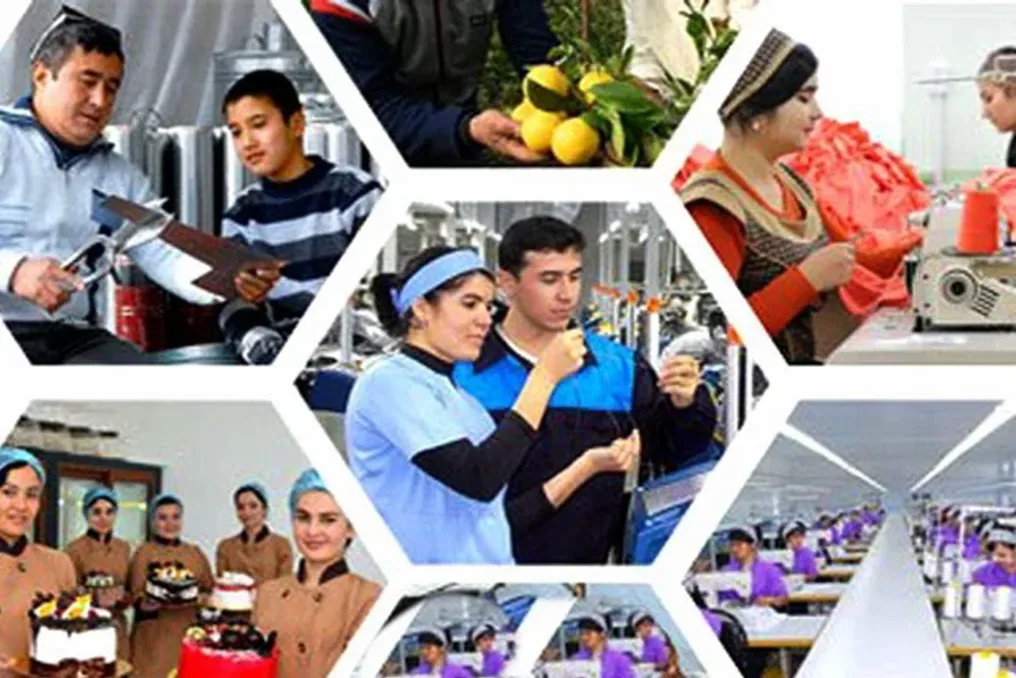
According to the National Committee on Statistics, as of June 1, 2026, there are 430,900 active commercial organizations operating in Uzbekistan.
According to the National Committee on Statistics, as of June 1, 2026, there are 430,900 active commercial organizations operating in Uzbekistan.
The most common organizational and legal form in the country remains limited liability companies (LLCs). 343,584 such LLCs have been registered, accounting for 79.7 percent of the total number of commercial structures.
Private enterprises rank second in number, with 46,515 entities, or 10.8 percent of the total volume. Family businesses account for 36,697 registered subjects, which corresponds to 8.5 percent.
Additionally, 645 active joint-stock companies operate in Uzbekistan, making up 0.2 percent of the total. The remaining 3,496 commercial organizations belong to other legal forms and constitute 0.8 percent of the total number of enterprises.
The Business Ombudsman of Uzbekistan conducted a detailed analysis of the functioning of industrial zones in the country. Currently, 756 industrial zones operate in the republic, where 4,915 projects have been implemented, with a total value reaching 65.4 trillion soms.
During the study of the situation, it was established that a government decree provides for young entrepreneurs residing in remote and desert areas to participate in auctions for land plots in industrial zones starting at a price of only 1 som. However, due to the lack of proper integration and information exchange between the electronic systems Yerelektron and E-auksion, this preferential measure remained unused in practice.
To solve this problem, the Business Ombudsman sent official conclusions to relevant structures. Thanks to joint work with the Cadastre Agency and the Navoi Region Hokimiyat, the technical flaw was successfully eliminated.
As a result of these actions, an official address list of industrial and entrepreneurial zones located in remote and desert areas has been approved, making it possible to acquire land at the minimum starting price of 1 som. These steps will provide hundreds of young people with the opportunity to start their business with minimal financial investment, and will also provide employment and a source of income for over a thousand young men and women.
The International Monetary Fund (IMF) released a Selected Issues report on Uzbekistan, analyzing the scale of the public sector and its impact on the country's economy.
According to data from the State Assets Management Agency, which the IMF relies on, the total value of state-participated enterprise assets reached 101% of GDP by the end of 2024, covering 2,148 such enterprises. These assets were distributed between financial and non-financial companies: 52% of GDP belonged to financial state-owned enterprises, and 49% to non-financial ones.
Within the structure of non-financial state-owned enterprise assets, mining sector companies held the largest share (31%). The oil and gas industry and power generation accounted for 19%. The remaining 31% comprised enterprises in other areas, including chemical industry, road, and transport infrastructure.
Mining companies played a key role in shaping the financial performance of non-financial state-owned enterprises, providing 29% of their revenue, 69% of profits, and 87% of dividends. In the financial sector, the vast majority of assets (96%) were held by nine state commercial banks. The IMF notes that although state-owned enterprise assets are mainly concentrated in regulated or partially competitive spheres, such as energy, finance, and utilities, the situation is different in terms of company numbers: about 84% of state-owned enterprises, according to the fund's assessment, operate in competitive sectors.
In Uzbekistan, the state retains ownership of markets and trade complexes (31% of the total number of SOEs), as well as agricultural and processing enterprises (10%), services and trade (10%), and pharmaceutical, tourism, and social facilities (10%). In these areas, as indicated in the report, there are no clear signs of market failures that would justify state intervention.
Large non-financial state-owned enterprises in Uzbekistan are more widespread than is common in global practice. Unlike the global trend of concentrating SOEs in network industries (transport, utilities, banks), large state companies in Uzbekistan also operate in competitive sectors, such as automotive, mining, and chemical industries, where the private sector often dominates in other countries.
Furthermore, most large state-owned enterprises in Uzbekistan are wholly owned by the state, whereas many developing countries have a mixed ownership structure. For example, about 60% of utility companies in Brazil and China are public-private partnerships, which encourages greater efficiency.
Under the World Bank's expanded definition (including companies with a state stake of 10% or more), over 80% of Uzbekistan's state-owned enterprises operate in competitive commercial sectors, exceeding the 70% figure based on the Global Business of the State database.
High state participation in commercial activities is traditionally associated with lower productivity due to fewer new entrants, high market concentration, and weak labor mobility. The share of the state in banking assets in Uzbekistan (63%) is significantly higher than the average for middle-income economies (around 23%), which can increase the vulnerability of the financial sector and create budgetary obligations.
State enterprises are also major employers: in 2024, they provided jobs for 566.3 thousand people, corresponding to 4% of total employment in the country, 8% of formal employment, and approximately 19% of employment in the central government sector. The mining sector led among SOE employers, accounting for 18% of all employees, while the road and transport sector provided jobs for 16%, and the oil and gas sector for 14%. Power generation, banking, finance, and chemical industry each provided about 8% of employment, and the remaining sectors accounted for 27%.
According to the State Assets Management Agency, from the initial portfolio of 2,965 state-owned enterprises in 2020, 2,845 enterprises were excluded and 1,797 were added by February 2026. Thus, the number of state-owned enterprises was 1,917 at the end of February 2026. Reasons for exclusion included privatization (515 enterprises), liquidation (1,313), reorganization (757), and transfer to PPP or charter funds (260).
The report appendix lists major state-owned enterprises such as Navoi Mining and Metallurgical Combine,