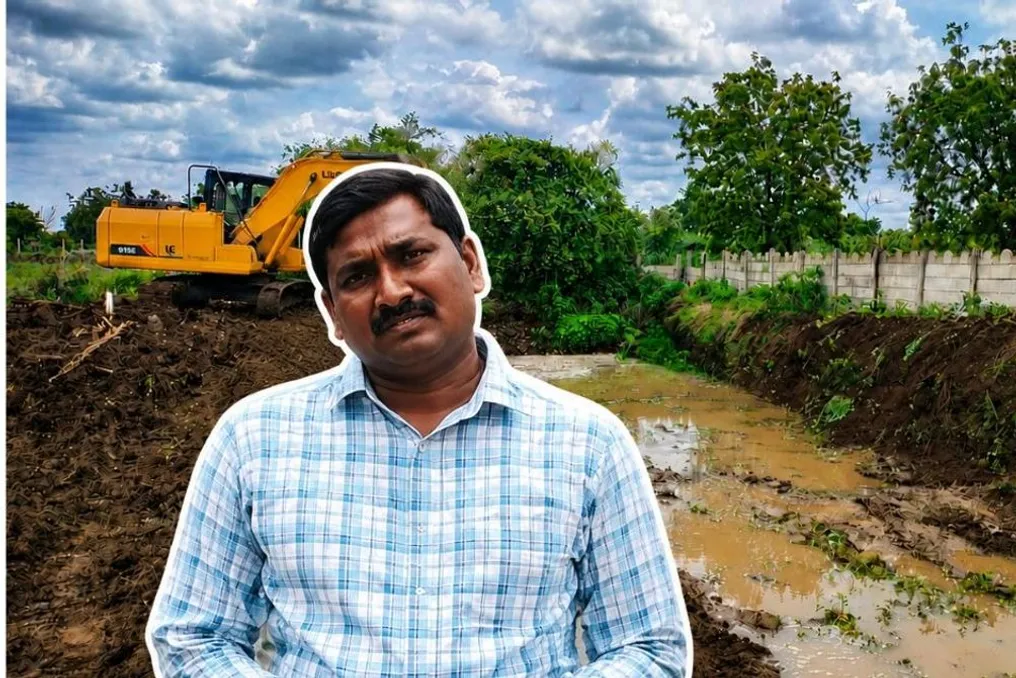
In the village of Khandali, located in Latur, the red earth is exposed to the scorching summer sun, and the silence is broken by the ringing of brass pots at the village well. Among the people waiting in line was once a boy whose hands ached from carrying heavy brass pots home. This boy was Parmeshwar Paul.
Returning to Drought Issues
In 2011, he moved to Pune, where a career in Geographic Information Systems (GIS) provided stability and opportunities. However, memories of his childhood in a drought-prone village, where every drop of water was hard-won, never left him. Just one year later, in 2012, he returned to Khandali.
His return was not aimed at comfort but back into the arid landscape that shaped his childhood. He believed that science could help communities live with water scarcity, rather than just endure it. Today, after 14 years, his work in water conservation has transformed villages, campuses, rivers, and communities across Marathwada.
Turning Maps into Action
Paul's return was more than a personal homecoming—it went against the tide. While many left rural Maharashtra in search of better opportunities, he decided to return, bringing satellite mapping, hydrological surveys, and scientific planning to villages where wells regularly dried up.
As part of his Master's thesis (MPhil), he mapped rooftops in Ahmedpur to develop rainwater harvesting systems for households that received water only once every eight days. For his doctoral dissertation (PhD), he expanded this work to 123 villages, studying local water sources and proposing crop rotation schemes and groundwater usage methods that combined scientific analysis with traditional knowledge.
One of the ideas he implemented was the 'Water Budget.' Farmer Balasaheb Deshmukh recalls: 'He presented the concept of Water Budget in Sheboli and Padi. We count our rupees every day—why not count our water?' This simple calculation gradually became a community habit, helping villages make informed decisions about how much water they can safely use.
Water Conservation Projects
Working as a technical expert and 'Jaldut' (Water Ambassador), Paul helped implement water conservation projects across the region. At Swami Ramananda Tirth Marathwada University, campus landscapes were transformed using water retention dams, ponds, recharge structures, and reservoirs.
In seven lakes in the districts of Nanded and Nashik, farmers removed nearly 334,000 cubic meters of nutrient-rich silt, which was distributed across agricultural lands to improve soil fertility and increase lake storage capacity. Since one cubic meter equals 1000 liters, the dredging alone created an additional storage capacity of approximately 334 million liters of water. Combined with other rainwater harvesting initiatives, this work significantly strengthened local water security.
Across Marathwada, recharge pits, contour trenches, rooftop rainwater harvesting systems, and innovations such as the low-cost C-Jal (Bhujaldhara) filter and tree root irrigation were implemented, demonstrating how local materials can improve groundwater recharge and drinking water quality.
Professor Dr. Rajendra Shrimant Ingale notes: 'He tirelessly moves across Marathwada, village after village, carrying the message of water conservation. From farm ponds and deepening streams to afforestation and river rejuvenation—his interventions have left a visible mark. What makes these efforts outstanding is how he unites local representatives, administrators, social organizations, schools, and colleges, turning conservation into a collective mission.'
Ingale's case study on water resource management in the village of Shemboli, conducted under Paul's guidance, won first place among 24 universities at the Avishkar Research Festival in 2018, sponsored by the Raj Bhavan of Maharashtra.
Tradition-Based Innovations
For Paul, innovation always meant creating simple, accessible, and practical solutions. One such example is the C-Jal (Bhujaldhara) filter, built using local materials to improve the quality of rainwater entering wells. Filtering rooftop rainwater before it enters the well improves both the physical and biological quality of the water. This filter, being affordable, easy to clean, and easily reproducible, was installed in homes throughout the village and town. The first installation was at the residence of the district collector, which helped build trust in the locally developed innovation.
At Swami Ramananda Tirth Marathwada University, Paul and his colleagues also proposed the 'Green University' concept. With the support of the Vice-Chancellor, the campus was equipped with over 300 rainwater harvesting systems, including ponds, retention dams, recharge pits, trenches, and filtration systems. These measures significantly increased groundwater recharge and created the capacity to store hundreds of millions of liters of water, helping solve the long-standing problem of water shortage at the university. The campus stopped depending on expensive water tankers in the summer, saving hundreds of thousands of rupees annually. Furthermore, thousands of trees were planted, and this initiative later received recognition from the Jal Shakti Ministry.
Cities, Rivers, and Classrooms
Paul's work extended far beyond farms. Working as a technical expert alongside police personnel and NGOs, he helped install rainwater recharge systems in wells at the Nanded police headquarters and police stations in Ardhaapur, Limbgaon, and Malakoli. These systems ensured year-round water availability, helped protect mature trees during dry periods, and improved groundwater recharge.
He also helped construct a 450-meter recharge trench capable of holding 75,000 liters of water, which now replenishes about 15 million liters of groundwater annually. Wastewater treatment systems were installed in police settlements, and drinking water purification systems capable of processing about 6000 liters per day improved access to safe water. Along the Godavari River, Paul led regular Sunday clean-up drives, turning the riverbanks into open classrooms where environmental responsibility was taught through practical action.
In schools, he promoted water literacy, encouraging children to view geography not just as maps and textbooks, but as something deeply connected to daily life.
Jaldut: Water Messengers
The word Jaldut literally means 'messenger of water.' Over the years, Paul has trained hundreds of volunteers—including students, farmers, teachers, civil servants, and community members—to spread awareness about water conservation. In the Nanded district alone, about 160 Jalduts conduct seminars, demonstrate rooftop rainwater harvesting, promote non-polluting practices, and encourage communities to use water more responsibly. Because the focus of conservation is on people, the Jaldut movement has helped transform scientific ideas into daily actions.
3