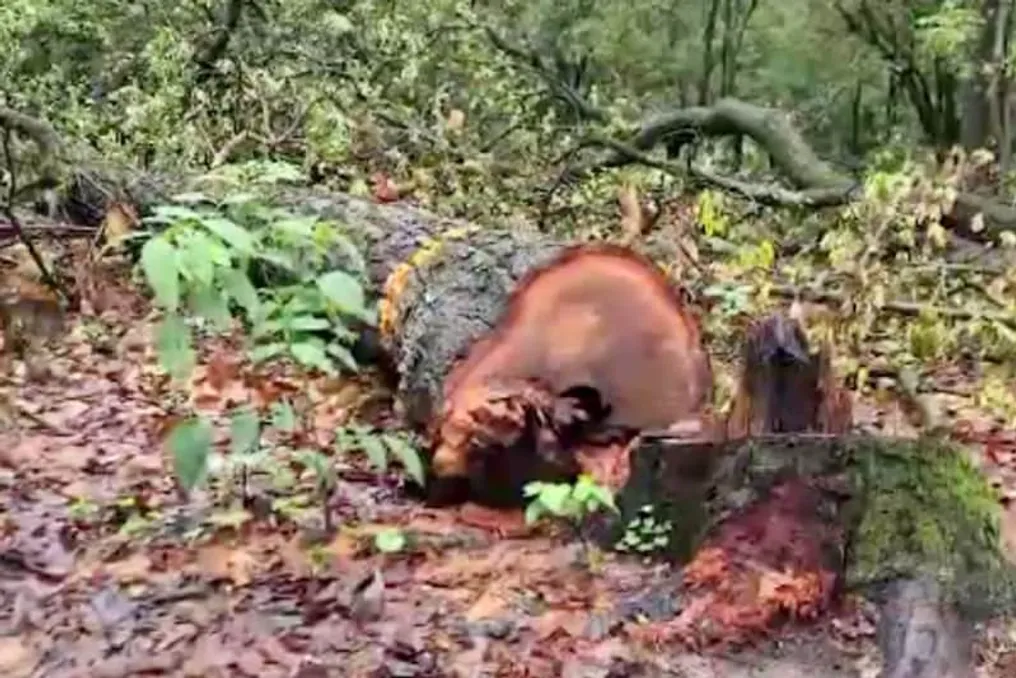
Work to expand the road and construct flyovers on the Dehradun-Rishikesh national highway is actively underway, which includes the felling of over 3000 trees in the forests of the 'Saat Mod' area. This initiative has caused serious dissatisfaction among local residents and environmentalists.
Environmentalists' Demands and Government Stance
Protesters claim that the mass felling of vegetation will negatively affect the ecological balance of the region. They accuse the authorities of damaging the forests under the guise of development, insisting on a thorough review of alternative plans.
Environmentalists have appealed to the government and relevant departments, demanding a revision of the project and the finding of other solutions to preserve as many trees as possible. Meanwhile, officials involved in the project emphasize its importance for improving the transport system and meeting future needs.
NHAI Information on the Project
NHAI reports that they are implementing the Bhaniwala–Joligarh–Rishikesh four/six-lane road project (NH-07) spanning approximately 20 km. This project will be developed under a Hybrid Annuity Model (HAM) with an investment of 743 crore rupees. The goal of the project is to improve connectivity between Dehradun, Joligarh airport, and Rishikesh, facilitate pilgrimage to the Char Dham and tourism, and reduce growing traffic pressure.
Currently, the two-lane highway serves about 18,456 vehicles daily, leading to congestion and increased accident risk. To minimize environmental impact, NHAI has restricted the Right-of-Way (ROW) in forest areas to 23 meters instead of the initial 60 meters. According to recommendations from the Forest Research Institute (FRI), 754 trees will be planted during the monsoon season.
Wildlife Protection Measures
This project passes through the forest areas of Bardkot, Rishikesh, and Tano. Based on proposals from the Forest Department, WWF-India, and the Wildlife Institute of India (WII), the plan includes constructing one bridge with an underground passage for elephants, four underground passages for elephants, and installing green hedges, sound barriers, anti-glare screens, wildlife warning signs, speed reduction measures, and 'no-horn' zones.
The Forest Department noted that 29 wild animals died on this route due to road accidents over the past five years. This is why a special system for safe wildlife movement is planned, including a flyover approximately 3.5 km long.
Legality and Concerns
According to NHAI, the project is proceeding in full compliance with all established laws and environmental clearances. Since the Uttarakhand High Court has not imposed an effective ban on tree felling, the state government has issued permission to proceed subject to certain conditions.
Upon completion of construction, it is expected that travel time will be reduced and congestion decreased, road safety improved, and a balance achieved between infrastructure development, future traffic management, and environmental conservation.
Environmentalists' View
Environmentalist Padmashri Dr. Anil Joshi expressed concern over the exploitation of forests under the pretext of development. He emphasized that these trees are invaluable and that the scale of deforestation for progress must now be reconsidered.