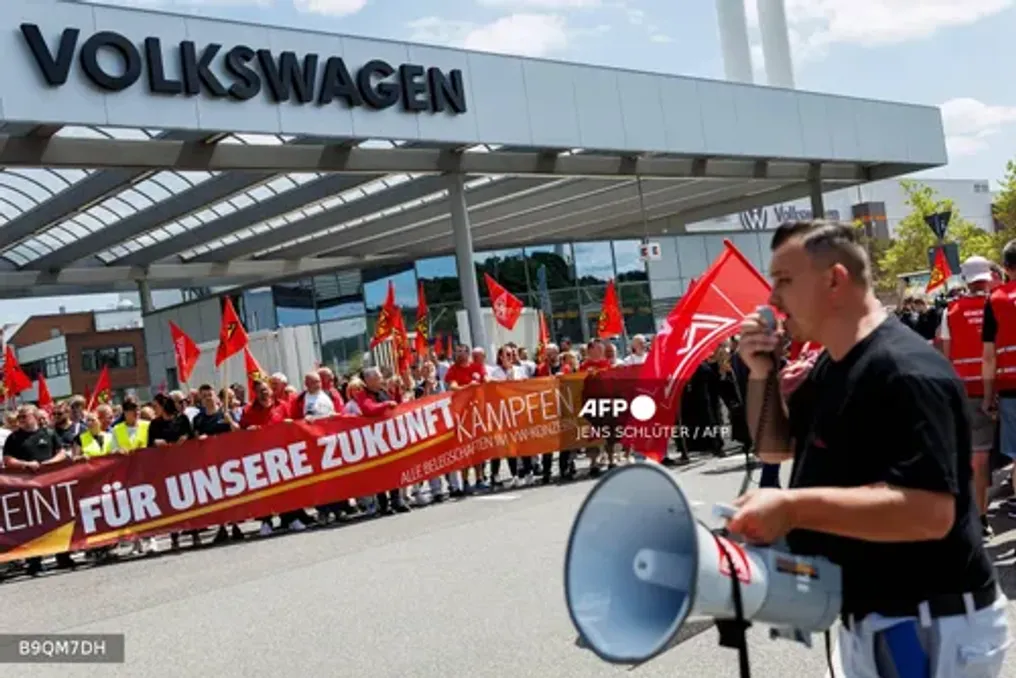
Volkswagen workers held protests across the country on Thursday as unions warned of a 'major conflict' if the German automotive giant continues its large-scale restructuring. The protests were organized by the IG Metall union in disagreement with the plans to cut jobs and reorganize at the Volkswagen plant in Zwickau, eastern Germany, on July 9, 2026.
Europe's largest automaker is facing intense pressure from US tariffs, declining profitability in electric vehicles, and most significantly, fierce competition in the Chinese market, which is the world's largest. Although thousands of job cuts were previously announced, reports have emerged that CEO Oliver Blume is considering increasing these reductions to 100,000 people and potentially closing four plants in Germany.
While VW management presented its transformation plan to the supervisory board of the group of 10 brands, workers staged demonstrations near the plants, and unions warned of readiness to escalate industrial action. Torsten Gröger, an IG Metall representative, told reporters at VW's headquarters in Wolfsburg: 'Whoever takes on the workers risks a major conflict.' He added: 'We will not stand idly by and do nothing if the company does not change course.'
At one of the factories allegedly slated for closure in Zwickau, eastern Germany, about 200 workers joined the rally. Union official Thomas Knabel addressed the gathered crowd, who held signs reading 'United, fighting for our future,' stating: 'This place will not be closed, not against our will—we will defend it.'
One worker, who gave only the name Denny and works for the plant's supplier, told AFP that 'the region is dead if VW leaves.' He noted that the plant closure was 'absolutely realistic' because 'demand is collapsing, other brands are appearing that are cheaper, Chinese brands are appearing.'
VW, whose brands range from the mass-market Seats to the premium Porsche, has already announced plans to cut up to 50,000 jobs in Germany, including 35,000 at its own brand. These cuts were part of an agreement with the unions reached at the end of 2024, which also excluded the closure of German plants until at least the end of the decade. However, the situation has deteriorated significantly, according to VW management, prompting them to seek much deeper cuts.
If the new plans are implemented, it will lead to a reduction of VW's global workforce, which stands at around 630,000 people, by approximately 15 percent. This would exceed all other major job reduction campaigns in the automotive industry, such as General Motors' move in Detroit to cut nearly 50,000 jobs in 2009 during bankruptcy. In recent years, the entire German automotive industry, including VW's competitors—BMW and Mercedes-Benz—as well as their suppliers, has faced difficulties, making cuts and reorganizations increasingly common.
Nevertheless, carrying out such a massive reorganization at VW could prove difficult. Typically, the 20 members of the supervisory board are split evenly between employee and shareholder representatives, but due to the recent departure, the majority of votes currently belongs to the labor side. This group also has a complex ownership model that complicates reorganizations. The state of Lower Saxony, home to Wolfsburg and six VW plants, holds a significant stake, giving it the power to block decisions. According to several sources close to the matter, no major announcements are expected after Thursday's meeting, as it is likely the beginning of a long negotiation process.
A VW representative, refusing to disclose details, had previously stated that the group needed to 'increase its competitiveness' and apply 'even stricter cost and investment discipline.' Higher US tariffs on cars and auto parts, introduced last year, are projected to cost VW five billion euros ($5.7 billion) annually, with the situation being particularly acute for Audi and Porsche, which lack American plants. Furthermore, VW is being pushed out of the Chinese market, and years of declining sales amid fierce local competition last year have led to the company's shipments to the country reaching their lowest level since 2011. Blume stated in a letter to shareholders in March: 'Our business model of past decades no longer works.' He pointed to 'regional market conditions, changes in trade policy, huge regulatory requirements in various regions of the world, and our high cost structure, especially in Europe.'