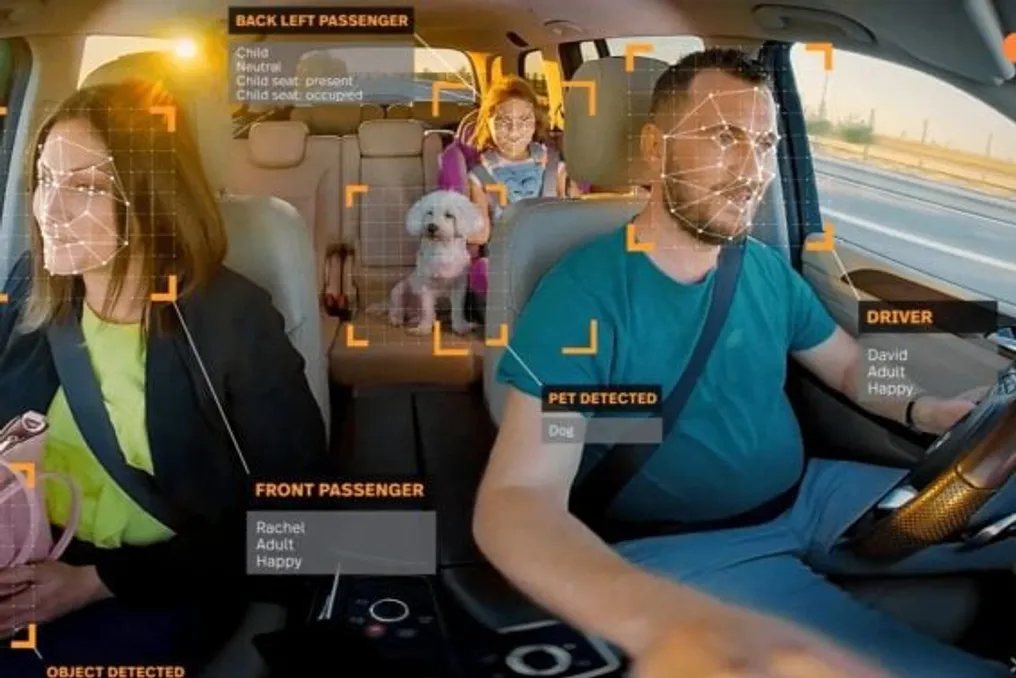
The European Union has advanced vehicle safety regulations by stipulating that all new passenger cars and vans sold in the bloc must be equipped with driver monitoring systems. This requirement, known as ADDW (Advanced Driver Distraction Warning), came into effect on July 7th.
Popular
How the Monitoring Technology Works
The system uses infrared sensors installed on the dashboard and eye-tracking software to identify signs of driver fatigue or inattention. Although many manufacturers already offered this feature, the new standard elevates it from optional to a legal requirement, impacting approximately 15 million vehicles annually.
Operationally, the system works with rigorous criteria. It monitors internal areas such as the steering wheel, dashboard, multimedia center, and console. If the driver fixes their gaze on these regions for more than six seconds at speeds between 20 and 50 km/h, or for more than 3.5 seconds at higher speeds, visual and audible alerts are issued. To prevent false triggers, a minimum tolerance margin of 50 milliseconds has been established.
Justification and Criticism of the Standard
The European Commission bases this determination on the fact that distraction is responsible for 10% to 30% of accidents on the continent, projecting a saving of 25 thousand lives by 2038. However, the mandatory nature has generated strong criticism focused on privacy and effectiveness issues.
Sectoral assessments point out that some systems may generate incorrect alerts due to blinks or natural head movements. The concern over data collection is even greater, despite European legislation stipulating that the system operates in a 'closed circuit,' without external transmission of information. Privacy advocates question the absence of independent auditing mechanisms. A report from the website Risky Business, based on reporting by the Belgian broadcaster VRT, mentioned that Volvo had acknowledged real-time data processing on cloud servers, which would violate the directive.
Privacy and Market Concerns
The industry's history raises fears that vehicles could turn into mobile surveillance devices. Companies like GM, Hyundai, and Kia have been reported for collecting driving patterns and passing this data to brokers, who use it to increase insurance premiums. Additionally, the new European legislation imposes other requirements on brand-new cars and vans, including automatic emergency braking with pedestrian and cyclist detection, better front visibility, and more glass area protecting against pedestrians, in addition to extra tests for worn tires.
In the Brazilian context, there is currently no equivalent regulation forcing the installation of driver-facing cameras in passenger cars. The use of these devices is restricted to corporate fleets, either by voluntary choice or contractual requirement. National regulation follows a different path: a Contran resolution will make automatic emergency braking mandatory in new vehicles starting in 2029, but this technology focuses on the external environment, not the driver's face.
Implications of LGPD in Brazil
Should facial recognition systems arrive in Brazil, they would be subject to the General Data Protection Law (LGPD). This law classifies biometric data, such as facial and ocular characteristics, as 'sensitive data,' requiring specific legal bases, such as explicit consent or legal hypotheses, and prohibiting use based solely on 'legitimate interest.' The ANPD, the responsible body, is analyzing the issue cautiously and has already started discussions on biometrics and facial recognition. Non-compliance can result in fines of up to 2% of revenue, limited to R$ 50 million per infraction.