By 2026, the cryptocurrency market will continue to evolve, leading to more personalized storage and trading services. Crypto enthusiasts, whether they are traders using exchanges for day trading, margin trading, or bots for strategy automation, will require either a hot or a cold wallet. This guide evaluates ten of the best crypto wallets for 2026, helping to find a balance between convenience and security.
Top Crypto Wallets in Review
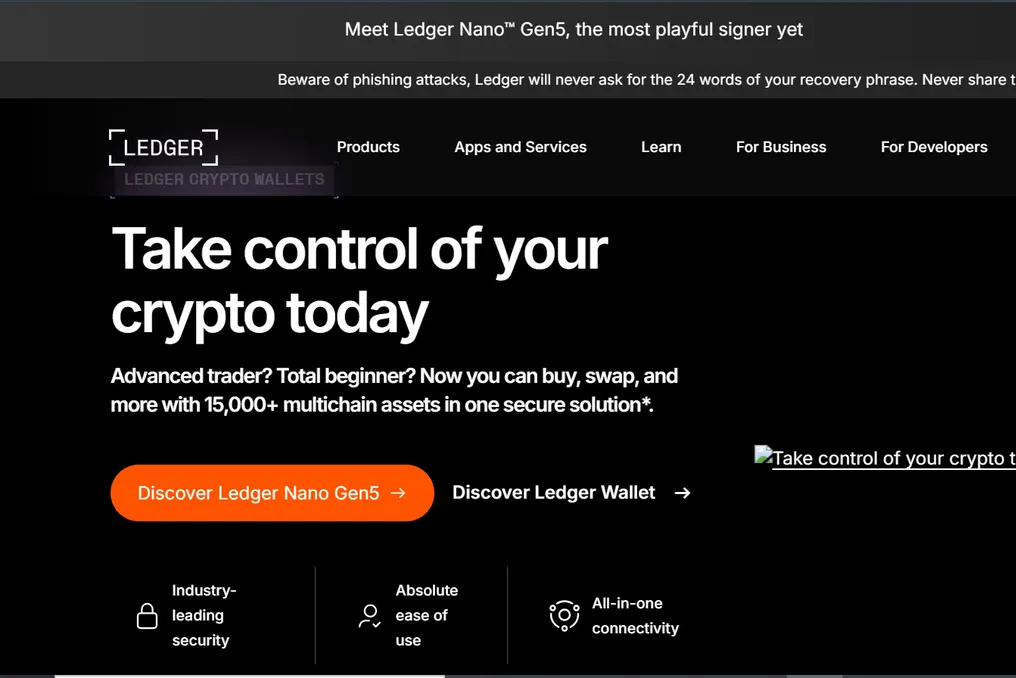
Ventureburn has compiled a list of the best crypto wallets. Among them, Ledger Nano Flex stands out as the best hardware wallet overall. It provides maximum protection thanks to its EAL-certified Secure Element chip and supports connection via Bluetooth and USB, allowing tokens and NFTs to be stored securely long-term on a phone or computer. It is compatible with thousands of assets and works on desktop and mobile devices, although it is more expensive than most hardware options and requires Ledger Live to access all features.
Security and Accessibility
Trezor Safe 3 is presented as an excellent option for ensuring security at a reasonable price. This hardware wallet features open-source software and wide cryptocurrency coverage. It uses an EAL6+ Secure Element chip and connects only via USB-C cable. Although it supports thousands of cryptocurrencies and has a robust design, it lacks Bluetooth or wireless connectivity options and does not have a built-in dApp browser.
For beginners, Zengo offers a mobile wallet that eliminates traditional seed phrases by using Multi-Party Computation (MPC) technology. This makes it a very secure and convenient hot wallet. It operates only on mobile devices (iOS and Android) and allows users to buy cryptocurrency with fiat and exchange assets directly in the app, but it has limitations on supported chains.
Wallets for Web3 and DeFi
MetaMask is a popular software wallet focused on Ethereum and EVM-compatible networks, making it ideal for dApps and DeFi. It provides a ready-made Web3 environment, but because it is always connected to the internet, there is a certain risk, and manual backup of the seed phrase is required.
Trust Wallet stands out as a mobile, non-custodial wallet, allowing users to manage millions of tokens across more than 100 blockchains. It includes staking support, NFTs, and easy dApp access. However, as a hot wallet, it carries certain security risks and does not have a desktop application.
Exodus is a very user-friendly wallet that works on desktops, mobile devices, and browsers. It supports hundreds of assets, has built-in exchange and staking features, but is not open-source and is not ideal for advanced DeFi users.
Cold Solutions for Long-Term Storage
Tangem uses a 'tap-and-go' enabled card for cold storage, protected by an EAL-certified chip. This ensures ease of self-custody. The wallet supports numerous assets and is durable, but it requires a mobile application and lacks native desktop support.
Sparrow focuses exclusively on Bitcoin and is designed for users who value complete control and transaction privacy. It runs only on desktop operating systems (Windows, Mac, Linux) and allows detailed UTXO control, but it does not support other coins or DeFi.
Mobile and Specialized Wallets
Best Wallet is positioned as a new non-custodial tool that combines simplicity with advanced features, including staking rewards and analytics. It uses MPC and biometrics for high security but is still in the early stages of development.
Coinbase Wallet gives users control over their assets in a self-custody format. It is available on both mobile devices and as a browser extension, integrating DeFi and NFTs. Despite the convenience of Web3 entry, it is a hot wallet that carries risks associated with device access.
Hot vs. Cold Wallets
The choice between a hot and cold wallet depends on the needs for accessibility and security. Hot wallets are used for short-term storage because they are constantly connected to the network and highly accessible, which is ideal for beginners. However, they are susceptible to online attacks such as phishing and malware.
Cold wallets, conversely, store private keys offline, making them the best way to protect digital assets from hacker attacks. Hardware wallets are considered the best option for long-term investors because they offer unparalleled security, although they are less convenient for daily use.