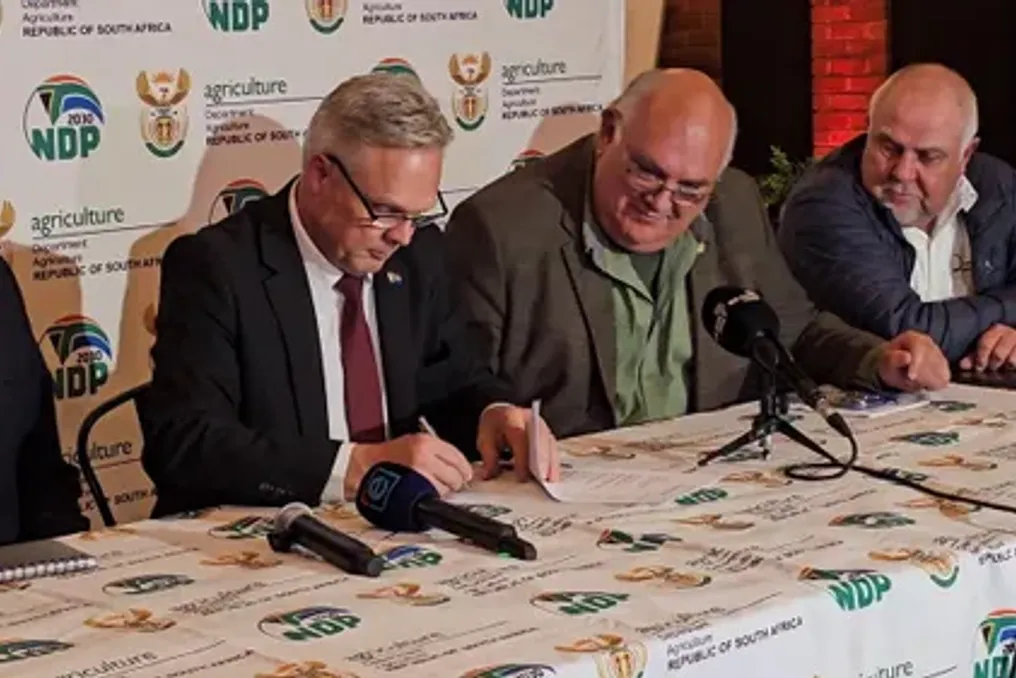
Minister Willie Aucamp signed an agreement that marks a significant step for the South African livestock industry. It abolishes the state monopoly on Foot-and-Mouth Disease (FMD) vaccines and allows the private sector to participate in this process.
Substance of the New Agreement
The government has ended its monopoly on FMD vaccine imports, creating conditions for farmers and private companies to acquire and administer vaccines through a new private system based on the signed agreement. This agreement was announced on Thursday following negotiations held in Pretoria.
The agreement resolves a legal dispute between the Department of Agriculture and agricultural organizations Sakeliga, South African Agri Initiative (SAAI), and Free State Agriculture. This is expected to accelerate access to vaccines as South Africa continues to combat frequent outbreaks of this highly contagious animal disease.
Regulatory Changes
Agriculture Minister Willie Aucamp called this settlement a turning point for the country's livestock farming, noting the beginning of a new era of cooperation between the state and the private sector. He emphasized that the agreement benefits all South African farmers, as this sector contributes significantly to job creation and the country's GDP.
Under the terms of the agreement, owners and managers of four-legged animals can voluntarily vaccinate their livestock provided they adhere to established biosecurity measures, traceability requirements, and reporting obligations. One of the key changes is the Department of Agriculture and Onderstepoort Biological Products (OBP) relinquishing their exclusive rights to import and distribute FMD vaccines.
Position of Authorities and Sector
Aucamp stated that it is necessary to allow the private sector to carry out large-volume imports, so the department and OBP have directly waived their sole rights to import and distribute FMD vaccines. He clarified that the agreement takes effect immediately, and the government will do everything possible to facilitate this process.
The Minister acknowledged that the government could not handle the disease alone and noted the vital importance of closer partnership with the agricultural sector. SAAI Chairman Theo de Jager stated that the agreement removes a major obstacle preventing farmers from responding quickly to the disease. He urged farmers to follow all rules, including notifying five days before vaccination and completing reporting within two weeks after the procedure.
Views of Participants
Free State Agriculture President Francois Vilken noted that his organization approached the courts seeking practical solutions rather than confrontation. He stressed that only farmers and their livestock benefit from this case. Sakeliga leader Piet le Roux stated that the legal process achieved its main goal—ensuring farmers can vaccinate their livestock. He added that the litigation should be viewed as a legitimate way to resolve disagreements.
Western Cape Agriculture Minister Ivan Meyer noted that the reached agreement demonstrates how collaboration can improve outcomes for farmers, emphasizing the importance of unity for nation-building.
Next Steps and Goals
Despite opening the market to private companies, the government stated that it will continue to procure vaccines for public vaccination programs, especially in outbreak areas and for farmers who cannot afford private doses. Aucamp noted that opening the market stimulates healthy competition and increases vaccine accessibility, allowing the state and private sector to work in parallel to strengthen the fight against future FMD outbreaks.