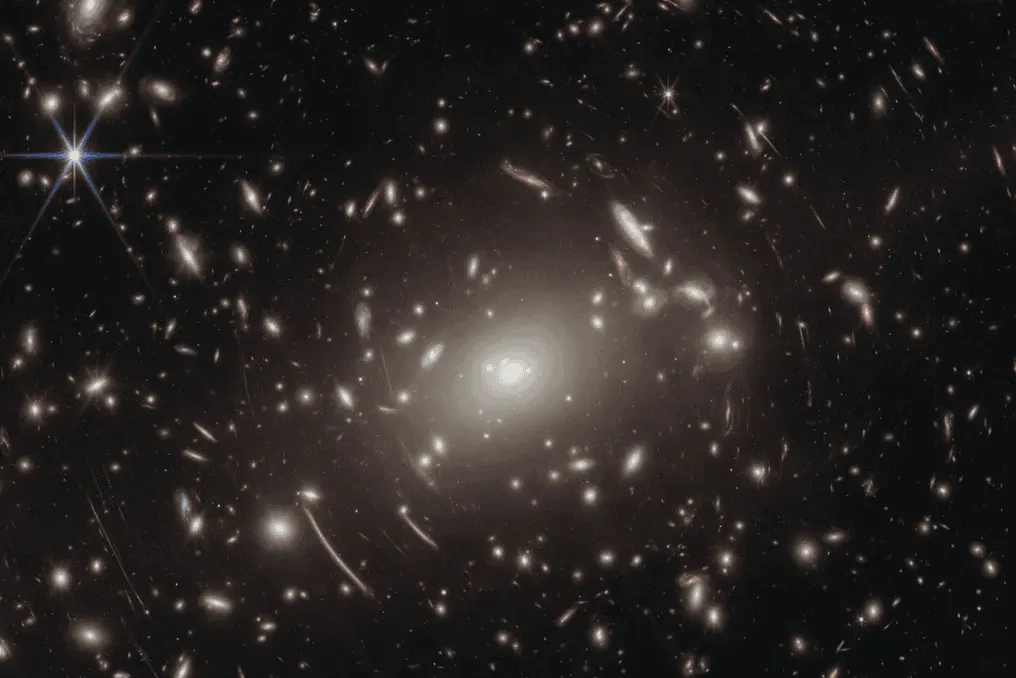
In the early 20th century, Albert Einstein revolutionized the understanding of the Universe by showing that gravity can curve spacetime. This curvature governs the motion of celestial bodies and even deflects the path of light, turning a massive object into a kind of cosmic lens. Decades later, this prediction was confirmed, and today gravitational lenses have become one of the most powerful tools in modern astronomy.
How Microlenses Work
Among these are microlensing—a subtler effect created by isolated stars, planets, and even black holes. These microlenses are discovered through the temporary brightening of distant stars, which occurs when the observer, the lens, and the light source are almost perfectly aligned.
Significance of the Observation Method
This method allows for the detection of exoplanets that remain unnoticed by other means, the discovery of dimly luminous objects, the study of matter distribution in the Milky Way, and the testing of Einstein's theory of relativity. Thus, it is an ingenious way to study the invisible and expand our understanding of the cosmos.
Program Participation
As part of the 'Olhar Espacial' program, viewers will be able to delve deeper into the topic of microlensing this Friday (the 10th) with a Brazilian specialist in the field—Leandro de Almeida. He is a researcher at the Astrophysics Department of the National Institute for Space Research (INPE) and a postgraduate lecturer in astrophysics at this institute. Leandro de Almeida holds a Ph.D. in Physics from UFRN and conducts research in areas such as exoplanets, microlensing, stellar astrophysics, astronomical instrumentation, and temporal astronomy.
The host of the 'Olhar Espacial' program is Marcelo Zurita, an astronomer and columnist for Olhar Digital. The program airs every Friday starting at 9:00 PM Brazilian time on social media.